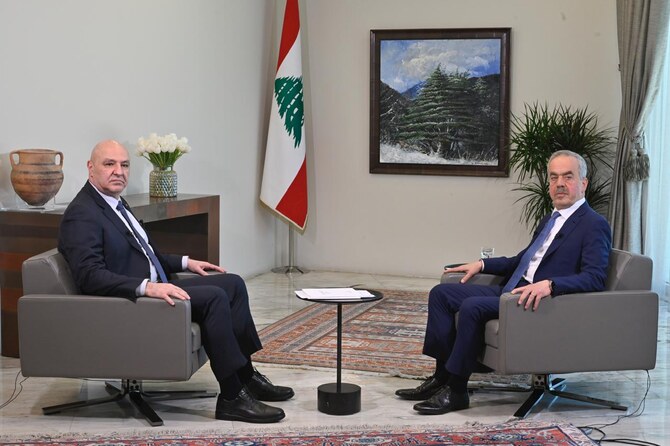

BEIRUT: Lebanese President Joseph Aoun says he wants to build a state that has the decision of war and peace and stressed he is committed to implementing Security Council Resolution 1701.
In an interview with Asharq Al-Awsat, his first since his election in January, Aoun said: “Our objective is to build the state, so nothing is difficult. And if we want to talk about the concept of sovereignty, its concept is to place the decisions of war and peace in the hands of the state, and to monopolize or restrict weapons to the state.”
“When will it be achieved? Surely, the circumstances will allow it,” he told the newspaper.
Asked whether the state will be able to impose control over all Lebanese territories with its own forces and without any military or security partnership, he said: "It is no longer allowed for anyone other than the state to fulfill its national duty in protecting the land and the people ... When there is an aggression against the Lebanese state, the state makes the decision, and it determines how to mobilize forces to defend the country."
He also stressed his full commitment to implement UN Security Council Resolution 1701. “The state and all its institutions are committed to implementing the Resolution” on the “entire Lebanese territories,” Aoun said.
On the possible adoption of a defense strategy, Aoun insisted that even if a state does not have enemies on its borders, it should agree on a national security strategy that not only deals with military goals but also economic and fiscal objectives.
“We are tired of war,” he said in response to a question. “We hope to end military conflicts and resolve our problems through diplomatic efforts,” he said.
Asked whether he was surprised that the Israeli army has stayed at five points in south Lebanon, Aoun said that Israel should have committed to the ceasefire agreement that was sponsored by the US and France and should have withdrawn from all areas it had entered during the war with Hezbollah.
“We are in contact with France and the US to pressure Israel to withdraw from the five points because they don’t have any military value,” he said.
“With the emergence of technologies, drones and satellites,” an army does not need a hill for surveillance, Aoun added.
"Saudi Arabia has become a gateway for the region and for the whole world. It has become a platform for global peace,” he said when asked why he has chosen to visit the Kingdom on his first official trip abroad.
“I hope and expect from Saudi Arabia, especially Crown Prince Mohammed bin Salman, that we correct the relationship for the benefit of both countries and remove all the obstacles ... so that we can build economic and natural relations between us.”
He said that during his visit he plans to ask Saudi Arabia to revive a grant of military aid to Lebanon.
On relations with the Syrian authorities, Aoun said he intends to have friendly ties the new Syrian administration and that one of the pressing issues is to resolve the problem of the porous border between the two countries.
“There are problems on the border (with Syria) with smugglers. Most importantly, the land and sea border with Syria should be demarcated,” he said.
Aoun also called for resolving the problem of Syrian refugees in Lebanon. “The Syrian state cannot give up on 2 million citizens who have been displaced to Lebanon.”
The refugees should return because “the Syrian war ended and the regime that was persecuting them collapsed,” he said.
- This article was originally published by Asharq Al-Awsat and can be read here.