JAKARTA: Muslims in Indonesia are shopping for sweets and new clothes and taking part in traditional festivities as millions observe the holy month of Ramadan, which started on Saturday.
Celebrations in the world’s most populous Muslim-majority country range from colorful nighttime parades and cleaning family graves to preparing food for predawn breakfasts and elaborate post-sundown meals known as “iftars.”
Each region in the vast archipelago nation of 17,000 islands has its own way to mark the start of Ramadan, when Muslims refrain from eating, drinking, smoking and sexual intercourse from sunrise until sunset for the whole month.
Even a tiny sip of water or a puff of smoke is enough to invalidate the fast. At night, family and friends gather and feast in a festive atmosphere.
Religious Affairs Minister Nasaruddin Umar announced on Friday that Ramadan will begin on Saturday, after the sighting of the crescent moon was confirmed by Islamic astronomy observers in Indonesia’s westernmost province of Aceh.
Shortly after the announcement, mosques flooded with devotees offering evening prayers known as “tarawih” on the first eve of Ramadan. In Jakarta’s Istiqlal Grand Mosque, the largest in Southeast Asia, tens of thousands of worshippers crammed together shoulder-to-shoulder.
The daylong fasting is aimed at bringing the faithful closer to God and reminding them of the suffering of the poor. Muslims are expected to strictly observe daily prayers and engage in heightened religious contemplation. They are also urged to refrain from gossip, fighting or cursing during the holy month.
Flares, drums and tradition
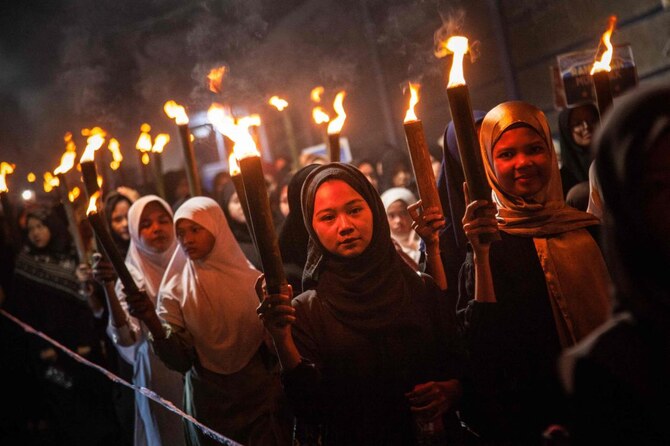
Samsul Anwar, his wife and their 8-year-old nephew were among hundreds of people taking part in a torchlight parade along the streets of their neighborhood in Tangerang, a city just outside the capital of Jakarta, on Wednesday after evening prayers.
They carried torches, lit flares and played Islamic songs accompanied by the beat of rebana, the Arabic handheld percussion instrument, as they walked along the cramped streets of the densely populated neighborhood.
“Every year we welcome Ramadan with a tradition that has been passed down from generation to generation,” said Anwar.
Chinese Indonesian communities also participated in the parade by performing the vibrant “barongsai” or “lion dance,” a prominent part of Chinese New Year celebration, to the sound of drums and trumpets.
The barongsai performance “was also held to show unity between the religious communities of Chinese and Muslim, aiming to increase religious tolerance,” Anwar said.
Cost of living anxieties
It’s also an exciting time for business. Hotels, restaurants and cafes all prepare special Ramadan promotions, and shoppers flock to shopping centers for new clothes and home decorations for the holiday of Eid Al-Fitr, which marks the end of Ramadan. Children often receive new clothes and gifts.
However, some Muslims worry how they will cope financially during Ramadan this year amid soaring prices.
“Everything to do with cooking is rising (in cost) day by day,” said Asih Mulyawati, a mother of two who lives in Jakarta’s outskirt of Tangerang. “I worry this situation will impact Ramadan celebrations.”
Despite soaring food prices in the past month, popular markets such as Tanah Abang in Jakarta were teeming with shoppers buying clothes, shoes, cookies and sweets before the holiday.
Indonesia’s Trade Ministry has said prices of imported staple foods including wheat, sugar, beef and soybeans have increased sharply this year as a result of rising global commodity prices and supply chain disruptions.
But many people say the rise in prices not only impacts imported foods but also local commodities like rice, eggs, chili, palm oil and onions. Many also blame the government for rising gas and electricity prices.
“The current gloomy economic situation and extreme weather recently also contribute to the soaring prices and the weakening of people’s purchasing power,” said Heru Tatok, a trader in Jakarta’s Pasar Senen market.


![]()

Millions of Muslims in Indonesia mark the start of the holy month of Ramadan
Short Url
https://arab.news/6dv4n
Millions of Muslims in Indonesia mark the start of the holy month of Ramadan
- Each region in the vast archipelago nation of 17,000 islands has its own way to mark the start of Ramadan


Latest updates


Recommended


© 2026 SAUDI RESEARCH & PUBLISHING COMPANY, All Rights Reserved And subject to Terms of Use Agreement.