


JOLIET, Illinois: A jury found an Illinois landlord guilty of murder and hate crime charges Friday for the brutal killing of a 6-year-old whose mother rented rooms in the man’s home, an attack that spiked fears over anti-Muslim discrimination in the earliest days of the war in Gaza.
Joseph Czuba, 73, was charged in the fatal stabbing of Wadee Alfayoumi and the wounding of his mother, Hanan Shaheen on Oct. 14, 2023 in Plainfield, about 40 miles (64 kilometers) from Chicago. Authorities alleged the family was targeted because of their Islamic faith and as a response to the war between Israel and Hamas that erupted on Oct. 7, 2023.
Jurors deliberated less than 90 minutes before returning with the verdict.
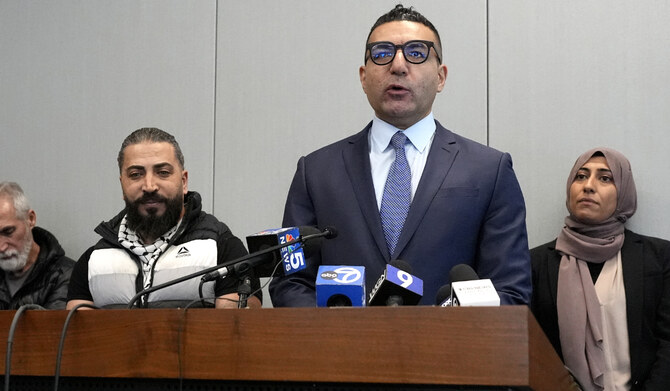
“I don’t know if I should be pleased or upset, if I should be crying or laughing,” Wadee’s father, Odai Alfayoumi, said at a news conference, speaking in Arabic. “People are telling me to smile. Maybe if I were one of you, I would be smiling, but I’m the father of the child and I’ve lost the child. And I feel like this decision came to a little too late.”
Ben Crump, the national civil rights attorney representing Shaheen, released a statement calling the verdict a “measure of justice.”
“Wadee was an innocent six-year-old child whose life was stolen in an act of unimaginable violence fueled by hatred,” the statement added. “While we are relieved that his killer has been held accountable, we must continue to stand against the rising tide of hate that led to this senseless act. We must honor Wadee’s memory by continuing to fight against hate in all its forms and working toward a future where every child is safe, valued, and free from violence.”
Crump asked that the media continue respecting Shaheen’s privacy as she honors her son’s memory.
Shaheen did not speak at a press conference following the jury decision. Ahmed Rehab, executive director of the civil rights group Council on American-Islamic Relations, or CAIR-Chicago, said it was too difficult for her and added that she “only prays for peace and love.”
The trial featured detailed testimony from police officers, medical workers, Czuba’s ex-wife and Shaheen, who described how Czuba attacked her with a knife before going after her son in a different room. Prosecutors say that the child had been stabbed 26 times. He was found naked with a knife still in his side.
Graphic photos of the murder, a knife holder Czuba allegedly used that day, along with police video footage were central to the Will County prosecutors’ case. At times video screens showing explicit footage were turned away from the public viewing audience where members of Wadee’s family sat during the trial.
“If it wasn’t enough that this defendant killed that little boy, he left the knife in the little boy’s body,” Michael Fitzgerald, a Will County assistant state’s attorney, told jurors during opening statements.
Czuba’s attorney, George Lenard, declined comment Friday. Czuba had pleaded not guilty. He faced murder, attempted murder, aggravated battery and hate crime charges in an eight-count indictment.
Czuba is scheduled for sentencing on May 2, according to the Will County Circuit Clerk’s office.
Defense attorneys insisted pieces of evidence tying Czuba to the crimes were missing. His ex-wife, testifying for the prosecution, could only describe one outburst during their 30 years of marriage and said he carried knives often because he was handy around the house.
“Go beyond the emotions to carefully examine the evidence,” said Kylie Blatti, one of Czuba’s public defenders. “It is easy to get lost in the horror of those images.”
One of the critical parts of the trial was Shaheen’s testimony and the 911 call she made to report the crime that happened just days after the war started. She said they had not previously had any issues in the two years they rented from the Czubas. They shared a kitchen and living room with the Czubas.
Then after the start of the war, Czuba told her that they had to move out because Muslims were not welcome. Later, he confronted Shaheen and attacked her, holding her down, stabbing her and trying to break her teeth.
“He told me ‘You, as a Muslim, must die,” said Shaheen, who testified in English and Arabic though a translator.
Shaheen had more than a dozen stab wounds and it took her weeks to recover. The boy was later pronounced dead.
Police testified that officers found Czuba outside the house sitting on the ground with blood on his body and hands.
Separately, civil lawsuits have been filed over the boy’s death, including by his father, Alfayoumi, who is divorced from Shaheen and was not living with them.
The case generated headlines around the world and struck deeply for the Chicago area’s large and established Palestinian community. The US Department of Justice also launched a federal hate crimes investigation.
“All of us who are parents, who are Arab or Palestinian … who are Muslim, we all saw our children die in Wadee Alfayoumi, because this could have been any one of our boys, any one of our girls,” CAIR-Chicago’s Rehab said. “It just so happened that it was Wadee Alfayoumi. When he was targeted, all of our children were targeted. Every Muslim was targeted when he (Czuba) yelled, ‘All Muslims must die.’”


