

Dubai exhibition reflects on Syria’s post-Assad transition 

This exhibition features the works of eight talented artists, photographers, sculptors and painters, who collectively explore the complex aftermath of more than a decade of civil war. (Supplied)
Short Url
Updated 01 March 2025
Follow

Dubai exhibition reflects on Syria’s post-Assad transition 

  • In ‘6:18, The DAWN,’ eight artists explore the aftermath of a bloody civil war and a brutal regime 

DUBAI: From Feb. 9 to March 2, Atelier 14 in Dubai will host “6:18, The DAWN,” a powerful collective exhibition that delves into the cultural and artistic landscape of the Syrian Arabic Republic following the fall of the former president, Bashar Assad.  

This exhibition features the works of eight talented artists, photographers, sculptors and painters, who collectively explore the complex aftermath of more than a decade of civil war. 

“6:18, The DAWN” provides a poignant insight into how art can reflect the scars and hopes of a country in transition.  


'Home' by Majd Henawi. (AN photo)

The exhibition is a platform for dialogue and reflection on the fragility of post-conflict societies and the struggle for identity. It is anchored in the tumultuous months following the fall of Assad’s regime and shows how, amid this chaos, art has remained an essential outlet for expression and renewal, charting the emotional and social evolution of a country now faced with the task of rebuilding both physically and spiritually, and depicting the tension between destruction and rebirth, chaos and renewal. 

One of the show’s standout features is the work of renowned French-Syrian photographer Ammar Abd Rabbo, known for his emotionally charged and politically moving work. He presents three photographs that capture the significant shift in Syria’s political and cultural landscape. They were taken in Damascus in December, just after the regime’s sudden collapse, and each image a unique perspective on those moments of upheaval. 

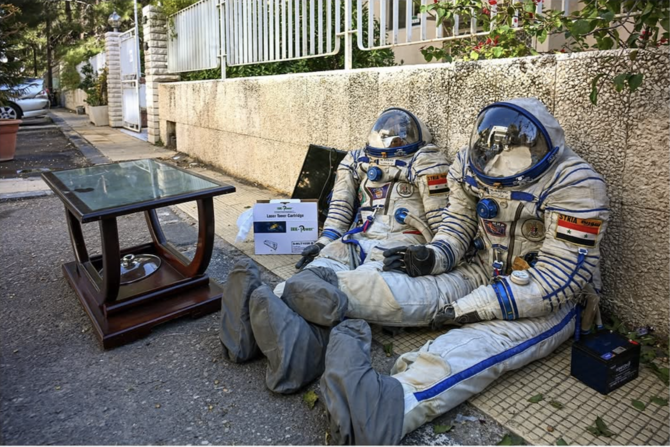
The first features two astronaut suits abandoned on a Damascus pavement.  


A charcoal artwork by Mohannad Orabi. (Supplied)

“These suits were left after an incident where citizens tried to steal items from the president’s residence, symbolizing the desperation of a population grappling with the aftermath of years of oppression,” Abd Rabbo told Arab News on opening night. “The photo captures a surreal scene.” 

The second shows a man holding the Syrian flag — a moment of both defiance and of hope for the future. The third depicts a group of people toppling a statue of Assad, a vivid representation of the collapse of the regime and the collective desire for a fresh start. 

The work by the other seven artists in the show also point to the possibility of healing and reconstruction, without ignoring the horrors of the past. Through abstract forms, vivid color palettes, and intricate textures, the artists explore the emotional complexities of life in a post-conflict society — grappling with loss, rebuilding, and forging a new collective identity. 


From Ammar Abd Rabbo's 'Damascus, December 2024' series. (Supplied)

Their diverse styles ensure that the exhibition offers a multifaceted view of Syria’s cultural evolution. It speaks to the varied experiences of individuals affected by the war, from those who witnessed the conflict first-hand to those abroad who have found creative ways to make sense of the country’s developments. 

The exhibition also provides a vital opportunity for audiences to engage with the ongoing changes in Syria, offering an understanding of the personal and collective dimensions of war and recovery.  

Art, as highlighted in “6:18, The DAWN,” serves not only as a form of healing but also as an essential medium for documenting history and inspiring hope. 

- This article was first published on Arab News France. 


World of Coffee trade show capitalizes on Gulf’s strong coffee culture

Updated 06 January 2026
Follow

World of Coffee trade show capitalizes on Gulf’s strong coffee culture

DUBAI: Long regarded as the birthplace of coffee brewing, the Middle East is entering a new phase of cafe culture — and the fifth edition of World of Coffee, which takes place in Dubai from Jan. 18-20, will help drive that momentum.

Saudi Arabia alone is home to more than 5,100 branded cafes, with daily coffee consumption exceeding 36 million cups. Coffee is part of the social and cultural fabric, from traditional majlis gatherings to contemporary specialty cafes.

“Saudi Arabia’s coffee sector is evolving rapidly. There is increasing investment in quality, education, and presentation, alongside renewed interest in origin storytelling and cultural context,” said Shouq Bin Redha, exhibition manager for World of Coffee Dubai 2026, where Saudi Arabia will host a national pavilion.

“Saudi coffee has a very distinct identity rooted in heritage, ritual, and hospitality. Its profile is closely tied to traditional preparation methods and regional flavor preferences, which sets it apart on the global stage,” she told Arab News. “The national pavilion reflects this balance between tradition and modernization.”

Organized by DXB LIVE in partnership with the Specialty Coffee Association, World of Coffee Dubai has expanded dramatically, growing from 5,000 sq. meters in 2022 to more than 20,000 sq. meters in 2026. The event brings together producers, traders, roasters, cafe owners and innovators from around the world.

“At its core, the event is about bringing together the full coffee value chain in one place,” Redha said. “We want participants to leave not only having discovered new products or origins, but with stronger partnerships, clearer market insight, and a deeper understanding of how the industry is evolving.”

She added: “The Gulf has become an increasingly attractive market for producers because it combines strong consumer demand with a growing appreciation for quality, origin, and traceability.”

The UAE’s coffee market alone exceeds $3.2 billion, while Dubai continues to strengthen its position as one of the world’s most cafe-dense and diverse cities.

“Dubai, in particular, offers a unique gateway to multiple markets at once. For producers, World of Coffee Dubai provides direct access not only to local buyers, but to an international audience that uses the city as a regional and global trading hub,” Redha said.

When it comes to trends in the Gulf’s coffee scene, Redha said she expected to see “continued diversification in sourcing, with buyers exploring a broader range of origins and flavor profiles. There is also growing interest in coffees that offer greater transparency, whether through direct trade relationships, clearer traceability, or stronger sustainability credentials.”