RABAT: A court governing international soccer disputes has ruled that depicting the disputed Western Sahara as part of Morocco on club jerseys violates rules against political messaging.
The Switzerland-based Court of Arbitration for Sport, or CAS, on Wednesday upheld an appeal from Algeria’s soccer federation contesting the Confederation of African Football’s April 2024 decision allowing a northern Moroccan club to wear jerseys featuring the disputed map.
The world governing body states that no item of kit which “includes political statements or images” may be worn.
“The image of a map of Morocco including Western Sahara on the shirts of RS Berkane depicts a message, a demonstration or propaganda of a political nature as it represents the assertion of a territorial dispute that is contested and still unresolved as of today,” the court’s panel of judges ruled.
Diplomatic ties cut in 2021
Western Sahara, a phosphate-rich former Spanish colony the size of the United Kingdom, is a territory claimed by both Morocco and Polisario Front, a pro-independence movement that operates out of refugee camps in southern Algeria. A 1991 UN-brokered ceasefire established a mission to organize a referendum on the region’s future, but disagreements over voter eligibility have long stalled the process.
The territorial dispute drives foreign policy for both Morocco and Algeria, which supports Polisario’s claims. The two countries cut diplomatic ties in 2021 and have since fought over soccer jerseys, caftans, tiles and airspace.
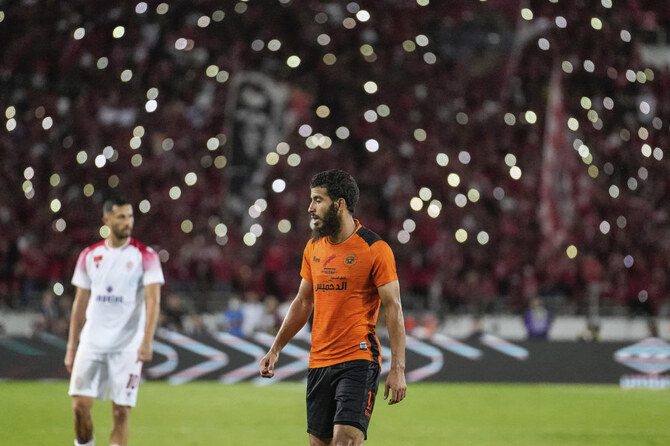
The soccer dispute originated last year when players for Morocco’s RS Berkane had uniforms seized by Algerian authorities at the airport before the first leg of a semifinal against USM Alger.
The Confederation of African Football (CAF) which organizes the continent’s international soccer competitions, denied Algeria’s request to ban the shirts. RS Berkane refused to wear replacements and the game did not go ahead. Days later, USM Alger refused to play the second leg of the match in Morocco if the hosts wore the jerseys. CAF awarded wins to RS Berkane by default.
The case hinges on the laws of soccer requiring jerseys “not have any political, religious or personal slogans, statements or images.”
‘Sporting justice’
The ruling comes as Morocco emerges as a political force in African soccer, preparing to host this year’s Africa Cup of Nations and the 2030 World Cup, along with Spain and Portugal.
Moroccan soccer federation president Fouzi Lekjaa is a key influence at CAF, as a member of its executive committee, and within FIFA, where he is among the elected African members of the world soccer body’s ruling council. Lekjaa also is a past president of RS Berkane.
Lekjaa’s influence, also as a government finance minister, led to FIFA agreeing to open a development office for African soccer in the Moroccan capital, Rabat.
In a statement, the USM Alger club thanked the Algerian government and soccer federation and described the ruling as “sporting justice.”
RS Berkane also lauded the ruling and framed it as a victory, celebrating the panel’s decision to reject Algeria’s request to annul the results of last year’s semifinal games and impose sanctions.


![]()

Sports highest court says Moroccan soccer shirt depicting map of disputed area was breach of rules
Short Url
https://arab.news/j6383
Sports highest court says Moroccan soccer shirt depicting map of disputed area was breach of rules
- The world governing body states that no item of kit which “includes political statements or images” may be worn
- “The image of a map of Morocco including Western Sahara on the shirts of RS Berkane depicts a message, a demonstration or propaganda of a political nature,” the court ruled


Latest updates




© 2026 SAUDI RESEARCH & PUBLISHING COMPANY, All Rights Reserved And subject to Terms of Use Agreement.