At Security Council, concerns over ‘fragmentation’ of Sudan

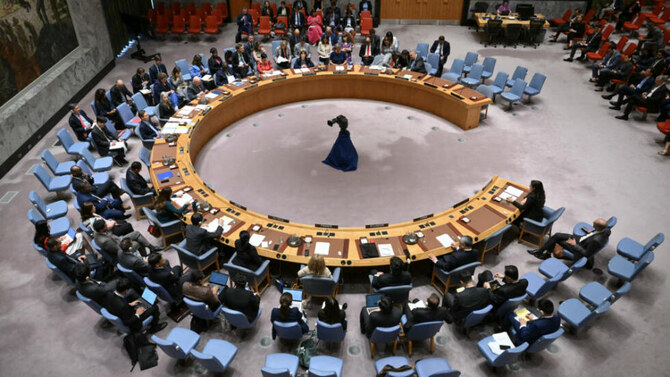
Several members of the UN Security Council on Wednesday voiced concern over the declaration of a parallel government by Sudan’s paramilitary Rapid Support Forces. (AFP/File)
Short Url
Updated 27 February 2025
Follow

At Security Council, concerns over ‘fragmentation’ of Sudan

  • The war has triggered the world’s largest displacement and hunger crisis

UNITED NATIONS, United States: Several members of the UN Security Council on Wednesday voiced concern over the declaration of a parallel government by Sudan’s paramilitary Rapid Support Forces, while Kenya pushed back against accusations that it had recognized the entity.
RSF rebels and their allies fighting government forces on Sunday agreed to form a rival government, triggering diplomatic tensions between Sudan and Kenya.
The parties to the agreement, inked behind closed doors in Nairobi, said the charter establishes a “government of peace and unity” in rebel-controlled areas of the northeast African country.
“Attempts by the RSF and aligned actors to establish a government in RSF-controlled territory in Sudan are unhelpful for the cause of peace and security in Sudan, and risks a de facto partition of the country,” US Representative John Kelley told a Security Council meeting.
British Ambassador Barbara Woodward also expressed “deep concern” over the development.
“Respect for Sudan’s charter rights, its unity, sovereignty and territorial integrity is vital and will be necessary for a sustainable end to this war,” she said.
Envoys from France and China echoed that view, with Chinese Ambassador Fu Cong saying the move “risks increasing the fragmentation of the Sudan.”
Deputy Algerian Ambassador Toufik Laid Koudri, speaking on behalf of the Council’s three African members Algeria, Somalia, Sierra Leone as well as Guyana, urged “the RSF and their allies to put the unity and national interest of Sudan above all other considerations.”
Sudanese Ambassador to the UN Al-Harith Idriss Al-Harith Mohamed denounced the move as “an unprecedented violation of the UN Charter and the AU constitution,” and accused Kenya of taking “a step that aims to dismantle the Sudan.”
His Kenyan counterpart Erastus Lokaale denied the claim.
“I reiterate that neither President William Ruto nor the Government of Kenya has recognized any independent entities in the Sudan or elsewhere,” he said.
The war in Sudan, which has claimed tens of thousands of lives, erupted after a rift emerged between Burhan and Dagalo over the future structure of the government.
The war has triggered the world’s largest displacement and hunger crisis.
Both warring sides face accusations of committing grave atrocities against civilians, with their leaders sanctioned by the US.


Israeli minister calls West Bank measures ‘de facto sovereignty,’ says no future Palestinian state

Updated 4 sec ago
Follow

Israeli minister calls West Bank measures ‘de facto sovereignty,’ says no future Palestinian state

  • Eli Cohen’s comments on Tuesday suggest these steps prevent the establishment of a Palestinian state
  • alestinians, Arab countries, and human rights groups view the actions as annexation
RAMALLAH: A top Israeli official said Tuesday that measures adopted by the government that deepen Israeli control in the occupied West Bank amounted to implementing “de facto sovereignty,” using language that mirrors critics’ warnings about the intent behind the moves.
The steps “actually establish a fact on the ground that there will not be a Palestinian state,” Energy Minister Eli Cohen told Israel’s Army Radio.
Palestinians, Arab countries and human rights groups have called the moves announced Sunday an annexation of the territory, home to roughly 3.4 million Palestinians who seek it for a future state.
Cohen’s comments followed similar remarks by other members of Prime Minister Benjamin Netanyahu’s government, including Finance Minister Bezalel Smotrich and Defense Minister Israel Katz.
The moves — and Israeli officials’ own descriptions of them — put the country at odds with both regional allies and previous statements from US President Donald Trump. Netanyahu has traveled to Washington to meet with him later this week.
Last year, Trump said he won’t allow Israel to annex the West Bank. The US-brokered ceasefire between Israel and Hamas that aimed to stop the war in Gaza also acknowledged Palestinian aspirations for statehood.
Widespread condemnation
The measures further erode the Palestinian Authority’s limited powers, and it’s unclear the extent to which it can oppose them. Still, Hussein Al Sheikh, the Palestinian Authority’s deputy president, said on Tuesday “the Palestinian leadership called on all civil and security institutions in the State of Palestine” to reject them
In a post on X on Tuesday, he said the Israeli steps “contradict international law and the agreements signed with the Palestine Liberation Organization.”
A group of eight Arab and Muslim-majority countries expressed their “absolute rejection” of the measures, calling them in a joint statement Monday illegal and warning they would “fuel violence and conflict in the region.”
Israel’s pledge not to annex the West Bank is embedded in its diplomatic agreements with some of those countries and renewed warnings that it was a “red line” for the Emirates led Israel to shelve some high-level discussions on the matter last year.
United Nations Secretary General Antonio Guterres said he was “gravely concerned” by the measures.
“They are driving us further and further away from a two-State solution and from the ability of the Palestinian authority and the Palestinian people to control their own destiny,” his spokesperson, Stephane Dujarric, said on Monday.
What the measures mean
The measures, approved by Netanyahu’s Security Cabinet on Sunday, expand Israel’s enforcement authority over land use and planning in areas run by the Palestinian Authority, making it easier for Jewish settlers to force Palestinians to give up land.
Smotrich and Katz on Sunday said they would lift long-standing restrictions on land sales to Israeli Jews in the West Bank, shift some control over sensitive holy sites — including Hebron’s Ibrahimi Mosque, also known as the Tomb of the Patriarchs — and declassify land registry records to ease property acquisitions.
They also revive a government committee empowered to make what officials described as “proactive” land purchases in the territory, a step intended to reserve land for future settlement expansion.
Taken together, the moves add an official stamp to Israel’s accelerating expansion and would override parts of decades-old agreements that split the West Bank between areas under Israeli control and areas where the Palestinian Authority exercises limited autonomy.
Israel has increasingly legalized settler outposts built on land Palestinians say documents show they have long owned, evicted Palestinian communities from areas declared “military zones” and villages near archaeological sites it has reclassified as “national parks.”
More than 700,000 Israelis live in the occupied West Bank and east Jerusalem, territories captured by Israel in 1967 and sought by the Palestinians for an independent state along with the Gaza Strip.
Palestinians are not permitted to sell land privately to Israelis. Settlers can buy homes on land controlled by Israel’s government.
The international community overwhelmingly considers Israeli settlement construction to be illegal and an obstacle to peace.
“These decisions constitute a direct violation of the international agreements to which Israel is committed and are steps toward the annexation of Areas A and B,” anti-settlement watchdog group Peace Now said on Sunday, referring to parts of the West Bank where the Palestinian Authority exercised some autonomy.