

Pakistan, Uzbekistan call for Muslim unity, two-state solution in Middle East
Pakistan, Uzbekistan call for Muslim unity, two-state solution in Middle East/node/2591710/pakistan
Pakistan, Uzbekistan call for Muslim unity, two-state solution in Middle East
Palestinians sheltering in tents set up near the rubble of buildings, amid a ceasefire between Israel and Hamas, in Gaza City on February 26, 2025. (REUTERS)
ISLAMABAD: Pakistan’s Prime Minister Shehbaz Sharif and Uzbek President Shavkat Mirziyoyev on Wednesday reiterated their support for a two-state solution in the Middle East, calling for Muslim countries to unite in the face of complex challenges worldwide.
Prominent Muslim countries around the world, including Pakistan, have been advocating for an independent state of Palestine based on “internationally agreed parameters” and the pre-1967 borders with Al-Quds Al-Sharif as its capital.
Sharif, who arrived on an official visit to Uzbekistan to promote trade and investment on Tuesday, said he and Mirziyoyev reviewed the Middle East situation, where an uneasy truce currently holds after Israel’s 15-month war on Gaza.
“Finally, I would like to mention that Pakistan stands by the people of Gaza, we believe in a two-state concept, an independent state of Palestine and their rights enshrined in UN Security Council resolutions,” Sharif said.
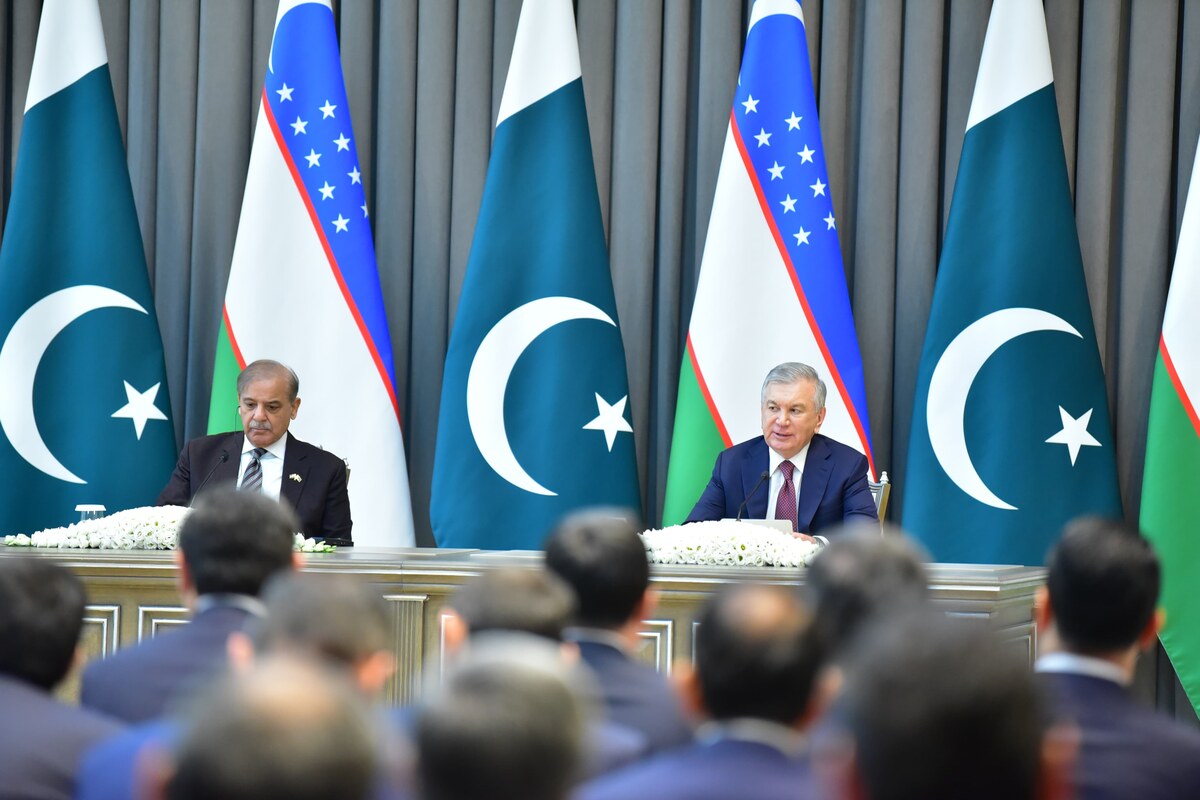
Uzbekistan President Shavkat Mirziyoyev speaks during a joint press stakeout with Pakistan Prime Minister Shehbaz Sharif in Tashkent on February 26, 2025. (Photo courtesy: X/@PakPMO)
He said both leaders agreed on the need for greater Muslim unity to navigate the challenges of the complex world.
“I also told you that in this complex world we need to unite the Muslim world and we talked about Gaza during the negotiations,” Mirziyoyev said.
“There should be a two-state concept whether anyone would like it or not.”
Israel killed over 48,000 Palestinians in Gaza through its relentless military campaigns that began since Oct. 7, 2023 after a surprising Hamas attack.
Both sides agreed to an uneasy truce in January this year which has led to the cessation of hostilities and exchange of hostages.
Fears of the truce collapsing were renewed last week after Israel delayed the release of some 600 Palestinian prisoners on Saturday to protest what it says is the cruel treatment of hostages during their release by Hamas.
The Palestinian group has released hostages, and the bodies of four dead hostages, in large public ceremonies during which the Israelis were paraded and forced to wave to large crowds.
Hamas has said the delay is a “serious violation” of their ceasefire and that talks on a second phase of the truce are not possible until the Palestinians are freed.
PAINDA CHEENA, Pakistan: In the rugged mountains of Pakistan’s Tirah Valley, long lines of tractor-trolleys and mini-pickups inched toward a registration camp earlier this month.
The vehicles were stacked with bedding, food supplies and families escaping their homes as a military operation against militants looms in the conflict-striken northwestern region.
At the Painda Cheena registration point, 60-year-old Hajji Muhammad Yousuf sat wrapped in a shawl, waiting with dozens of others after traveling nearly 40 kilometers from his village in Maidan Tirah, a journey that took four days instead of the usual few hours. He still faces another 66-kilometer trip to Bara, near the northwestern city of Peshawar, the provincial capital of Khyber Pakhtunkhwa.
Like thousands of others, Yousuf is leaving behind a fully furnished home ahead of an expected security offensive in the volatile border region near Afghanistan.
“Today is our fourth night here,” Yousuf said. “We have left fully furnished houses behind ... There are no facilities, no amenities for us. We are facing great hardships.”
Families load their belongings onto vehicles in Pakistan’s Tirah Valley on January 15, 2026. (AN photo)
Officials say the evacuation could affect up to 20,000 families, marking a significant escalation in Pakistan’s campaign against the proscribed militant group Tehreek-e-Taliban Pakistan (TTP). Despite major military operations in the mid-2010s, Tirah Valley has remained a stronghold for insurgents, prompting authorities to plan what they describe as a targeted clearance.
The scale of displacement has placed acute pressure on limited local infrastructure. While the journey from Maidan Tirah to the registration point at Mandi Kas normally takes around two hours by vehicle, congestion and verification procedures have stretched the trip into days for many families.
“Last night, a woman died of hunger in Sandana,” Yousuf said. “There is no arrangement for medicine, no doctor, no food, no washroom. Women and children are facing problems.”
Displaced residents say they feel trapped between militant threats and state action.
“We ourselves are opposing terrorism, yet we do not understand why, if a Taliban comes in the evening and we give bread, the government comes in the morning asking why the bread was given,” Yousuf said. “In the end, we were forced to do this [to leave].”
RELIEF MEASURES
The Khyber Pakhtunkhwa (KP) provincial government has announced a compensation package for displaced families. Talha Rafi, assistant commissioner for Bara, said authorities had set up 15 biometric counters at the registration site.
“One person receives a one-time compensation of Rs255,000 ($911), and a monthly Rs50,000 ($179) is provided,” he said, adding that SIM cards were being issued to ensure digital disbursement of funds.
Families load their belongings onto vehicles in Pakistan’s Tirah Valley on January 15, 2026. (AN photo)
Provincial officials say the payments are intended to cover basic needs during displacement, though residents and tribal elders argue that cash alone cannot offset the absence of shelter, health care and transport arrangements during evacuation.
The evacuation has also exposed tensions between the provincial government and Pakistan’s military establishment over the use of force in the region.
“We have neither allowed the operation nor will we ever allow the operation,” KP Law Minister Aftab Alam Afridi said, arguing that past military campaigns had failed to deliver lasting stability.
“These people are our own people. They are also the people of this state, the people of this province. We will definitely take care of them,” he said, adding that the KP cabinet had approved what he described as “a large package” for the displaced families.
Federal authorities and the military have signaled a firmer stance. While Federal Information Minister Ataullah Tarar and the military’s public relations wing did not respond to requests for comment, military spokesperson Lt. Gen. Ahmed Shareef Chaudhry has previously defended security operations as necessary.
Families sittinng in vehicles with their belongings in Pakistan’s Tirah Valley on January 15, 2026. (AN photo)
In a recent briefing, Chaudhry said security forces carried out 75,175 intelligence-based operations nationwide last year, including more than 14,000 in Khyber Pakhtunkhwa, attributing the surge in violence to what he described as a “politically conducive environment” for militants.
Analysts say political divisions have allowed the TTP to regain ground.
Peshawar-based journalist Mehmood Jan Babar said many militants now operating in Tirah are local residents who returned after refusing settlement offers in remote parts of Afghanistan.
“Whenever we have seen division at the national level, the Taliban have taken advantage of it,” he said.
But for families waiting in freezing conditions at Painda Cheena, such strategic calculations offer little comfort. Tribal elders accuse civil authorities of ordering displacement without adequate logistical planning.
“The government has, without any administrative arrangements, ordered these people to migrate,” said Muhammad Khan Afridi, an elderly local resident. “You yourselves are seeing what suffering these people are facing, what humiliation they are experiencing.”
As a January 25 evacuation deadline approaches, uncertainty dominates daily life for those uprooted.
“Bringing peace is in the government’s hands,” Yousuf said. “It is up to them whether they normalize the situation or drive us out again tomorrow.”