

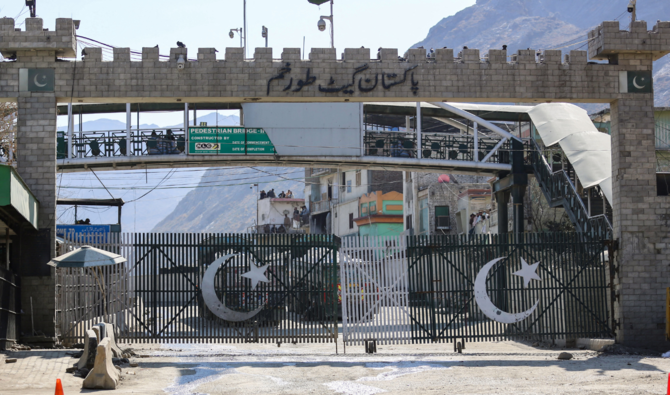
Key Pakistan-Afghanistan border crossing remains shut for fifth day over ‘construction’ dispute 

The closed Torkham gate is seen from the zero point at the Torkham border crossing between Afghanistan and Pakistan, in Nangarhar province on February 23, 2023. (AFP/File)
Short Url
Updated 26 February 2025
Follow

Key Pakistan-Afghanistan border crossing remains shut for fifth day over ‘construction’ dispute 

  • Pakistani authorities closed border Friday night after Afghan forces constructed trenches, says police official 
  • Pakistani, Afghan customs clearing agents say border closure resulting in perishable items getting spoiled 

PESHAWAR: The key Torkham border crossing connecting Pakistan and Afghanistan remained shut for trade and traffic for the fifth consecutive day on Wednesday, a senior police official confirmed, as a dispute between both sides related to “construction” work lingers on. 

Pakistani authorities closed the Torkham border crossing late Friday night when Afghan authorities initiated “construction of trenches and other development work” along the border, Naheed Khan, a senior police official in Pakistan’s Khyber district that borders Afghanistan said.

Border clashes between Pakistani and Afghan forces have led to the closure of key crossings like Torkham and Chaman in the past, severely disrupting trade and halting the movement of people between the two countries.

Khan said both sides held two rounds of talks at Torkham recently but negotiations between border officials failed to yield any results. 

“Now it is highly likely that the issue will be taken up for high-level discussions between Islamabad and Kabul,” Khan told Arab News. 

The police official said some families from Bacha Mina, a dusty town on the Torkham border’s outskirts on the Pakistani side, had already left the area out of fear of a skirmish the two between border forces. 

He said most trucks loaded with perishable items had returned to Landi Kotal and Jamrud Bazaar towns in Pakistan near Torkham.

There was no immediate comment from the Afghan side on the closure of the key border crossing.

Kiftan Bacha, an Afghan customs clearing agent, told Arab News that fruits and vegetables laden on trucks on Afghanistan’s side were being spoiled due to the border closure. 

“Passengers and especially patients suffer the most,” Bacha said. “Authorities on both sides should at least allow patients to cross the border for immediate treatment in Pakistan.”

Zarqeeb Shinwar, a Pakistani customs clearing agent agreed, calling on both countries to seek a permanent solution to the dispute. 

“Its [border] closure creates a logistical crisis, discouraging trade and causing immense problems for travelers,” Shinwar told Arab News.

“Both sides need to explore its immediate and permanent solution to alleviate problems of people living in border areas.”

The development comes at a time of strained ties between Pakistan and Afghanistan over a surge in militant attacks in Pakistan’s western provinces that lie on its border with Afghanistan.

Islamabad has frequently accused Afghanistan of sheltering and supporting militant groups that launch cross-border attacks. Afghan officials deny involvement and insist that Pakistan’s security issues are the country’s internal matter. 

In August, the Torkham border was shut down for three days after the Afghan Taliban announced they were investigating reports of Pakistani fighter jets allegedly violating Afghanistan’s airspace in Nangarhar and Kunar provinces.

Tensions escalated again between the two countries in December, following reports of Pakistani airstrikes targeting alleged militant camps in Afghanistan. Afghan officials reported that the strikes resulted in civilian casualties.


IMF board to approve Pakistan reviews today ‘if all goes well,’ say officials

Updated 08 December 2025
Follow

IMF board to approve Pakistan reviews today ‘if all goes well,’ say officials

  • IMF’s executive board is scheduled to meet today to discuss the disbursement of $1.2 billion
  • Economists say the money will boost Pakistan’s forex reserves, send positive signals to investors

KARACHI: The International Monetary Fund’s (IMF) executive board is scheduled to meet today, Monday, to approve the release of about $1.2 billion for Pakistan under the lender’s two loan facilities, said IMF officials who requested not to be named.

The IMF officials confirmed the executive board was going to decide on the Fund’s second review under the $7 billion Extended Fund Facility (EFF) and first review under the $1.4 billion Resilience and Sustainability Facility (RSF), a financing tool that provides long-term, low-cost loans to help countries address climate risks.

“The board meeting will be taking place as planned,” an IMF official told Arab News.

“The board is on today yes as per the calendar,” said another.

A well-placed official at Pakistan’s finance ministry also confirmed the board meeting was scheduled today to discuss the next tranche for Pakistan.

The IMF executive board’s meeting comes nearly two months after a staff-level agreement (SLA) was signed between the two sides in October.

Procedurally, the SLAs are subject to approval by the executive board, though it is largely viewed as a formality.

“If all goes well, the reviews should pass,” said the second IMF official.

On approval, Pakistan will have access to about $1 billion under the EFF and about $200 million under the RSF, the IMF said in a statement in October after the SLA.

The fresh transfer will bring total disbursements under the two arrangements to about $3.3 billion, it added.

Experts see smooth sailing for Pakistan in terms of the passing of the two reviews, saying the IMF disbursements will help the cash-strapped nation to strengthen its balance of payments position.

Samiullah Tariq, group head of research at Pakistan Kuwait Investment Company Limited, said the IMF board’s approval will show that Pakistan’s economy is on the right path.

“It obviously will help strengthen [the country’s] external sector, the balance of payments,” he told Arab News.

Until recently, Pakistan grappled with a macroeconomic crisis that drained its financial resources and triggered a balance of payments crisis.

Pakistan has reported financial gains since 2022, recording current account surpluses and taming inflation that touched unprecedented levels in mid-2023.

Economists also viewed the IMF’s bailout packages as crucial for cash-strapped Pakistan, which has relied heavily on financing from bilateral partners such as Saudi Arabia, China and the United Arab Emirates, as well as multilateral lenders.

Saudi Arabia, through the Saudi Fund for Development, last week extended the term of its $3 billion deposit for another year to help Pakistan boost its foreign exchange reserves, which stood at $14.5 billion as of November 28, according to State Bank of Pakistan statements.

“In our view this [IMF tranche] will be approved,” said Shankar Talreja, head of research at Karachi-based brokerage Topline Securities Limited.

“This will help strengthen reserves and will eventually help a rating upgrade going forward,” he said.

The IMF board’s nod, Talreja said, would also send a signal to the international and local investors regarding the continuation of the reform agenda by Pakistan’s government.