

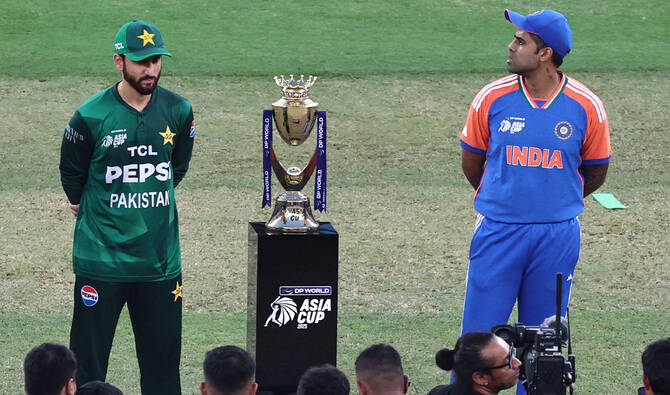

NEW DELHI: Cricket’s T20 World Cup begins Saturday after an acrimonious buildup overshadowed by political turmoil, with Bangladesh kicked out and Pakistan refusing to face arch-rivals and co-hosts India.
When the first ball is finally bowled after a chaotic lead-in, Pakistan will open the tournament against the Netherlands in Colombo.
Defending champions and tournament favorites India will make their tournament bow in the night match on day one against the United States in Mumbai, carrying the hopes of a billion-plus home cricket supporters.
Led by Suryakumar Yadav, India will start as firm tournament favorites and are expected to ease into the Super Eight stage from Group A.
But they will be wary of the United States, who are looking to take down another cricketing powerhouse, having shocked Pakistan to make the Super Eights in 2024.
Former champions Australia and England are also strong contenders to lift the trophy and deny holders India the title for a record second straight time.
The 2021 winners Australia have been hit hard by the absence of pace spearhead Pat Cummins, who was ruled out with a lower back injury.
Pace bowler Josh Hazlewood will miss the early stages as he recovers from hamstring and Achilles injuries.
Led by Mitchell Marsh, the Australians should still ease into the next round from Group B against Ireland, who they play first on Wednesday, plus co-hosts Sri Lanka Oman and Zimbabwe.
Harry Brook’s England, full of confidence after a 3-0 T20 series win in Sri Lanka this week, are expected to make the Super Eights from a Group C that also features two-time winners West Indies, debutants Italy, Nepal and Scotland.
Brook, under intense scrutiny after having to apologize for an incident with a night club bouncer in New Zealand last year, takes charge at a global tournament for the first time since he replaced Jos Buttler as white ball captain.
England, who start with a match against Nepal on Sunday in Mumbai, won the tournament in 2010 and 2022.
Scotland, after their 11th-hour call-up to replace Bangladesh, will take guard on the opening day when they face the West Indies in Kolkata.
Football powerhouse Italy will make an appearance at a cricket World Cup for the first time, and will kick off against the Scots in Kolkata on Monday.
South Africa, the runners-up in 2024, have never won a white ball World Cup, but are buoyed by winning the World Test Championship last year.
They will be a threat but must first emerge from a tough-looking Group D that contains dangerous opponents in New Zealand and Afghanistan.
They begin against Canada on Monday in Ahmedabad, with the UAE the other team in that group.
The top two teams from each of the four groups of five teams will advance to the Super Eights, with the top four making the semifinals.
POLITICS, PULLOUTS
There will be relief at the weekend when the action gets under way finally after weeks of political posturing that has dominated the build-up to 10th edition of the showpiece tournament.
Bangladesh refused to play in India, citing security concerns, as relations between the two countries soured and were kicked out by the International Cricket Council (ICC) from England’s Group C.
The ICC is led by Jay Shah, the former Indian cricket board secretary and son of the powerful Indian home minister Amit Shah.
Pakistan, who had backed Bangladesh’s plea to have their games moved to Sri Lanka, were cleared to play by the Islamabad government but they ordered the team not to play the marquee group clash against fierce rivals India on February 15.
According to media reports, the ICC is still waiting formal communication from the Pakistan Cricket Board on the boycott, leaving the door slightly ajar for a last-minute deal to get the game on.
If India are awarded a walkover, Pakistan will lose two points and take a big hit to their net run rate.
If any of their other three Group A games are lost to the weather then it could make it almost impossible for Pakistan to qualify.
Pakistan’s pullout will result in a loss of millions of dollars in revenue for broadcasters, and will be a huge letdown for fans on both sides.
The crisis was triggered last month when India’s cricket board ordered the IPL’s Kolkata Knight Riders to drop Bangladesh fast bowler Mustafizur Rahman, a move that deepened political strains between the neighbors.
The tournament will conclude with the final on March 8 in Ahmedabad or Colombo, depending on whether Pakistan go that far.


