

Saudi stars on show at third Diriyah Contemporary Art Biennale

‘On the Red Sea,’ Nouf Al-Harthi. (Supplied)
Short Url
Updated 05 February 2026
Follow

Saudi stars on show at third Diriyah Contemporary Art Biennale

  • Selected works from some of the local artists participating in this year’s exhibition 

Nouf Al-Harthi 

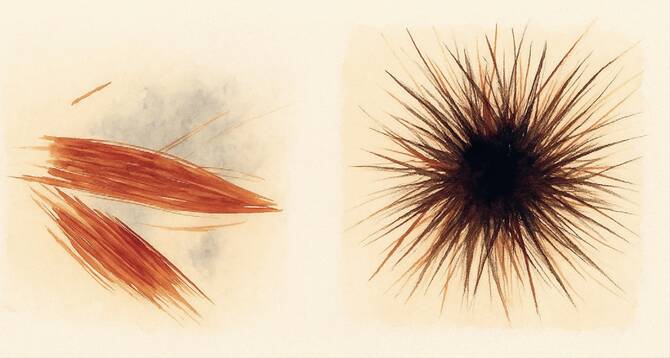
‘On the Red Sea’ 

Al-Harthi, who was born in Asir, is, according to the exhibition catalogue, “an interdisciplinary researcher, writer, and storyteller whose practice moves between sound, poetry, and music.” In a new commission for the biennale, she contributes this performance and poetry recital, which “focuses on sea sawdust, a type of marine bacteria that forms blooms during the hottest months.” As they decay, they turn from green to a reddish-brown, and it’s believed that the sighting of slicks of these bacteria is why the Red Sea is so named. In her piece, Al-Harthi uses sea sawdust “as a lens for deconstructing the relationship between human and non-human,” the catalogue states. “Reading the sea and the waves as sites of knowledge production, ‘On the Red Sea’ shifts our perspective through the biological and the mythical, weaving a network of environmental, historical, and linguistic relations.”

Ahaad Alamoudi 

‘The Run’ 

The Jeddah-born multidisciplinary artist’s 2025 video features in the exhibition’s “Disjointed Choreographies” gallery, in which, the catalogue says, “artists grapple with their relationships to the past, celebrate the legacy of historical and cultural figures, and tells the stories that shape their world.” Alamoudi’s film shows a solitary runner “traversing printed banners that display static images of the very ground they occupy. As she runs through them, the land itself remains immutable and silent. The only sound is the steady rhythm of footsteps … amplifying both the futility and persistence of forward motion.” The video was shot in NEOM and “invites us to interrogate the narratives embedded in shifting lands — how symbols, screens, silences, and the cadence of sound shape our collective imagination.”

Leen Aljan  

‘Takki’ 

The Jeddah-born architectural designer’s installation for the biennale is a giant takki board (takki is a card game similar to Uno) consisting of “modular, inhabitable forms made out of reclaimed wood from the tracks of the Hejaz Railway, which connected Damascus and Madinah. On the benches and tables are traditional folk games that are no longer played — or modernized versions of them.” The piece’s composition “echoes classical Hejazi courtyards and tiled interiors.” All of this ties into Aljan’s wider practice, in which she “investigates the intersection of cultural memory with sensory experience and spatial design.”

Mohammad Al-Ghamdi  

‘Untitled’ 

This is one of three of Al-Ghamdi’s pieces on display in the biennale’s “A Hall of Chants” gallery, in which the works “map our complicated relationships to place and language.” The works are all mixed media on wood, and the catalogue describes them as “simultaneously contemporary and archaeological.” They are, it continues, “composed of reclaimed fragments carrying traces of social life, including a cable spool, decorative motifs, and a drawing on wood.” The artist is quoted as saying: “My work is not a nostalgic attempt to relive the past, but is rather an endorsement of the power of the past to create the future.” The works “invite viewers to witness the upheaval of matter and consider the enduring possibilities that reside within what is often overlooked, discarded, or deemed obsolete.”

Ramy Alqthami  

‘Al Bitra’ 

The Jeddah-based artist’s work at the biennale is a collection of three photographs and a sculpture, created in 2014. Alqthami has “reconfigured a numbered concrete post — originally issued as a traditional marker of land ownership — into both sculpture and image” in the piece, which “originates in a personal history tied to (his) tribal roots in Saudi Arabia’s Taif region, where his family was assigned such a post to demarcate their land.” The post is the sculpture, while the photographs “point at its original location, shifting the marking stone from a local gesture of governance into a visual symbol.” It is a work that is supposed to invite a variety of interpretations, the catalogue states, “including as an instrument of power residing in the liminal space between ancestral knowledge and legal contracts.”


Robert Duvall: understated actor’s actor, dead at 95

Updated 16 February 2026
Follow

Robert Duvall: understated actor’s actor, dead at 95

  • One of his most memeorable characters was the maniacal, surfing-mad Lt. Gen. William Kilgore in Francis Ford Coppola’s 1979 Vietnam War epic ‘Apocalypse Now’
  • One regret was turning down the lead part in ‘Jaws’ (which went to Roy Scheider) because he instead wanted to play the salty fisherman, a role that went to Robert Shaw

LOS ANGELES: Robert Duvall, a prolific, Oscar-winning actor who shunned glitz and won praise as one of his generation’s greatest and most versatile artists, has died at age 95.
Duvall’s death on Sunday was confirmed by his wife Luciana Duvall in a statement posted Monday on Facebook.
Duvall shone in both lead and supporting roles, and eventually became a director over a career spanning six decades. He kept acting in his 90s.
His most memorable characters included the soft-spoken, loyal mob lawyer Tom Hagen in the first two installments of “The Godfather” and the maniacal, surfing-mad Lt. Gen. William Kilgore in Francis Ford Coppola’s 1979 Vietnam War epic “Apocalypse Now.”
The latter earned Duvall an Oscar nomination and made him a bona fide star after years playing lesser roles. In it he utters what is now one of cinema’s most famous lines.
“I love the smell of napalm in the morning,” his war-loving character — bare chested, cocky and sporting a big black cowboy hat — muses as low-flying US warplanes strafe a beachfront tree line with the incendiary gel.
That character was originally created to be even more over the top — his name was at first supposed to be Col. Carnage — but Duvall had it toned down in a show of his nose-to-the-grindstone approach to acting.
“I did my homework,” Duvall told veteran talk show host Larry King in 2015. “I did my research.”
Duvall was a late bloomer in the profession — he was 31 when he delivered his breakout performance as the mysterious recluse Boo Radley in the 1962 film adaptation of Harper Lee’s novel “To Kill a Mockingbird.”
He would go on to play myriad roles — a bullying corporate executive in “Network” (1976), a Marine officer who treats his family like soldiers in “The Great Santini” (1979), and a washed-up country singer in “Tender Mercies” (1983), for which he won the Oscar for best actor. Duvall was nominated for an Oscar six other times as well.
Duvall often said his favorite role, however, was one he played in a 1989 TV mini-series — the grizzled, wise-cracking Texas Ranger-turned-cowboy Augustus McCrae in “Lonesome Dove,” based on the novel by Larry McMurtry.
Film critic Elaine Mancini once described Duvall as “the most technically proficient, the most versatile, and the most convincing actor on the screen in the United States.”
In her statement Luciana Duvall said, “to the world, he was an Academy Award-winning actor, a director, a storyteller. To me, he was simply everything. His passion for his craft was matched only by his deep love for characters, a great meal, and holding court.”

‘A lot of crap’ 

Born in 1931, the son of a Navy officer father and an amateur actress mother, Duvall studied drama before spending two years in the US Army.
He then settled in New York, where he shared an apartment with Dustin Hoffman. The pair were friends with Gene Hackman as all three worked their way up in showbiz. These were lean times for the future stars.
“Hoffman, me, my brother, three or four other actors and singers had a place on 107th and Broadway in Manhattan, uptown,” Duvall told GQ in 2014.
Duvall said he had few regrets in his career.
But one was turning down the lead part in “Jaws” (which went to Roy Scheider) because he instead wanted to play the salty fisherman, a role that went to Robert Shaw.
Director Steven Spielberg told Duvall he was too young for that part.
Duvall also admitted he took some jobs just for the money.
“I did a lot of crap,” he told The Wall Street Journal in 2017. “Television stuff. But I had to make a living.”
Duvall made his home far from the glitz and chatter of Hollywood — in rural Virginia, where his family had roots.
He and his fourth wife, Argentine-born Luciana Pedraza, 40 years his junior, lived in a nearly 300-year-old farmhouse. Duvall never had children.
He said he went to New York and Los Angeles only when necessary.
“I like a good Hollywood party,” he told the Journal. “I have a lot of friends there. But I like living here.”
And of all his storied roles, Duvall says his favorite was indeed that of the soft-hearted cowboy McCrae in “Lonesome Dove.”
“That’s my ‘Hamlet,’” he told The New York Times in 2014.
“The English have Shakespeare; the French, Moliere. In Argentina, they have Borges, but the Western is ours. I like that.”