



ISLAMABAD: Pakistan and Uzbekistan on Wednesday signed a joint declaration to establish a High-Level Strategic Council aimed at strengthening economic, diplomatic and security cooperation, as Prime Minister Shehbaz Sharif met Uzbek President Shavkat Mirziyoyev during a state visit to Tashkent.
Sharif landed in Tashkent late Tuesday following a visit to Baku, during which multiple agreements were signed to enhance cooperation in trade, energy, tourism and education, among other sectors.
Pakistan is seeking to leverage its strategic position as a key trade and transit hub to connect the landlocked Central Asian republics to the global market. Since last year, there has been a flurry of high-level visits, investment discussions and other economic engagements between Pakistan and the Central Asian states.
On Wednesday, Sharif arrived at the Congress Center in Tashkent, where he was received by the Uzbek president. The two leaders jointly oversaw the signing of multiple memoranda of understanding (MoUs) covering trade, technology, security, youth affairs and media cooperation.
“This historic visit is an important event that will open a new chapter in the expansion of our strategic partnership,” Mirziyoyev said after the signing of the agreements, vowing to increase bilateral trade, which currently exceeds $400 million, to $2 billion.
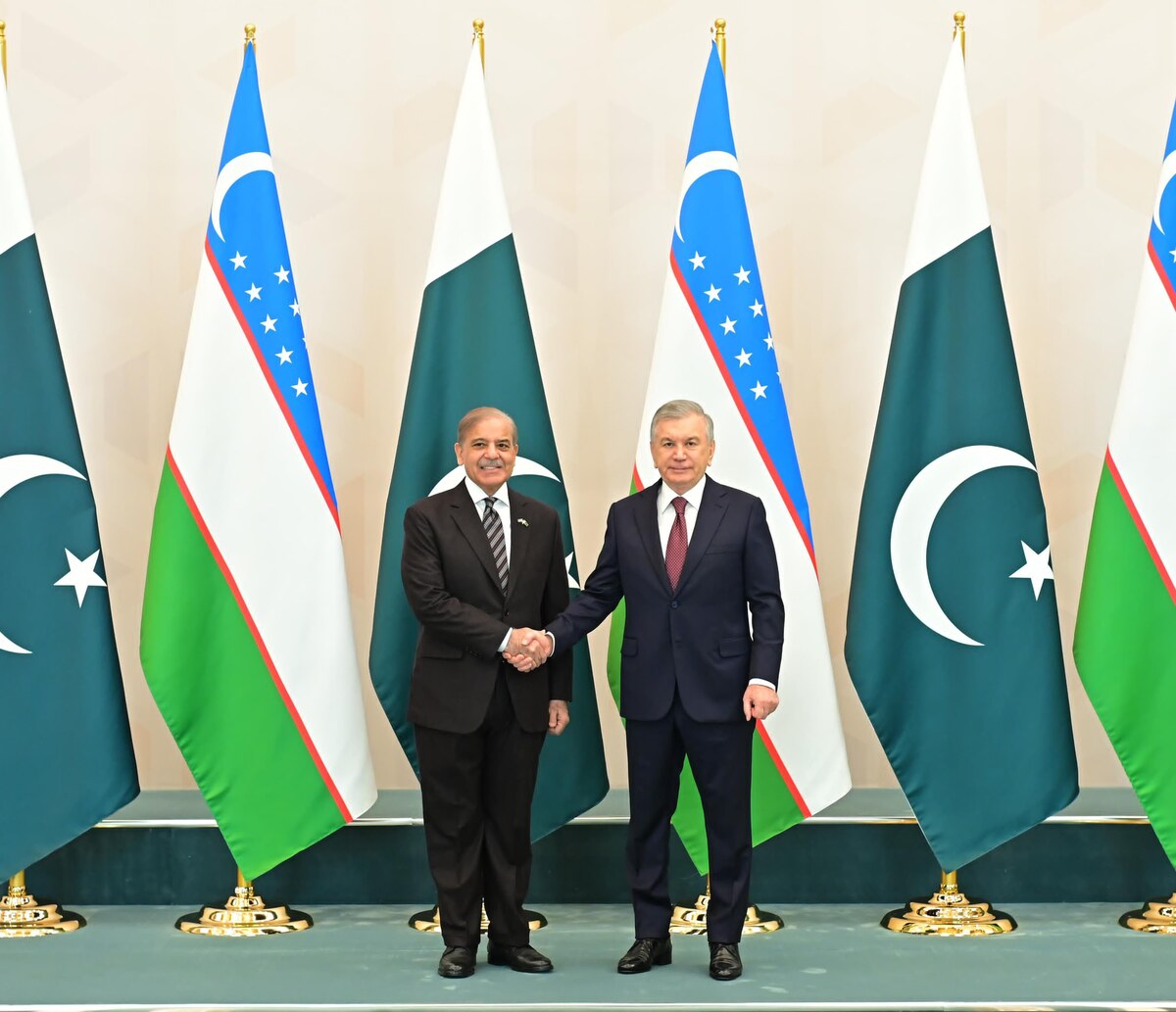
A photo of Prime Minister Shehbaz Sharif and Uzbek President Shavkat Mirziyoyev during the Pakistani prime minister's visit to Tashkent on February 26, 2025. (Photo courtesy: PMO)
“We have also decided to establish a High-Level Strategic Council ... Once in two months we will have calls by mobile phones. Once a month, all the ministries and relative bodies will report to us in the online format on the implementations of the instructions and measures.”
He said the council would evaluate challenges to bilateral cooperation and work to address them.
Speaking about the status of economic ties, he said there were at least 130 joint ventures between the two nations while more trade houses had been opened in Karachi and Tashkent.
An intergovernmental commission was “working effectively” while many political consultations, business events and exhibitions of national products had been successfully organized, and more were in the works.
“The chairperson of Uzbek central bank will go to Pak and his counterpart will come here. We will resolve any possible challenges,” the Uzbek leader said.
Mirziyoyev said he had also held detailed discussions with Sharif on regional connectivity with a focus on the trans-Afghan rail service aimed at linking the three countries.
“We are planning to increase the trade turnover to $2 billion and we will increase the industrial cooperation, develop the transport and logistic connections, we will create favorable conditions and incentives for the entrepreneurs and that was the main topic for our discussions today,” the Uzbek president said.
“And regarding the pharmaceuticals, textiles, leather industry, agriculture, honorable Prime Minister [Shehbaz Sharif] also made the proposals on the energy, geology, and the mining spheres, to develop those industries and to have regional cooperation and access to third countries.”
While air travel had already been launched between Tashkent and Lahore, the number of flights would be increased and new routes introduced connecting Samarkand and Bukhara to Karachi, Mirziyoyev added.
Speaking at the occasion, Sharif said the two leaders had discussed and decided on “a joint way forward in economic terms.”
“We will explore joint projects such as the Afghan railway connectivity, which will be a game-changer not only for Pakistan and Uzbekistan but for the entire region,” he said, adding that they had also discussed cooperation in mining and minerals, the potential for investment in each other’s economic zones, and the expansion of trade.
“We will also expand tourism, allowing people from Peshawar, Quetta, Karachi, and Lahore to visit Bukhara and Samarkand, while the people of Uzbekistan will also come to visit the historic sites in Pakistan,” Sharif said.
“I look forward to increasing flight connectivity between Tashkent, Lahore, Karachi, and other cities, to facilitate greater interaction and cooperation between our nations. Through industry, investment, agriculture, trade, and culture, we will strengthen our ties and build on the roots of our shared history.”
Among the MoUs signed was one for cooperation between news agencies, and others on youth affairs, science and visa-free travel.
Sharif and Mirziyoyev are also scheduled to participate in a Pakistan-Uzbekistan Joint Business Forum after their bilateral meeting, while the Pakistani prime minister will visit the Tashkent-based Technopark, where he will tour Uzbekistan’s industrial manufacturing units.
Uzbekistan is the largest consumer market and the second-biggest economy in Central Asia. It is central to Pakistan’s regional connectivity plans and was the first Central Asian nation with which Pakistani officials signed a bilateral Transit Trade Agreement (UPTTA) and a Preferential Trade Agreement (PTA) covering 17 items.
A landmark moment in the relationship was the signing of the Joint Declaration on the Establishment of a Strategic Partnership during a high-level Pakistani visit to Uzbekistan on July 15-16, 2021. This was followed by President Shavkat Mirziyoyev’s visit to Pakistan on March 3-4, 2022, which resulted in the signing of another Joint Declaration on Further Steps to Enhance the Strategic Partnership and multiple agreements covering trade, investment, and economic cooperation.
In February 2023, Pakistan and Uzbekistan signed a $1 billion trade deal to enhance bilateral commerce, facilitating the exchange of goods and services.
Last month, Uzbekistan’s Ambassador to Pakistan, Alisher Tukhtaev, announced plans to launch direct flights between Uzbekistan and Pakistan’s southern port city of Karachi. Uzbekistan and Pakistan are also working toward optimizing cargo flows, green corridors at border customs points, and digitalization of customs clearance processes to facilitate smoother trade operations.


