The White House says it ‘will determine’ which news outlets cover Trump, rotating traditional ones

1 / 2
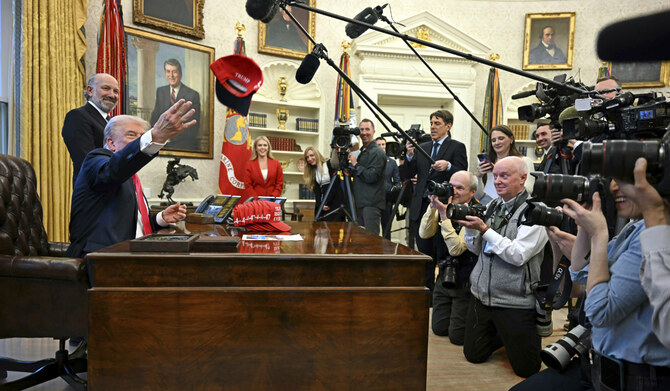
President Donald Trump throws a hat that reads "Trump Was Right About Everything" as he talks to reporters while Commerce Secretary Howard Lutnick, and White House press secretary Karoline Leavitt, back center, watch, in the Oval Office at the White House in Washington, Tuesday, Feb. 25, 2025. (AP)
2 / 2
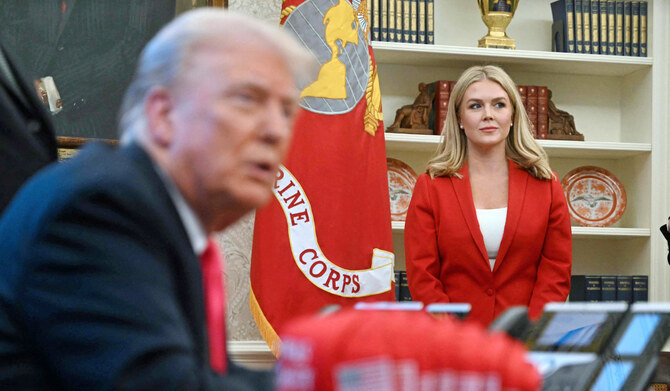
White House Press Secretary Karoline Leavitt (R) looks on as US President Donald Trump speaks to the press next to hats reading "Trump was right about everything", after signing an Executive Order at the Oval Office of the White House in Washington, DC on February 25, 2025. (AFP)
Short Url
Updated 26 February 2025
Follow

The White House says it ‘will determine’ which news outlets cover Trump, rotating traditional ones

  • “The White House press team, in this administration, will determine who gets to enjoy the very privileged and limited access in spaces such as Air Force One and the Oval Office,” Leavitt said at a daily briefing

WASHINGTON: The White House said Tuesday that its officials “will determine” which news outlets can regularly cover President Donald Trump up close — a sharp break from a century of tradition in which a pool of independently chosen news organizations go where the chief executive does and hold him accountable on behalf of regular Americans.
The move, coupled with the government’s arguments this week in a federal lawsuit over access filed by The Associated Press, represented an unprecedented seizing of control over coverage of the American presidency by any administration. Free speech advocates expressed alarm.
White House press secretary Karoline Leavitt said the changes would rotate traditional outlets from the group and include some streaming services. Leavitt cast the change as a modernization of the press pool, saying the move would be more inclusive and restore “access back to the American people” who elected Trump. But media experts said the move raised troubling First Amendment issues because the president is choosing who covers him.
“The White House press team, in this administration, will determine who gets to enjoy the very privileged and limited access in spaces such as Air Force One and the Oval Office,” Leavitt said at a daily briefing. She added at another point: “A select group of D.C.-based journalists should no longer have a monopoly of press access at the White House.”
Leavitt said the White House will “double down” on its decision to bar the AP from many presidential events, a departure from the time-tested and sometimes contentious practice for more than a century of a pool of journalists from every platform sharing the presidents’ words and activities with news outlets and congressional offices that can’t attend the close-quarter events. Traditionally, the members of the pool decide who goes in small spaces such as the Oval Office and Air Force One.
“It’s beyond time that the White House press operation reflects the media habits of the American people in 2025, not 1925,” Leavitt said.
At an event later in the Oval Office, the president linked the AP court case with the decision to take control of credentialing for the pool. “We’re going to be now calling those shots,” Trump said.
There are First Amendment implications
The change, said one expert on presidents and the press, “is a dangerous move for democracy.”
”It means the president can pick and choose who covers the executive branch, ignoring the fact that it is the American people who through their taxes pay for the running of the White House, the president’s travels and the press secretary’s salary,” Jon Marshall, a media history professor at Northwestern University and author of “Clash: Presidents and the Press in Times of Crisis,” said in a text.
Eugene Daniels, president of the White House Correspondents’ Association, said the organization consistently expands its membership and pool rotations to facilitate the inclusion of new and emerging outlets.
“This move tears at the independence of a free press in the United States. It suggests the government will choose the journalists who cover the president,” Daniels said in a statement. “In a free country, leaders must not be able to choose their own press corps.”
The Reporters Committee for Freedom of the Press called it “a drastic change in how the public obtains information about its government.”
“The White House press pool exists to serve the public, not the presidency,” Bruce D. Brown, the group’s president, said in a statement.
It comes in the context of a federal lawsuit
Leavitt spoke a day after a federal judge refused to immediately order the White House to restore the AP’s access to many presidential events. The news outlet, citing the First Amendment, sued Leavitt and two other White House officials for barring the AP from some presidential events over its refusal to call the Gulf of Mexico the “Gulf of America” as Trump ordered. AP has said its style would retain the “Gulf of Mexico” name but also would note Trump’s decision.
“As you know, we won that lawsuit,” Trump said incorrectly. In fact, US District Judge Trevor N. McFadden said the AP had not demonstrated it had suffered irreparable harm — but urged the Trump administration to reconsider its two-week-old ban, saying that case law in the circuit “is uniformly unhelpful to the White House.”
McFadden’s decision was only for the moment, however. He told attorneys for the Trump administration and the AP that the issue required more exploration before ruling. Another hearing was scheduled for late March.
The AP Stylebook is used by international audiences as well as those within the United States. The AP has said that its guidance was offered to promote clarity.
Another Trump executive order to change the name of the United States’ largest mountain back to Mount McKinley from Denali is being recognized by the AP Stylebook. Trump has the authority to do so because the mountain is completely within the country he oversees, AP has said.


Winter storm packing snow and strong winds to descend on Great Lakes, Northeast

Updated 30 December 2025
Follow

Winter storm packing snow and strong winds to descend on Great Lakes, Northeast

  • The fierce winds on Lake Erie sent water surging toward the basin’s eastern end near Buffalo, New York, while lowering water on the western side in Michigan to expose normally submerged lakebed — even the wreck of a car and a snowmobile

NEW YORK: A wild winter storm was expected to bring strong winds, heavy snow and frigid temperatures to the Great Lakes and Northeast on Tuesday, a day after a bomb cyclone barreled across the northern US and left tens of thousands of customers without power.
The storm that hit parts of the Plains and Great Lakes on Monday brought sharply colder air, strong winds and a mix of snow, ice and rain, leading to treacherous travel. Forecasters said it intensified quickly enough to meet the criteria of a bomb cyclone, a system that strengthens rapidly as pressure drops.
Nationwide, more than 127,000 customers were without power Tuesday morning, more than a third of them in Michigan, according to Poweroutage.us.

BACKGROUND

The storm that hit parts of the Plains and Great Lakes on Monday brought sharply colder air, strong winds and a mix of snow, ice and rain, leading to treacherous travel.

As the storm moved into Canada, the National Weather Service predicted more inclement weather conditions for the Eastern US, including quick bursts of heavy snow and gusty winds known as snow squalls. Blustery winds were expected to add to the arctic chill, with low temperatures dipping below freezing as far south as the Florida panhandle, the agency said.
New York Gov. Kathy Hochul warned that whiteout conditions were expected Tuesday in parts of the state, including the Syracuse metro area.
“If you’re in an impacted area, please avoid all unnecessary travel,” she said in a post on the social platform X.
Snow piled up quickly in Michigan’s Upper Peninsula on Monday, where as much as 2 feet (60 centimeters) fell in some areas, according to the National Weather Service. Meteorologist Ryan Metzger said additional snow was expected in the coming days, although totals would be far lighter.
Waves on Lake Superior that were expected to reach 20 feet (6 meters) on Monday sent all but one cargo ship into harbors for shelter, according to MarineTraffic.com.
The fierce winds on Lake Erie sent water surging toward the basin’s eastern end near Buffalo, New York, while lowering water on the western side in Michigan to expose normally submerged lakebed — even the wreck of a car and a snowmobile.
Kevin Aldrich, 33, a maintenance worker from Monroe, Michigan, said he has never seen the lake recede so much and was surprised on Monday to spot remnants of piers dating back to the 1830s. He posted photos on social media of wooden pilings sticking up several feet from the muck.
“Where those are at would typically be probably 12 feet deep,” he said. “We can usually drive our boat over them.”
Dangerous wind chills plunged as low as minus 30 F (minus 34 C) across parts of North Dakota and Minnesota on Monday. And in northeast West Virginia, rare, nearly hurricane-force winds were recorded on a mountain near Dolly Sods, according to the National Weather Service.
In Iowa, after blizzard conditions eased by Monday morning, high winds continued blowing snow across roadways, keeping more than 200 miles (320 kilometers) of Interstate 35 closed. State troopers reported dozens of crashes during the storm, including one that killed a person.
On the West Coast, the National Weather Service warned that moderate to strong Santa Ana winds were expected in parts of Southern California through Tuesday, raising concerns about downed trees in areas where recent storms had saturated the soil. Two more storms were forecast later this week, with rain on New Year’s Day potentially soaking the Rose Parade in Pasadena for the first time in about two decades.