The White House says it ‘will determine’ which news outlets cover Trump, rotating traditional ones

1 / 2
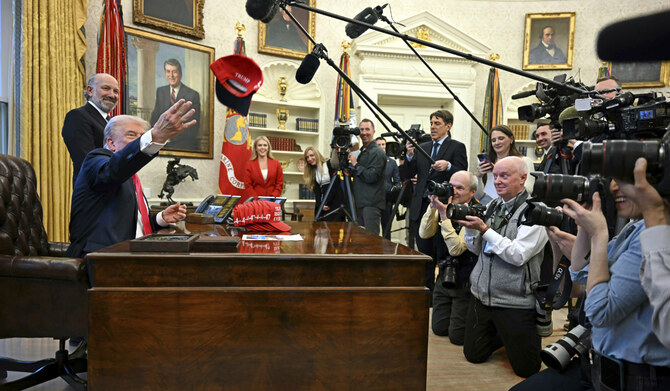
President Donald Trump throws a hat that reads "Trump Was Right About Everything" as he talks to reporters while Commerce Secretary Howard Lutnick, and White House press secretary Karoline Leavitt, back center, watch, in the Oval Office at the White House in Washington, Tuesday, Feb. 25, 2025. (AP)
2 / 2
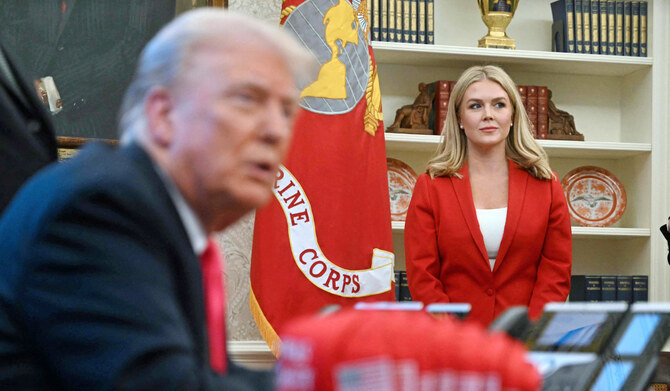
White House Press Secretary Karoline Leavitt (R) looks on as US President Donald Trump speaks to the press next to hats reading "Trump was right about everything", after signing an Executive Order at the Oval Office of the White House in Washington, DC on February 25, 2025. (AFP)
Short Url
Updated 26 February 2025
Follow

The White House says it ‘will determine’ which news outlets cover Trump, rotating traditional ones

  • “The White House press team, in this administration, will determine who gets to enjoy the very privileged and limited access in spaces such as Air Force One and the Oval Office,” Leavitt said at a daily briefing

WASHINGTON: The White House said Tuesday that its officials “will determine” which news outlets can regularly cover President Donald Trump up close — a sharp break from a century of tradition in which a pool of independently chosen news organizations go where the chief executive does and hold him accountable on behalf of regular Americans.
The move, coupled with the government’s arguments this week in a federal lawsuit over access filed by The Associated Press, represented an unprecedented seizing of control over coverage of the American presidency by any administration. Free speech advocates expressed alarm.
White House press secretary Karoline Leavitt said the changes would rotate traditional outlets from the group and include some streaming services. Leavitt cast the change as a modernization of the press pool, saying the move would be more inclusive and restore “access back to the American people” who elected Trump. But media experts said the move raised troubling First Amendment issues because the president is choosing who covers him.
“The White House press team, in this administration, will determine who gets to enjoy the very privileged and limited access in spaces such as Air Force One and the Oval Office,” Leavitt said at a daily briefing. She added at another point: “A select group of D.C.-based journalists should no longer have a monopoly of press access at the White House.”
Leavitt said the White House will “double down” on its decision to bar the AP from many presidential events, a departure from the time-tested and sometimes contentious practice for more than a century of a pool of journalists from every platform sharing the presidents’ words and activities with news outlets and congressional offices that can’t attend the close-quarter events. Traditionally, the members of the pool decide who goes in small spaces such as the Oval Office and Air Force One.
“It’s beyond time that the White House press operation reflects the media habits of the American people in 2025, not 1925,” Leavitt said.
At an event later in the Oval Office, the president linked the AP court case with the decision to take control of credentialing for the pool. “We’re going to be now calling those shots,” Trump said.
There are First Amendment implications
The change, said one expert on presidents and the press, “is a dangerous move for democracy.”
”It means the president can pick and choose who covers the executive branch, ignoring the fact that it is the American people who through their taxes pay for the running of the White House, the president’s travels and the press secretary’s salary,” Jon Marshall, a media history professor at Northwestern University and author of “Clash: Presidents and the Press in Times of Crisis,” said in a text.
Eugene Daniels, president of the White House Correspondents’ Association, said the organization consistently expands its membership and pool rotations to facilitate the inclusion of new and emerging outlets.
“This move tears at the independence of a free press in the United States. It suggests the government will choose the journalists who cover the president,” Daniels said in a statement. “In a free country, leaders must not be able to choose their own press corps.”
The Reporters Committee for Freedom of the Press called it “a drastic change in how the public obtains information about its government.”
“The White House press pool exists to serve the public, not the presidency,” Bruce D. Brown, the group’s president, said in a statement.
It comes in the context of a federal lawsuit
Leavitt spoke a day after a federal judge refused to immediately order the White House to restore the AP’s access to many presidential events. The news outlet, citing the First Amendment, sued Leavitt and two other White House officials for barring the AP from some presidential events over its refusal to call the Gulf of Mexico the “Gulf of America” as Trump ordered. AP has said its style would retain the “Gulf of Mexico” name but also would note Trump’s decision.
“As you know, we won that lawsuit,” Trump said incorrectly. In fact, US District Judge Trevor N. McFadden said the AP had not demonstrated it had suffered irreparable harm — but urged the Trump administration to reconsider its two-week-old ban, saying that case law in the circuit “is uniformly unhelpful to the White House.”
McFadden’s decision was only for the moment, however. He told attorneys for the Trump administration and the AP that the issue required more exploration before ruling. Another hearing was scheduled for late March.
The AP Stylebook is used by international audiences as well as those within the United States. The AP has said that its guidance was offered to promote clarity.
Another Trump executive order to change the name of the United States’ largest mountain back to Mount McKinley from Denali is being recognized by the AP Stylebook. Trump has the authority to do so because the mountain is completely within the country he oversees, AP has said.


Grief, trauma weigh on survivors of catastrophic Hong Kong fire

Updated 5 sec ago
Follow

Grief, trauma weigh on survivors of catastrophic Hong Kong fire

HONG KONG: Hong Kong fire survivor Yip Ka-kui has turned happy holiday photos into a heartfelt tribute to his beloved wife a month after she died in the huge blaze that destroyed their home.
Yip, 68, is among thousands grieving the 161 killed at the Wang Fuk Court housing complex, a disaster few could imagine happening in one of Asia’s safest and most developed cities.
Even as the Hong Kong government forges ahead with investigations and relief efforts, experts caution that the psychological scars will be hard to heal for survivors, bereaved families and onlookers alike.
In dozens of shots compiled into a memorial video, Yip’s wife of four decades, Pak Shui-lin, 66, gently smiles at the camera at the Pyramids of Giza, the Taj Mahal and the Eiffel Tower.
“I blame myself. I always feel I was late to warn her, so she couldn’t escape in time,” said retired engineer Yip, recalling how the couple tried to flee the burning building on November 26.
Flames quickly engulfed seven out of eight residential towers, which were undergoing renovations and wrapped in substandard netting that may have contributed to the fire’s spread.
Yip got out first. When the fire alarms failed to sound, his wife knocked on neighbors’ doors to warn them, according to one person she saved.
Yip said he did not think Pak was trying to “exchange one life for another,” only that she was “doing what needed to be done.”
“The difference of a few minutes between us means that I will never see her again. That’s what I can’t accept.”

Like fighting a war ‘every day’ 

Not long after the fire started, counselling psychologist Isaac Yu helped organize dozens of others in his field to support displaced residents.
“The scale, immediacy and level of shock of this (incident) were beyond” anything they had trained for, Yu said.
Those who lost everything might have appeared calm at first, he recalled, but the fear was that they would break down during quiet moments and develop post-traumatic stress disorder.
NGOs such as the Samaritan Befrienders have contacted bereaved families to offer free mental-health services, with additional support available in transitional housing and schools, authorities said.
Many of Hong Kong’s 7.5 million residents obsessively followed live updates of the fire, which could have caused them mental strain, Yu added.
“For those who don’t actively seek help, I’m worried about missing the chance to intervene, which may lead to more serious mental health problems and tragedies,” he said.
Johnson Wong, a 51-year-old business manager, told AFP that his family struggled to process their grief while two of their relatives remained unaccounted for.
While most of the bodies have been identified, some remains have turned to ash and time-consuming DNA tests are needed, police said, adding the death toll could rise further.
Wong’s wife, a nurse, had hoped that her mother and sister would survive. But her worst fears were all but confirmed when she was shown pictures of two charred bodies found inside their flat.
“If the (DNA test) is a match, that marks an ending. But if not, what can we do?” Wong said, adding that the fire had likely deprived his niece, a university student, of her only remaining parent.
“Every day we have been fighting a war... It will take a long time to calm the family.”

‘Incomprehensible’ 

As Hong Kong marks the festive season, more than 4,600 people displaced by the fire still rely on temporary accommodation including hotels, according to Hong Kong’s government.
Some elderly people who were shunted into unfamiliar districts have had trouble adapting, according to local media.
Having moved in with his sons, Yip said his “unrealistic” wish was for his home to be rebuilt the way it was.
The government has yet to commit to renovating or knocking down the ruined estate, and industry figures say resettlement will take years.
On Tuesday, a judge-led committee visited the site as part of an investigation that is expected to yield a report in nine months.
Police said in early December that 21 people linked to various construction and contractor firms had been arrested, most for manslaughter and some for fraud. Those numbers have not been updated since.
Yip said he hoped the authorities would find the truth in the many “incomprehensible” aspects of the tragedy, but Wong was less sanguine.
“Getting an answer is better than none, but can it restore what we lost?” Wong said.
“What we need most are our family members. Two of them are gone.”