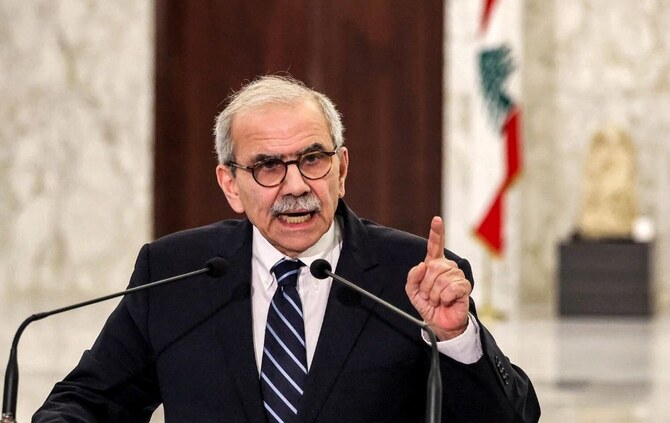
BEIRUT: Lebanon’s Prime Minister Nawaf Salam told the country’s parliament on Tuesday that his government “seeks a state that fully assumes responsibility for the country’s security and defends its borders and frontiers.”
He emphasized the need for a state that “deters aggressors, protects its citizens, fortifies independence, and mobilizes the Arab community and other nations to safeguard Lebanon.”
Salam reaffirmed the government’s “commitment to its obligations, particularly regarding the complete implementation of Resolution 1701, without any omissions or selective adherence.”
The prime minister said: “The government is committed, under the National Accord Document ratified in Taif, to take all necessary measures to liberate all Lebanese territories from the Israeli occupation and assert the state’s sovereignty over all its territories, exclusively through its forces, and deploy the army in the internationally recognized Lebanese border areas.”
At the same time, he underscored “Lebanon’s right to self-defense in the event of any aggression, following the UN charter, and to implement the provisions outlined in the presidential oath regarding the state’s responsibility to monopolize the use of force.”
Salam continued: “We want a state that has the power to decide war and peace, a state whose army has a defensive combat doctrine that protects the people and fights any war in accordance with the provisions of the constitution.”
The prime minister highlighted “the need to rebuild what the Israeli enemy destroyed,” pledging “to mobilize support and allocate funding through a dedicated, transparent reconstruction fund that demonstrates the state’s support for the people, ensuring they feel included and not discriminated against.”
He emphasized that “defending Lebanon requires a national security strategy on the military, diplomatic and economic levels.”
Salam said: “The government must empower the legitimate armed forces by increasing their numbers, equipping and training them, and improving their conditions, which strengthens their capabilities to confront any aggression, secure the borders to the south, north, east and sea, prevent smuggling, and combat terrorism.
“We want a state that upholds the constitution and the National Reconciliation Accord we endorsed in the Taif Agreement. This commitment requires the implementation of the remaining provisions of this accord that have yet to be carried out.”
Salam said: “The rise of the state necessitates a foreign policy that neutralizes Lebanon from the conflict of axes, which contributes to restoring its international and Arab status, and secures the support of our brotherly and friendly capitals and Arab and international organizations.”
He stressed that “Lebanon must not be used as a platform to attack our brotherly Arab countries and friendly nations.”
Regarding Lebanese-Syrian relations, Salam said Lebanon “has an opportunity to initiate a serious dialogue with the Syrian Arab Republic.
“This dialogue aims to ensure the sovereignty and independence of both nations, regulate and demarcate their borders, and prevent interference in each other’s internal affairs.
“It also aims to address the issue of Syrian refugees, whose continued presence could have existential consequences for Lebanon unless they return to their homeland.”
Salam also expressed Lebanon’s opposition to “the localization and displacement of Palestinians.
“We reiterate their right to return to their homes per Resolution 194 and to establish an independent state on their land as outlined in the Arab Peace Initiative adopted at the Beirut Arab League Summit in 2002,” he said.
Salam underlined the Lebanese state’s right “to exercise full authority over its territory, including Palestinian refugee camps, while ensuring the protection of the dignity and human rights of Palestinian refugees residing in Lebanon.”
He stated his commitment “to pursuing a sound policy aimed at increasing revenues, maintaining solvency margin and thus, ensuring financial stability."
This, he said, requires tax collection and reform, customs reform, as well as “combatting waste, illegal economy and smuggling.”
Salam announced that his government intends to negotiate a new program with the International Monetary Fund to address financial defaults and public debt.
“The government is committed to boosting the economy, which will involve restructuring the banking sector to stimulate economic growth. Our primary care will be directed toward deposits, and we will develop an integrated plan following the highest international standards to preserve the depositors’ rights,” he said.
Salam expressed hope that parliament would pass the necessary legislation to support these goals.
More than 75 MPs requested the opportunity to comment on the ministerial statement, based on which Salam’s government is expected to obtain a vote of confidence.
In the first session, Hezbollah's parliamentary bloc announced through its head, Mohammed Raad, its agreement to give the government a vote of confidence.
Free Patriotic Movement MP Gebran Bassil, formerly allied with Hezbollah, announced that he would not give the government his vote of confidence despite agreeing with its statement “regarding Resolution 1701, the liberation of the land, the state’s exclusive rights to arms, and the authority to decide on war and peace.”
In a clear stance, he called for “disarming Palestinian camps,” stressing that “there is no justification for the continued presence of any Syrian refugee in Lebanon.”


![]()


We want a state that can protect its people, Lebanese PM tells parliament
Short Url
https://arab.news/bc96q
We want a state that can protect its people, Lebanese PM tells parliament
- PM Salam reiterates President Aoun’s stance reserving use of force for the state
- Hezbollah announces intention to back government in vote of confidence


US transfers thousands of Daesh detainees from Syria to Iraq
BAGHDAD: The United States Central Command said it has completed the transfer of more than 5,700 detained Daesh group suspects from Syria to Iraq.
The detainees from some 60 countries had for years been held in Syrian prisons run by Kurdish-led forces before the recapture of surrounding territory by Damascus prompted Washington to step in.
CENTCOM said it “completed a transfer mission following a nighttime flight from northeastern Syria to Iraq on Feb 12 to help ensure Daesh detainees remain secure in detention facilities.”
“The 23-day transfer mission began on Jan 21 and resulted in US forces successfully transporting more than 5,700 adult male Daesh fighters from detention facilities in Syria to Iraqi custody,” it added in a statement.
The US had previously announced it would transfer around 7,000 detainees.
Daesh swept across Syria and Iraq in 2014, committing massacres and forcing women and girls into sexual slavery.
Backed by US-led forces, Iraq proclaimed the defeat of Daesh in the country in 2017, and the Kurdish-led Syrian Democratic Forces (SDF) ultimately beat back the group in Syria two years later.
The SDF went on to jail thousands of suspected jihadists and detain tens of thousands of their relatives in camps.
- 61 countries -
Last month, Syrian troops drove Kurdish forces from swathes of northern Syria, sparking questions over the fate of the Daesh prisoners.
Lingering doubts about security pushed Washington to announce it would transfer them to Iraq to prevent “a breakout” that could threaten the region.
“We appreciate Iraq’s leadership and recognition that transferring the detainees is essential to regional security,” said head of CENTCOM Admiral Brad Cooper.
“Job well done to the entire Joint Force team who executed this exceptionally challenging mission on the ground and in the air,” he added.
Iraq’s National Center for International Judicial Cooperation (NCIJC) said 5,704 Daesh detainees of 61 nationalities have arrived in Iraq.
They include 3,543 Syrians, 467 Iraqis, and another 710 detainees from other Arab countries.
There are also more than 980 foreigners including those from Europe, Asia, Australia and the United States.
The NCIJC said Iraq’s judiciary will interrogate the detainees before taking legal action against them.
Many prisons in Iraq are already packed with Daesh suspects.
Iraqi courts have handed down hundreds of death sentences and life terms to those convicted of terrorism offenses, including foreign fighters.
Under Iraqi law, terrorism and murder offenses are punishable by death, and execution decrees must be signed by the president.
The detainees in Syria were transferred to Baghdad’s Al-Karkh prison, once a US Army detention center known as Camp Cropper, where former ruler Saddam Hussein was held before his execution.
To make space for the newcomers, authorities moved thousands of prisoners from the Karkh prison to other facilities, a lawyer and an inmate told AFP on condition of anonymity.
- Repatriation -
Iraq has issued calls for countries to repatriate their nationals among the Daesh detainees, though this appears unlikely.
For years, Syria’s Kurdish forces also called on foreign governments to take back their citizens, but this was done on a small scale limited to women and children held in detention camps.
Most foreign families have left northeast Syria’s Al-Hol camp, which holds relatives of Daesh fighters, since the departure of Kurdish forces who previously guarded it, humanitarian sources told AFP on Thursday.
Last month, the Syrian government took over the camp from Kurdish forces who ceded territory as Damascus extended its control across swathes of Syria’s northeast.
The detainees from some 60 countries had for years been held in Syrian prisons run by Kurdish-led forces before the recapture of surrounding territory by Damascus prompted Washington to step in.
CENTCOM said it “completed a transfer mission following a nighttime flight from northeastern Syria to Iraq on Feb 12 to help ensure Daesh detainees remain secure in detention facilities.”
“The 23-day transfer mission began on Jan 21 and resulted in US forces successfully transporting more than 5,700 adult male Daesh fighters from detention facilities in Syria to Iraqi custody,” it added in a statement.
The US had previously announced it would transfer around 7,000 detainees.
Daesh swept across Syria and Iraq in 2014, committing massacres and forcing women and girls into sexual slavery.
Backed by US-led forces, Iraq proclaimed the defeat of Daesh in the country in 2017, and the Kurdish-led Syrian Democratic Forces (SDF) ultimately beat back the group in Syria two years later.
The SDF went on to jail thousands of suspected jihadists and detain tens of thousands of their relatives in camps.
- 61 countries -
Last month, Syrian troops drove Kurdish forces from swathes of northern Syria, sparking questions over the fate of the Daesh prisoners.
Lingering doubts about security pushed Washington to announce it would transfer them to Iraq to prevent “a breakout” that could threaten the region.
“We appreciate Iraq’s leadership and recognition that transferring the detainees is essential to regional security,” said head of CENTCOM Admiral Brad Cooper.
“Job well done to the entire Joint Force team who executed this exceptionally challenging mission on the ground and in the air,” he added.
Iraq’s National Center for International Judicial Cooperation (NCIJC) said 5,704 Daesh detainees of 61 nationalities have arrived in Iraq.
They include 3,543 Syrians, 467 Iraqis, and another 710 detainees from other Arab countries.
There are also more than 980 foreigners including those from Europe, Asia, Australia and the United States.
The NCIJC said Iraq’s judiciary will interrogate the detainees before taking legal action against them.
Many prisons in Iraq are already packed with Daesh suspects.
Iraqi courts have handed down hundreds of death sentences and life terms to those convicted of terrorism offenses, including foreign fighters.
Under Iraqi law, terrorism and murder offenses are punishable by death, and execution decrees must be signed by the president.
The detainees in Syria were transferred to Baghdad’s Al-Karkh prison, once a US Army detention center known as Camp Cropper, where former ruler Saddam Hussein was held before his execution.
To make space for the newcomers, authorities moved thousands of prisoners from the Karkh prison to other facilities, a lawyer and an inmate told AFP on condition of anonymity.
- Repatriation -
Iraq has issued calls for countries to repatriate their nationals among the Daesh detainees, though this appears unlikely.
For years, Syria’s Kurdish forces also called on foreign governments to take back their citizens, but this was done on a small scale limited to women and children held in detention camps.
Most foreign families have left northeast Syria’s Al-Hol camp, which holds relatives of Daesh fighters, since the departure of Kurdish forces who previously guarded it, humanitarian sources told AFP on Thursday.
Last month, the Syrian government took over the camp from Kurdish forces who ceded territory as Damascus extended its control across swathes of Syria’s northeast.
Latest updates


Recommended


© 2026 SAUDI RESEARCH & PUBLISHING COMPANY, All Rights Reserved And subject to Terms of Use Agreement.