

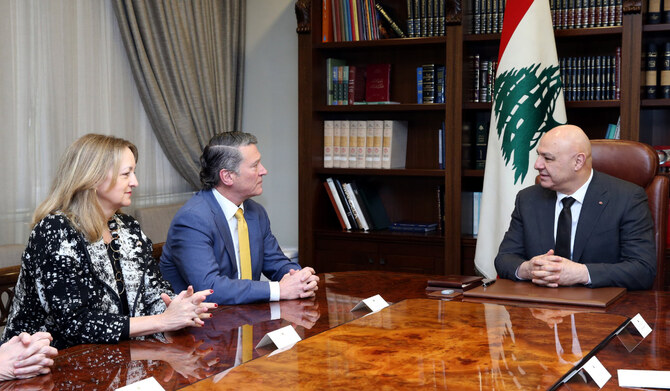

BEIRUT: The US “wants to witness a new era of peace and stability in Lebanon and the Middle East amid the many changes happening in the region,” US Congressman Ronny Jackson said in Beirut on Saturday.
His assurance came during a meeting with Lebanese President Joseph Aoun as US diplomatic efforts toward Lebanon continued with government leaders seeking US intervention to pressure Israel into withdrawing from the five strategic hills it still occupies.
President Aoun received US Congressman Darrell Issa and his delegation on Friday evening.
Following the meeting, Darrell said that UN Resolution 1701 had taken years to reach the stage where it was at today.
“However, in less than 60 days, we witnessed a quasi-full cooperation between both the Lebanese and Israeli sides.”
He added that the Israelis withdrew from most Lebanese territories, except for five areas. The Lebanese Army has strengthened its control over the Lebanese lands.
“However, what has not yet happened, and what I discussed with President Aoun and other leaders this week, is the destruction of large weapon depots.
“Every day, there are explosions due to the destruction of weapons and the discovery of new tunnels full of firearms.
“Therefore, there will be a longer transitional period to eliminate the arms,” Issa said.
“Both sides understand that the full implementation of resolution 1701 will eventually take place, which includes Israel’s return to historically recognized borders, ensuring both Lebanese and Israeli sides can live without the fear of crossing each other’s borders with weapons.”
Amid the diplomatic drive, Lebanese Army Command requested to “retain the majority of military personnel of all ranks on duty on Sunday, Feb. 23.”
The military move is in parallel with the funeral proceedings of former Hezbollah chiefs Hassan Nasrallah and Hashem Safieddine, five months after their assassination in Israeli raids on Beirut’s southern suburbs.
The Lebanese state has officially become involved in the funeral proceedings of Nasrallah and Safieddine through the direct supervision of the security leadership.
The security chiefs attended Friday’s meeting led by President Aoun.
The army command has also moved to suspend all drone permits issued in Beirut and its surrounding areas.
It had previously announced that there would be a temporary freeze on all firearm permits, while Hezbollah “strictly prohibited its supporters from firing shots during the funeral proceedings.”
The Israeli threat remained a key concern for both the organizers and participants in the funeral proceedings, especially since Israeli violations of the ceasefire agreement have not ceased.
The Israeli army opened fire at a car on the outskirts of the border village of Houla, setting it ablaze.
An Israeli military drone launched a stun grenade near a citizen on a farm on the outskirts of Kfarchouba.
The General Directorate of Internal Security implemented special traffic measures ahead of the funeral of Nasrallah and Safieddine, which began on Friday night and will continue until the end of the funeral, “as large numbers of citizens are expected to attend.”
Hezbollah’s higher committee for the funeral (of Nasrallah) finalized the arrangements for the proceedings, scheduled to begin at 1 p.m. and conclude at 4 p.m. at the Camille Chamoun sports stadium at the southern entrance to Beirut.
The procession will then reach the old airport road, where Nasrallah will be laid to rest.
Hussein Fadlallah, the head of the committee, described the funeral as an “exceptional event that the world would not forget.”
Meanwhile, information about official attendees continued to surface.
It was confirmed on Saturday that Parliament Speaker Nabih Berri would attend the funeral in person.
An Iranian official said Foreign Minister Abbas Araghchi would also attend.
Al-Masirah TV, affiliated with Yemen’s Ansar Allah movement, reported that “a high-level delegation departed from Sanaa International Airport to attend the funeral, led by Yemen’s Grand Mufti Shams Al-Din Sharaf Al-Din.”
A security source told Arab News: “Delegations from Tehran will arrive in Beirut via a third country. This is due to Lebanon’s suspension of flight permissions for Iranian planes to land at Beirut Rafic Hariri International Airport, following Israeli threats to target the airport.”
The source said: “The news circulating among Hezbollah’s supporters about 400,000 travelers arriving at the airport for Nasrallah’s funeral is highly exaggerated. This number requires at least 2,000 planes to transport them from abroad.
“We estimate that the number of arrivals from abroad until Friday night does not exceed 40,000, half Lebanese citizens.”
Lebanese citizens holding French citizenship received a text message from the French Consulate in Beirut urging “all its (French) nationals in Lebanon to refrain from using the airport road and limit their movements on Sunday.”
Hezbollah invited numerous social media influencers, both Arab and foreign, to cover the funeral.
These include Americans such as Jackson Hinkle, as well as Europeans, Latin Americans, Iraqis, Yemenis, Palestinians, Algerians and Bahrainis.
Media coverage was organized for them in the southern suburbs of Beirut and several southern border towns, providing them with materials, images and statements that were made available to various journalists, focusing on resistance and the devastation caused by the Israeli enemy.
Social media platforms witnessed the emergence of pages dedicated to the occasion, encouraging people to participate in the funeral, which is regarded as a “day of farewell.”
This call to action comes amid challenging weather conditions, particularly as a polar storm has affected Lebanon since Saturday.
The storm has resulted in road closures from the Bekaa and southern regions toward the capital due to snow and ice accumulation, with temperatures dropping to unprecedented levels.
Wounded members of Hezbollah, who sustained injuries to their eyes and limbs from pager explosions, participated in these calls to the public.


