Russia security chief meets Prabowo in Indonesia

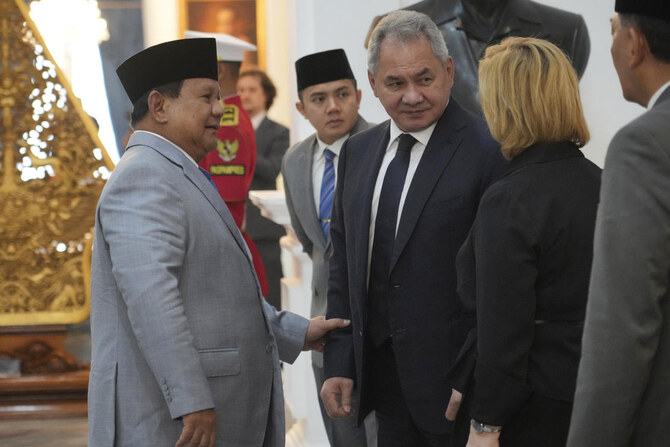
Indonesian President Prabowo Subianto, left, talks with Russian Security Council Secretary Sergei Shoigu, center, after a meeting at Merdeka palace in Jakarta on Feb. 25, 2025. (AP)
Short Url
Updated 25 February 2025
Follow

Russia security chief meets Prabowo in Indonesia

  • Southeast Asia’s biggest economy maintains a neutral foreign policy
  • In November, Indonesia and Russia held their first joint naval drills

JAKARTA: Top Russian security official Sergei Shoigu held talks in Indonesia with President Prabowo Subianto and his defense minister on Tuesday, as Moscow and Jakarta seek to boost defense ties.
Southeast Asia’s biggest economy maintains a neutral foreign policy, refusing to take sides in the Ukraine conflict or in the great power competition between the United States and China.
Shoigu, Russia’s former defense minister and now secretary of its Security Council, is seen as influential in the decision to send Russian troops into Ukraine in 2022 and is a staunch ally of President Vladimir Putin.
He met Defense Minister Sjafrie Sjamsoeddin for a courtesy call in the capital Jakarta on Tuesday morning, Indonesia’s defense ministry said in a statement.
Prabowo then received Shoigu at the presidential palace on Tuesday afternoon, the presidential palace said in a statement.
“This visit marks an important moment in strengthening bilateral relations between Indonesia and Russia, particularly in the fields of security and defense,” the statement said.
“They discussed various strategic issues related to bilateral relations and regional security.”
The palace said the visit opened up “broader opportunities for future cooperation” with both sides committed to “strengthening their strategic partnership.”
Recently inaugurated Prabowo has pledged to be bolder on the world stage and visited Moscow in July for talks with Putin.
In November, Indonesia and Russia held their first joint naval drills.
Russia sent three corvette-class warships, a medium tanker ship, a military helicopter, and a tugboat for the drills held in the east of Indonesia’s main island Java.
Jakarta has billion-dollar trade ties with Moscow, yet major arms imports have stalled in recent years after Russia seized Crimea in 2014 and launched its offensive on Ukraine.
Still, since becoming defense minister in 2019, Prabowo has kept alive a $1.1 billion Russian fighter jet deal agreed a year earlier, despite the reported threat of US sanctions.


The UN aid coordination agency cuts its funding appeal after Western support plunges

Updated 3 sec ago
Follow

The UN aid coordination agency cuts its funding appeal after Western support plunges

GENEVA: The UN’s humanitarian aid coordination office is downsizing its appeal for annual funding in 2026 after support this year, mostly from Western governments, plunged to the lowest level in a decade.
The United Nations Office for the Coordination of Humanitarian Affairs said Monday it was seeking $33 billion to help some 135 million people cope with fallout from wars, climate disasters, earthquakes, epidemics and food shortages. This year, it took in $15 billion, the lowest level in a decade.
The office says next year it wants more than $4.1 billion to reach 3 million people in Palestinian areas, another $2.9 billion for Sudan — home to the world’s largest displacement crisis — and $2.8 billion for a regional plan around Syria.
“In 2025, hunger surged. Food budgets were slashed — even as famines hit parts of Sudan and Gaza. Health systems broke apart,” said OCHA chief Tom Fletcher. “Disease outbreaks spiked. Millions went without essential food, health care and protection. Programs to protect women and girls were slashed, hundreds of aid organizations shut.”
The UN aid coordinator sought $47 billion for this year and aimed to help 190 million people worldwide. Because of the lower support, it and humanitarian partners reached 25 million fewer people this year than in 2024.
The donor fatigue comes as many wealthy European countries face security threats from an increasingly assertive Russia on their eastern flank and have experienced lackluster economic growth in recent years, putting new strains on government budgets and the consumers who pay taxes to sustain them.
“I know budgets are tight right now. Families everywhere are under strain,” Fletcher said. “But the world spent $2.7 trillion on defense last year – on guns and arms. And I’m asking for just over 1 percent of that.”
The UN system this year has slashed thousands of jobs, notably at its migration and refugee agencies, and Secretary-General António Guterres’ office has launched a review of UN operations — which may or may not produce firm results.
Fletcher, who answers to Guterres, has called for “radical transformation” of aid by reducing bureaucracy, boosting efficiency and giving more power to local groups. Fletcher cited “very practical, constructive conversations” almost daily with the Trump administration.
“Do I want to shame the world into responding? Absolutely,” Fletcher said. “But I also want to channel this sense of determination and anger that we have as humanitarians, that we will carry on delivering with what we get.”