

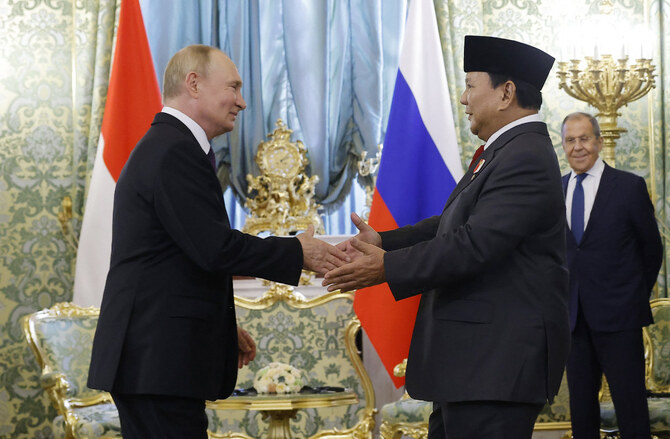

JAKARTA: Indonesia’s first joint military drills with Russia this week signal that new President Prabowo Subianto will seek a bigger role for Jakarta on the world stage as part of a significant foreign policy shift, analysts say.
Indonesia has long maintained a neutral foreign policy and refuses to take sides in the Russia-Ukraine conflict or US-China rivalry, but Prabowo has called for stronger ties with Moscow despite Western pressure on Jakarta.
“It is part of a broader agenda to elevate ties with whomever it may be, regardless of their geopolitical bloc, as long as there is a benefit for Indonesia,” said Pieter Pandie, researcher at the Center for Strategic and International Studies.
The southeast Asian ASEAN bloc, which Indonesia is a member of, held joint drills with Russia in 2021, but individual member nations have never held joint exercises with Moscow.
Jakarta has billion-dollar trade ties with Moscow, but major arms imports have stalled in recent years, according to weapons watchdog SIPRI, following Western sanctions on Russia after it seized Crimea in 2014 and invaded Ukraine in 2022.
Still, Prabowo has kept alive a $1.1 billion Russian fighter jet deal he agreed in 2018 as defense minister, despite the reported threat of US sanctions.
Jakarta also refused to budge when Western nations lobbied Indonesia to disinvite Russia from the G20 summit it hosted in 2022.
Prabowo met Russian President Vladimir Putin at the Kremlin in July, later announcing joint naval drills that experts say indicate how Moscow will grow in significance as part of a broader foreign policy.
The five-day drills begin Monday in eastern Java where Moscow will send three corvette-class warships, a medium tanker ship, a military helicopter, and a tug boat.
“They reaffirm that we will not alienate one or two countries in the geopolitical arena,” said Anton Aliabbas, professor at the Paramadina Graduate School of Diplomacy.
Diversifying partners
During his Kremlin visit, Prabowo — a 73-year-old ex-general — said he wanted to deepen the relationship with Russia.
“We consider Russia as a great friend and I would like to continue to maintain and enhance this relationship,” Prabowo told Putin.
Before his inauguration last month, Prabowo said he wanted to build a “web of strong friendships.”
To that end he visited more than a dozen countries including China and Australia, where he struck a key security deal, and Jakarta has since kickstarted a process to join the BRICS group of emerging economies.
The new leader has already been tested at sea, with a Chinese coast guard vessel being driven away three times from Indonesian-claimed waters by Jakarta’s ships last month.
For Indonesia, the chance to host one of the world’s most advanced navies is clear.
It will allow “capacity building to be obtained” and for Jakarta to “exchange ideas” on maintaining Russian equipment it already owns, said Curie Maharani Savitri.
Indonesia has Russian-made amphibious tanks, helicopters, missiles and fighter jets in its arsenal.
Different goals
Jakarta and Moscow have different maritime goals, with Indonesia facing threats of smuggling and piracy while Russia is looking for willing allies.
Pieter said he expects the exercises to not be as advanced as annual Super Garuda Shield drills Indonesia hosts with the US and other allies.
“I think it’s an introductory phase to the military relationship between the two, especially on the naval side,” he said.
But the drills may still raise eyebrows in Washington, which has been trying to diplomatically isolate Russia.
The US embassy in Jakarta declined to comment on the drills.
For Prabowo they allow him to send a message about his new policy in the early days of his presidency, said Pieter.
“Historically, the US has been the partner of choice for military exercises. But... Indonesia has been trying to diversify its partners,” he said.
“And I think there’s an overall bigger trend of that.”


