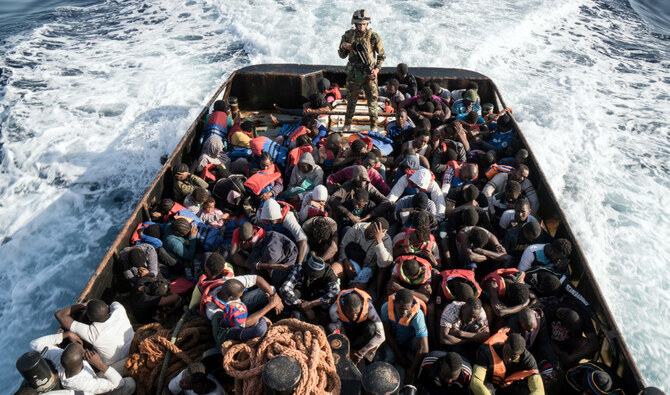

LONDON: From the orange desert sand of southeast Libya, investigators were met with the unmistakable signs of yet another cruel atrocity. In crude pits dug in this remote expanse, the tattered clothing and yellowing remains of multiple victims emerged from the earth.
The recent discovery of these latest mass graves in the troubled North African country has laid bare the horrific human cost of the migration crisis, exposing the ruthless exploitation of vulnerable people and the complicity of states and armed groups in perpetuating this grim cycle.
For years, Libya has functioned as a key transit hub for migrants attempting to reach Europe, but for thousands, the journey ends not with the hope of a new life, but with torture, enslavement, and, in the case of those found in these desert graves, even death.

The recent discovery of these latest mass graves in the troubled North African country has laid bare the horrific human cost of the migration crisis. (Reuters/File)
The latest mass graves are not isolated tragedies. They are the consequence of a system designed to control migration at any cost — no matter, it would seem, how many bodies it leaves behind.
In early February, the UN’s International Organization for Migration (IOM) confirmed the existence of two mass graves in Libya — one in Jakharrah, around 400 kilometers south of Benghazi, containing 19 bodies, and another in the Kufra desert in the southeast, where at least 30 and possibly up to 70 were found.
The victims’ identities remain unknown, but evidence suggests they were murdered, as many of the bodies had gunshot wounds. These graves, found near known migrant detention centers, provide further proof of the extreme abuses suffered by migrants on Libyan soil.
“The loss of these lives is yet another tragic reminder of the dangers faced by migrants embarking on perilous journeys,” Nicoletta Giordano, IOM’s Libya chief of mission, said in a statement.
“Far too many migrants along these journeys endure severe exploitation, violence, and abuse, underscoring the need to prioritize human rights and protect those at risk.”
FASTFACTS
• Collapse of Muammar Qaddafi’s regime in 2011 amid a NATO-backed uprising plunged Libya into chaos.
• Desert borders with Chad, Niger, Sudan, Egypt, Algeria and Tunisia make Libya a migrant gateway to Europe.
• Critics say externalization of migrant problem allows Europe to distance itself from abuses in Libya.
These latest discoveries follow years of similar grim findings. In March 2024, another mass grave containing the bodies of 65 migrants was uncovered in the country’s southwest. Yet, despite mounting evidence of the scale of abuse and killings, little has changed.
The international response has been slow, and Libya’s fractured governance has allowed human trafficking networks to flourish with near-total impunity.
For more than a decade, Libya has been at the center of a human trafficking and smuggling network with tentacles reaching across continents.

The country’s vast desert borders with Chad, Niger, Sudan, Egypt, Algeria and Tunisia make it an attractive gateway for those seeking to reach Europe. (AFP/File)
The collapse of Muammar Qaddafi’s regime in 2011 amid a NATO-backed uprising plunged the country into chaos, creating a lawless environment where armed groups, militias, and even government officials have profited from the suffering of migrants.
The country’s vast desert borders with Chad, Niger, Sudan, Egypt, Algeria and Tunisia make it an attractive gateway for those seeking to reach Europe, but they also make it a potential death trap for those who fall into the hands of traffickers.
“Libya’s trafficking networks aren’t just criminal enterprises — they’re institutionalized businesses involving state officials, armed groups, and even those tasked with stopping them,” Anas El-Gomati, director general of the Sadeq Institute, a Libyan think tank, told Arab News.
“Take Kufra, where these graves were found. It’s under the Libyan National Army and Khalifa Haftar’s control, yet these operations continue openly. Why? Because trafficking isn’t a bug in the system; it’s a feature.”
Migrants attempting to cross Libya are often captured, detained, and forced into brutal conditions. Some are held in unofficial prisons run by militias, where they often face beatings, torture, rape and forced labor.

For thousands, the journey ends not with the hope of a new life, but with torture, enslavement, and, in the case of those found in these desert graves, even death. (AFP/File)
Others are extorted, as families back home are contacted and pressured to pay ransoms for their release. If no ransom is forthcoming, migrants may be sold into slavery, trafficked again, or simply executed.
Tim Eaton, a senior research fellow at Chatham House, explains that human smuggling in Libya operates within a broad ecosystem of corruption and armed conflict.
“It’s not just about a highly integrated set of traffickers — though of course those traffickers exist. It’s more widely about that system, and it’s about the profits and the rents that are distributed throughout it,” he told Arab News.
“Armed groups are benefiting from both sides of the ledger — from facilitating smuggling to a degree and from the use of abusive patterns to extract labor and other things from the migrants. Plus they are able to get legitimacy and financial support from European policymakers for their work.”
Indeed, this cycle of abuse is fueled, in part, by European migration policies that even mainstream political parties now say should prioritize reducing the number of arrivals over the safeguarding of human lives.
Some say EU migration policies have played a significant role in shaping the crisis in Libya. Their argument: by outsourcing border control to Libyan authorities and funding the Libyan Coast Guard, the EU has effectively helped sustain a system that facilitates human trafficking rather than dismantling it.
Migrants intercepted at sea are often returned to detention centers where they are subjected to further abuse. “The most troubling part? The same forces receiving EU money to ‘combat trafficking’ are often the ones profiting from it,” said El-Gomati.

“It’s a lucrative cycle: intercept migrants, detain them, extort them, and sometimes traffic them again. All while Europe looks the other way, preferring to keep migrants out at any cost.”
This strategy of externalization has allowed European governments to distance themselves from the abuses occurring in Libya, while still benefiting from the reduction in irregular migration. The price of this policy is paid in human lives.
According to the UN, more than 2,200 people died or went missing in the Mediterranean in 2024 alone, and many more perished before ever reaching the coast.
The mass graves in Libya are a grim testament to the need for reform. Experts argue that without meaningful intervention, these tragedies will continue. But what should that intervention look like?
“The solution isn’t more boats for the Libyan Coast Guard or more funding for detention centers,” said El-Gomati. “We need a complete overhaul of the system.
“First, stop treating Libya as Europe’s border guard. Second, create safe, legal migration pathways. Third, implement real accountability — not just for low-level traffickers, but for the officials and armed groups running these networks.”

Migrants attempting to cross Libya are often captured, detained, and forced into brutal conditions. (AFP/File)
This may be wishful thinking, however, as across Europe and in the UK, public tolerance for immigration — both regular and irregular — seems to be at an all-time low. Eaton, nevertheless, agrees that securitization alone is not enough.
“Up until now, really, the prevailing approach has been to securitize this problem, to say that this is a rule of law issue, that the borders need to be enforced, that criminals need to be imprisoned. But in reality, that can never address all of the aspects of this ecosystem,” he said.
Instead, Eaton suggests a long-term solution must involve addressing the economic and political incentives that sustain human trafficking in Libya.
“If it’s going to be possible to convince Libyans who live in those areas to transition away from those sources of revenue, then clearly part of this is going to be looking at other, softer approaches, such as local economic development and finding pathways and alternatives for those people from these areas to find other sources of revenue,” he said.
Beyond Libya, experts want to see broader international cooperation to tackle the root causes of migration. Many of those who embark on these dangerous journeys are fleeing war, poverty, and persecution. Without addressing these underlying factors, aid agencies believe no amount of border security will stop people from risking everything for a chance at a better life.

Some say EU migration policies have played a significant role in shaping the crisis in Libya. (AFP/File)
The mass graves found in Libya are not just evidence of individual crimes — they are perhaps symbolic of a system that has allowed mass killings, enslavement, and exploitation to become routine.
Each person buried in these graves once dreamed of something better, who risked everything for a future that was denied to them.
Until there is the political will to dismantle trafficking networks, hold perpetrators accountable, and provide safe migration routes, it is highly likely that many more bodies will turn up in the desert and Libya will remain a hostage to criminality.