Lebanese government expected to win vote of confidence

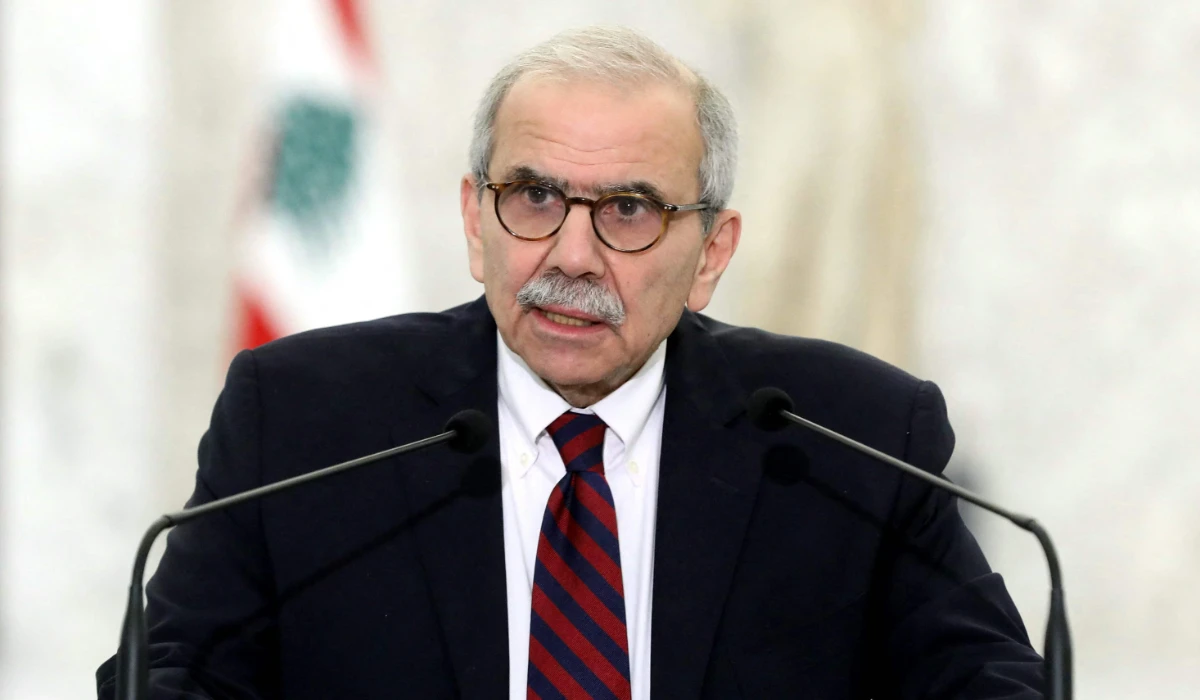
Prime Minister Nawaf Salam delivering a statement to the press at the presidential palace in Baabda, east of Beirut on February 8, 2025. (AFP)
Short Url
Updated 24 February 2025
Follow

Lebanese government expected to win vote of confidence

  • Lebanon will remain a bridge between East and West, Aoun assures Francophone ambassadors
  • President to hold Saudi talks next week once MPs endorse ‘rescue and reform’ plan

BEIRUT: Lebanon’s Prime Minister Nawaf Salam will seek parliamentary approval for his government during sessions scheduled for Tuesday and Wednesday.

A political observer predicted that Salam’s government — operating under the slogan “Government of Rescue and Reform,” could secure up to 100 votes out of the 128-member parliament.

Winning the vote of confidence will allow Salam’s Cabinet to commence its sessions to make major decisions, including on appointments to the Lebanese Central Bank, the security forces, the judiciary and the general directorates within various government ministries.

FASTFACT

Lebanese Forces MP Fadi Karam, meanwhile, warned that Hezbollah ‘is not yet prepared to relinquish control to the Lebanese state.’

Currently, 63 MPs have requested to speak during the parliamentary debates.

Opposing votes will likely be limited to MPs from the Free Patriotic Movement bloc, which is not represented in the government and has positioned itself in opposition, along with a few reformist MPs.

A source from the presidential palace told Arab News on Monday that President Joseph Aoun would schedule foreign visits once Salam’s government wins the confidence vote.

One of the most significant foreign trips is a visit to Saudi Arabia next week, following an official invitation.

A ministerial delegation will accompany the president to discuss bilateral relations and avenues for cooperation in Saudi Arabia.

The source indicated that the visit will be confirmed on Thursday after the confidence vote.

On Monday, Aoun addressed a delegation of ambassadors from Francophone countries, saying that Lebanon will remain a bridge between East and West.

“French, the second language after Arabic in Lebanon, represents culture, dialogue, modernity, and values,” he told the ambassadors.

Salam, meanwhile, told a delegation from the diplomatic corps that his government “commits to restoring Lebanon’s standing among its Arab brethren and ensuring that it does not serve as a platform for attacks on Arab and friendly nations.”

Elsewhere, the speech delivered by Hezbollah Secretary-General Sheikh Naim Qassem on Sunday at the funeral ceremonies for former leaders Hassan Nasrallah and Hashem Safieddine elicited mixed political reactions.

UN Special Coordinator for Lebanon Jeanine Hennis-Plasschaert emphasized the necessity of commencing the “actual implementation of UN Resolution 1701 now on both sides of the Blue Line, as well as beyond the banks of the Litani River.”

The UN official added that “in Lebanon specifically, all necessary elements are present to achieve this, including a commitment to ensure that conflict does not return. However, the success of this process relies on its inclusivity, as each party has a fundamental role to play.”

Lebanese Forces MP Fadi Karam, meanwhile, warned that Hezbollah “is not yet prepared to relinquish control to the Lebanese state.”

He said the group was “attempting to navigate this challenging phase with minimal damage and losses while waiting for an unlikely breakthrough.

“The state must be solely responsible for establishing full national sovereignty over Lebanese territory,” he said.

“It must be the only authority to engage in negotiations, monopolize the use of weapons, liberate its land, and safeguard all of its borders.

“However, if Sheikh Qassim remains hard-headed and refuses to surrender the party’s weapons south and north of the Litani River, then any reconstruction plan will fail,” he added.


Oman and Lebanon call for full Israeli withdrawal, urge end to attacks

Updated 58 min 46 sec ago
Follow

Oman and Lebanon call for full Israeli withdrawal, urge end to attacks

  • Joseph Aoun and Sultan Haitham bin Tariq make a joint call for an immediate halt to Israeli attacks on Lebanese territory
  • Reaffirmation of the unified Arab position on ending the Israeli occupation and establishing an independent Palestinian state based on the 1967 borders

BEIRUT: Lebanese President Joseph Aoun and his Omani counterpart Sultan Haitham bin Tariq on Wednesday made a joint call for an immediate halt to Israeli attacks on Lebanese territory and a full withdrawal from all occupied Arab lands, warning that continued violations pose a direct threat to regional stability.

The statement came during a high-level summit in Muscat, where both leaders voiced “serious concern over the ongoing Israeli aggression” and described the occupation as a “clear violation” of UN Security Council Resolution 1701 and other international resolutions.

The two sides also expressed support for international efforts to de-escalate tensions, stabilize the situation on the ground, facilitate the return of displaced persons, and advance post-conflict reconstruction.

Aoun led a Lebanese ministerial delegation to Oman that included Lebanon’s ministers of foreign affairs, interior, defense, health, and agriculture for talks with Omani officials.

The joint statement emphasized the strengthening of bilateral ties and expanding cooperation in key sectors including politics, the economy, investment, banking, tourism, transport, and logistics.

Both sides called for early preparations to hold the first session of the Omani-Lebanese Joint Committee, chaired by the two foreign ministers in Muscat, and to pursue new agreements and memorandums of understanding intended to enhance collaboration in trade, culture, and science. The statement also highlighted the need to boost private sector engagement in shared development opportunities.

The Omani side reaffirmed its full support for Lebanon’s sovereignty, independence, and territorial integrity, as well as for strengthening Lebanese state institutions, particularly the army and legitimate security forces, and backing the country’s ongoing economic, financial, and administrative reforms.

The two sides reaffirmed the unified Arab position on ending the Israeli occupation and establishing an independent Palestinian state based on the 1967 borders, with East Jerusalem as its capital. They also underscored the importance of strengthening Arab solidarity, respecting the sovereignty of states, and upholding the principles of good neighborliness and international law.

Aoun’s official visit to Oman took place within the context of Muscat’s established role as a regional and international mediator. During his meetings, Aoun praised Oman’s diplomatic standing and approach, describing it as “wise and responsible.”

He commended Oman’s foreign policy, grounded in dialogue, mediation, balance, and good neighborliness, saying it had earned the sultanate a “distinguished status and a pivotal role in promoting stability and resolving conflicts through peaceful means.”

Aoun said that, in Lebanon, “we hold this wise approach in high regard and deeply value the sultanate’s steadfast support for Lebanon in various international forums, as well as its support as we confront the challenges before us.”

For his part, Sultan Haitham bin Tariq reaffirmed Oman’s continued commitment to Lebanon’s stability and its close monitoring of the latest developments in the country.

He emphasized the deep-rooted relations between the two countries and the importance of strengthening bilateral cooperation and coordination. The sultan also praised the positive contributions of the Lebanese community in Oman.

On the sidelines of the visit, Lebanese Interior Minister Ahmed Al-Hajjar held a meeting with his Omani counterpart Hamoud bin Faisal Al-Busaidi at Al-Alam Palace in Muscat. They underlined the enhancement of joint cooperation, particularly in security and policing.

According to a joint statement, the discussions also covered Lebanon’s efforts to consolidate internal security and maintain stability.

Participating on the Omani side in the expanded talks were Al-Busaidi; Shihab bin Tarik Al-Said, deputy prime minister for defense affairs; Badr bin Hamad Al-Busaidi, foreign minister of Oman; Hamad bin Said Al-Aufi, head of the private office; Mahad bin Said Ba’owain, minister of labor and head of the honorary mission; Saud bin Hamoud Al-Habsi, minister of agricultural, fisheries and water resources; and Hilal bin Ali Al-Sabti, minister of health.