

Pakistan forecasts rain, snowfall in northern and western regions this week

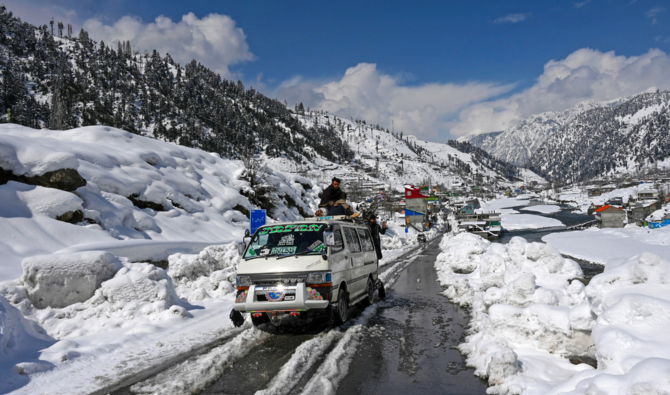
A van drives down a snow laden road in Kalam on March 4, 2024. (AFP/File)
Short Url
Updated 24 February 2025
Follow

Pakistan forecasts rain, snowfall in northern and western regions this week

  • The South Asian country last week received rains after a months-long drought severely dented winter crops in several areas
  • Authorities have warned of flash floods, landslides due to rains and urged citizens to exercise caution from Feb 24 till Mar. 1

ISLAMABAD: Pakistan’s National Disaster Management Authority (NDMA) on Monday forecast rain, wind, thunderstorms and snowfall in northern and western parts of the country till March 1, urging citizens to exercise caution during this period.

Parts of the South Asian country last week received rains after a months-long drought severely impacted crops like wheat, a staple food, as well as vital cash crops like potato in several regions, according to the Pakistani climate change ministry.

The Pakistan Meteorological Department (PMD) said rainfall from Sept. 1 to Jan. 15 was 40 percent below normal across Pakistan, with Sindh, Balochistan, and Punjab being the most affected provinces with deficits of 52 percent, 45 percent and 42 percent, respectively.

However, the NDMA says a strong westerly wave is expected to bring fresh rains, thunderstorms and snowfall in upper parts of the country between Feb. 24 and Mar. 1.

“Islamabad, upper Punjab, Pothohar Region, central and southern/northeastern Punjab, is expected to experience rain, wind, and thunderstorms accompanied by snowfall or hailstorms. Heavy rainfall may trigger flash floods in vulnerable areas,” the NDMA said in a statement.

“In Balochistan, rain, wind, and thunderstorms with snowfall over hills are anticipated in western, northwestern, and northern parts of the province, with the possibility of flash flooding in susceptible regions.”

Similarly, the Khyber Pakhtunkhwa (KP) province is likely to witness rains, winds and hailstorms along with snowfall over the hills in upper and western parts, including the Malakand and Hazara divisions, according to the NDMA.

In Gilgit-Baltistan (GB) and Azad Jammu and Kashmir (AJK), rain and snowfall are expected over the hills, which may disrupt travel and routine activities. Sindh is likely to experience mostly cold and dry weather throughout this period.

“Heavy rainfall in northern KP may lead to flash flooding and landslides,” the authority said. “The NDMA is closely monitoring the evolving situation and coordinating with relevant authorities to ensure timely response and mitigation efforts.”

Meanwhile, local authorities have issued warnings regarding potential hazards associated with the weather system, particularly the risk of heavy snowfall in Murree, Galliyat and other northern regions, which may impact travelers and tourists.


Pakistan PM orders accelerated privatization of power sector to tackle losses

Updated 15 December 2025
Follow

Pakistan PM orders accelerated privatization of power sector to tackle losses

  • Tenders to be issued for privatization of three major electricity distribution firms, PMO says
  • Sharif says Pakistan to develop battery energy storage through public-private partnerships

ISLAMABAD: Pakistan’s prime minister on Monday directed the government to speed up privatization of state-owned power companies and improve electricity infrastructure nationwide, as authorities try to address deep-rooted losses and inefficiencies in the energy sector that have weighed on the economy and public finances.

Pakistan’s electricity system has long struggled with financial distress caused by a combination of factors including theft of power, inefficient collection of bills, high costs of generating electricity and a large burden of unpaid obligations known as “circular debt.” In the first quarter of the current financial year, government-owned distribution companies recorded losses of about Rs171 billion ($611 million) due to poor bill recovery and operational inefficiencies, official documents show. Circular debt in the broader power sector stood at around Rs1.66 trillion ($5.9 billion) in mid-2025, a sharp decline from past peaks but still a major fiscal drain. 

Efforts to contain these losses have been a focus of Pakistan’s economic reform program with the International Monetary Fund, which has urged structural changes in the energy sector as part of financing conditions. Previous government initiatives have included signing a $4.5 billion financing facility with local banks to ease power sector debt and reducing retail electricity tariffs to support economic recovery. 

“Electricity sector privatization and market-based competition is the sustainable solution to the country’s energy problems,” Prime Minister Shehbaz Sharif said at a meeting reviewing the roadmap for power sector reforms, according to a statement from the prime minister’s office.

The meeting reviewed progress on privatization and infrastructure projects. Officials said tenders for modernizing one of Pakistan’s oldest operational hubs, Rohri Railway Station, will be issued soon and that the Ghazi Barotha to Faisalabad transmission line, designed to improve long-distance transmission of electricity, is in the initial approval stages. While not all power-sector decisions were detailed publicly, the government emphasized expanding private sector participation and completing priority projects to strengthen the electricity grid.

In another key development, the prime minister endorsed plans to begin work on a battery energy storage system with participation from private investors to help manage fluctuations in supply and demand, particularly as renewable energy sources such as solar and wind take a growing role in generation. Officials said the concept clearance for the storage system has been approved and feasibility studies are underway.

Government briefing documents also outlined steps toward shifting some electricity plants from imported coal to locally mined Thar coal, where a railway line expansion is underway to support transport of fuel, potentially lowering costs and import dependence in the long term.

State authorities also pledged to address safety by converting unmanned railway crossings to staffed ones and to strengthen food safety inspections at stations, underscoring broader infrastructure and service improvements connected to energy and transport priorities.