

Netanyahu says Israel won’t allow Syrian forces ‘south of Damascus’

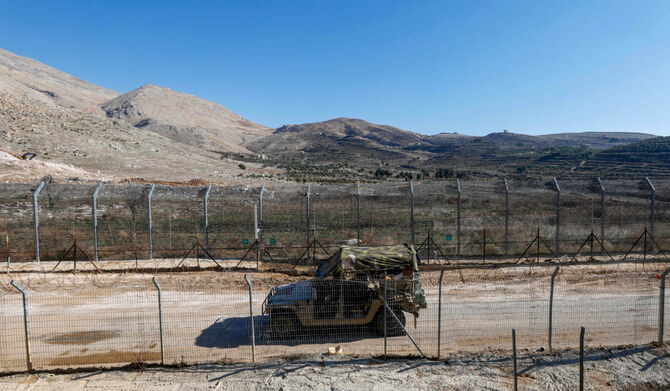
An Israeli army jeep drives in the buffer zone, which separates Israeli and Syrian forces on the Golan Heights, near the Druze village of Majdal Shams in the Israel-annexed Golan Heights on December 14, 2024. (AFP)
Short Url
Updated 24 February 2025
Follow

Netanyahu says Israel won’t allow Syrian forces ‘south of Damascus’

  • The same day Assad was ousted, Israel announced that its troops were entering a UN-patrolled buffer zone that has separated Israeli and Syrian forces on the strategic Golan Heights since 1974

JERUSALEM: Israeli Prime Minister Benjamin Netanyahu says Israel will not allow Syria’s new army or the insurgent group that led the ouster of former President Bashar Assad to “enter the area south of Damascus” as his government made clear Israeli forces would stay in parts of southern Syria for an indefinite period.
Netanyahu’s comments Sunday at a military graduation led to new concerns over the Israeli presence, and sway, in a swath of southern Syria as Damascus’ new leaders attempt to consolidate control after years of civil war.
“Take note: We will not allow HTS forces or the new Syrian army to enter the area south of Damascus,” Netanyahu said, referring to Syria’s new authorities as well as Hayat Tahrir Al-Sham, the main former rebel group.
“We demand the complete demilitarization of southern Syria in the provinces of Quneitra, Daraa and Suwayda from the forces of the new regime. Likewise, we will not tolerate any threat to the Druze community in southern Syria.”
There was no immediate response from Syrian authorities.
Defense Minister Israel Katz added that Israeli forces will remain on the peak of Mt. Hermon in southern Syria and in a buffer zone “for an indefinite period of time to protect our communities and thwart any threat.”
He said Israeli forces have built two posts on the mountain and another seven in the buffer zone “to ensure defense and offense against any challenge.”
After the fall of Assad in December, Israel seized the UN-patrolled buffer zone on Syrian territory. The zone was set up under a 1974 ceasefire agreement. Syria’s new authorities and UN officials have called for Israel to withdraw.
Meanwhile, Netanyahu’s government has been under pressure to protect Israelis living near border areas in the north.
Katz said Israel will “strengthen ties with friendly populations in the region,” notably the Druze, a religious minority who live in both southern Syria and in Israel’s Golan Heights, where Druze navigate their historically Syrian identity while living under Israeli rule.
“We will not tolerate any threat to the Druze community in southern Syria,” Netanyahu said.
More broadly, Israeli forces “will not allow hostile forces to establish themselves and be present in the security zone in southern Syria from here to Damascus. And we will act against any threat,” Katz said.


Israel’s hostage forum releases AI-generated video of last Gaza captive

Updated 23 December 2025
Follow

Israel’s hostage forum releases AI-generated video of last Gaza captive

  • The Gaza ceasefire, which came into effect in October, remains fragile with both sides alleging violations, and mediators fearing that Israel and Hamas alike are stalling

JERUSALEM: An Israeli group representing the families of Gaza hostages released on Tuesday an AI-generated video of Ran Gvili, the last captive whose body is still being held in the Palestinian territory.
The one-minute clip, created whole cloth using artificial intelligence, purports to depict Gvili as he sits in a Gaza tunnel and appeals to US President Donald Trump to help bring his body back to Israel.
“Mr President, I’m asking you to see this through: Please bring me home. My family deserves this. I deserve the right to be buried with honor in the land I fought for,” says the AI-generated image of Gvili.
Gvili was 24 at the time of Hamas’s October 7, 2023 attack on Israel.
He was an officer in Israel’s Yasam elite police unit and was on medical leave when he learnt of the attack.
He decided to leave his home and brought his gun to counter the Hamas militants.
He was shot in the fighting at the Alumim kibbutz before he was taken to Gaza.
Israeli authorities told Gvili’s parents in January 2024 that he had not survived his injuries.
The AI clip was released by the Hostages and Missing Families Forum, the main group representing those taken captive to Gaza.
The Forum said it was published with the approval of Gvili’s family.
“Seeing and hearing Rani speak in his own voice is both moving and heartbreaking. I would give anything to hear, see and hold him again,” Gvili’s mother Talik said, quoted by the Forum.
“But all I can do now is plead that they don’t move to the next phase of the agreement before bringing Rani home — because we don’t leave heroes behind.”
The Gaza ceasefire, which came into effect in October, remains fragile with both sides alleging violations, and mediators fearing that Israel and Hamas alike are stalling.
In the first stage, Palestinian militants were expected to return all of the remaining 48 living and dead hostages held in Gaza.
Since the ceasefire came into effect on October 10, militants have released 47 hostages.
In the next stages of the truce, Israel is supposed to withdraw from its positions in Gaza, an interim authority is to govern the Palestinian territory instead of Hamas, and an international stabilization force is to be deployed.
Israeli Prime Minister Benjamin Netanyahu is expected to meet Trump in Florida later this month to discuss the second phase of the deal.