JERUSALEM: Prime Minister Benjamin Netanyahu said on Sunday that Israel was prepared to resume fighting against Hamas after the Palestinian group accused it of endangering a five-week-old Gaza truce by suspending prisoner release.
The first phase of the truce, which has largely halted more than 15 months of devastating war in the Gaza Strip, is due to expire in early March, and details of a planned subsequent phase have not been agreed.
With tensions again surging over the deal, Israel on Sunday announced an expansion of military operations against Palestinian militants in the occupied West Bank, where violence has soared throughout the Gaza war.
Netanyahu, speaking at a military ceremony a day after Israel halted the release of hundreds of Palestinian prisoners in exchange for six hostages freed from Gaza, vowed to achieve the war’s objectives in negotiations “or by other means.”
“We are prepared to resume intense fighting at any moment,” he said.
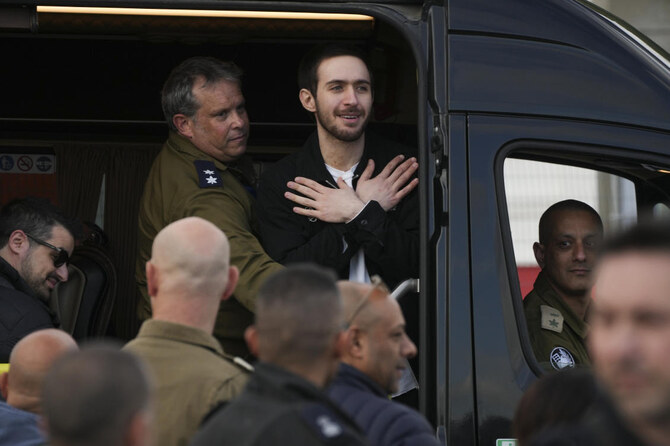
Since the ceasefire began on January 19, Gaza militants have released 25 living Israeli hostages in staged ceremonies, often flanked by masked gunmen and forced to speak.
After six were freed on Saturday, Israel put off the planned release of more than 600 Palestinians, citing what Netanyahu called “humiliating ceremonies” in Gaza.
The International Committee of the Red Cross, which has facilitated the hostage-prisoner exchanges, has previously appealed to “all parties” for the swaps to be carried out in a “dignified and private” manner.
Senior Hamas official Bassem Naim said postponing the release exposes “the entire agreement to grave danger.”
Naim called on the truce mediators, “especially the Americans,” to pressure Israel “to implement the agreement as it is and immediately release our prisoners.”
Both sides have accused each other of violations during the ceasefire but it has so far held.
Israel vowed to destroy Hamas after its October 7, 2023 attack on Israel that triggered the war.
The attack resulted in the deaths of more than 1,200 people, and Israel’s retaliation killed more than 48,000 in Gaza, according to figures from both sides.
Netanyahu on Sunday said that “we have eliminated most of Hamas’s organized forces, but let there be no doubt — we will complete the war’s objectives entirely — whether through negotiation or by other means.”
Israel’s war objectives include defeating Hamas and bringing back all hostages seized during the 2023 attack, 62 of whom remain in Gaza including 35 the Israeli military says are dead.
US President Donald Trump’s envoy Steve Witkoff said he was headed to the Middle East this week to “get an extension of phase one” of the truce.
“We’re hopeful that we have the proper time... to begin phase two, and finish it off and get more hostages released,” Witkoff told CNN.
Trump has floated the idea of a US takeover of war-ravaged Gaza under which its Palestinian inhabitants would move elsewhere, triggering widespread criticism.
Alongside the Gaza war — which displaced almost the entire population of 2.4 million — Israel has intensified its military operations in the West Bank.
The military said a tank division will be sent into the northern West Bank city of Jenin, the first such deployment to the territory in 20 years.
It called it part of “expanding” operations in the area, where the military began a major raid against militants just after the Gaza truce began.
The United Nations has said the military operation has led to “forced displacement” of 40,000 Palestinians from Jenin and other refugee camps.
Defense Minister Israel Katz said he has told troops “to prepare for a prolonged presence in the cleared camps for the coming year and to prevent the return of residents and the resurgence of terrorism.”
Michael Horowitz, head of intelligence for Le Beck risk management consultancy, said the deployment of tanks in the West Bank comes at a “very sensitive time for the ceasefire.”
He noted that Netanyahu, under domestic pressure over his handling of the war, could face the choice of either returning to fighting or his far-right coalition government potentially collapsing.
In the West Bank as well as in Gaza, families of Palestinian prisoners had waited with uncertainty into the night on Saturday, hoping for their release.
The six Israelis released Saturday were the last group of living hostages set to be freed under the truce’s first phase.
They included Hisham Al-Sayed, 37, and Avera Mengistu, 38, who had been held in Gaza for about a decade after they entered the territory individually.
The first transfer of dead hostages under the truce earlier this week sparked anger in Israel when the remains of captive Shiri Bibas were not initially returned, promoting Hamas to admit a possible “mix-up of bodies” and finally hand over hers.
UN human rights chief Volker Turk condemned the “parading of bodies” during a ceremony in which coffins, with pictures of the dead attached, were displayed on a slogan-bedecked stage.


![]()


Israel ready to resume Gaza war, PM warns after truce delay
Short Url
https://arab.news/7njeh
Israel ready to resume Gaza war, PM warns after truce delay
- First phase of ceasefire, which largely halted 15 months of devastating war, due to expire in early March
- Both sides accused each other of violations, but cessation in violence has so far held


Italy wants military to stay in Lebanon after peacekeepers leave
- Defense Minister Guido Crosetto says Italy will continue to 'do its part' even after UNIFIL mission ends next year
ROME: Italy said Monday it intends to keep a military presence in Lebanon even after the UN peacekeeping force it belongs to leaves as planned from December 31, 2026.
“Even after (the peacekeeping force) UNIFIL, Italy will continue to do its part, supporting with conviction the international presence and supporting the capacity development of the Lebanese armed forces,” Defense Minister Guido Crosetto said during a visit to Lebanon, according to a statement.
Asked by AFP if this meant Italy wanted to maintain a military presence in the country, a ministry spokesman confirmed that this was the case.
The United Nations Interim Force in Lebanon (UNIFIL) has acted as a buffer between Israel and Lebanon since 1978, remaining after Israel ended an occupation of southern Lebanon in 2000.
Lebanon had wanted UNIFIL to stay.
But the UN Security Council voted in August to allow only one final extension for UNIFIL after pressure from Israel and its US ally to end the mandate.
UNIFIL is currently led by Italian Major General Diodato Abagnara and numbers 9,923 troops from 49 countries, according to the force’s website.
Italy is the second biggest contributing country with 1,099 soldiers deployed after Indonesia which has 1,232 soldiers.
Israel has hailed the termination of UNIFIL and urged the Beirut government to exert its authority after an Israeli military campaign which devastated Iranian-backed militia Hezbollah.
Under a truce between Israel and Hezbollah, the long-fledgling Lebanese national army has been deploying in southern Lebanon and dismantling Hezbollah’s infrastructure.
“Support is needed to strengthen the Lebanese armed forces, so that they are in the best possible position to defend the country, ensuring security and respect for its borders,” Crosetto said in Monday’s statement.
“We will guarantee our presence in multilateral and bilateral contexts,” he said.
“Even after (the peacekeeping force) UNIFIL, Italy will continue to do its part, supporting with conviction the international presence and supporting the capacity development of the Lebanese armed forces,” Defense Minister Guido Crosetto said during a visit to Lebanon, according to a statement.
Asked by AFP if this meant Italy wanted to maintain a military presence in the country, a ministry spokesman confirmed that this was the case.
The United Nations Interim Force in Lebanon (UNIFIL) has acted as a buffer between Israel and Lebanon since 1978, remaining after Israel ended an occupation of southern Lebanon in 2000.
Lebanon had wanted UNIFIL to stay.
But the UN Security Council voted in August to allow only one final extension for UNIFIL after pressure from Israel and its US ally to end the mandate.
UNIFIL is currently led by Italian Major General Diodato Abagnara and numbers 9,923 troops from 49 countries, according to the force’s website.
Italy is the second biggest contributing country with 1,099 soldiers deployed after Indonesia which has 1,232 soldiers.
Israel has hailed the termination of UNIFIL and urged the Beirut government to exert its authority after an Israeli military campaign which devastated Iranian-backed militia Hezbollah.
Under a truce between Israel and Hezbollah, the long-fledgling Lebanese national army has been deploying in southern Lebanon and dismantling Hezbollah’s infrastructure.
“Support is needed to strengthen the Lebanese armed forces, so that they are in the best possible position to defend the country, ensuring security and respect for its borders,” Crosetto said in Monday’s statement.
“We will guarantee our presence in multilateral and bilateral contexts,” he said.
Latest updates



© 2025 SAUDI RESEARCH & PUBLISHING COMPANY, All Rights Reserved And subject to Terms of Use Agreement.