



TEL AVIV, Israel: Israel says the release of hundreds of Palestinian prisoners is delayed “until the release of the next hostages has been assured, and without the humiliating ceremonies” at handovers of Israeli captives in Gaza.
The statement by Prime Minister Benjamin Netanyahu’s office came early Sunday as military vehicles that normally move in advance of the buses carrying prisoners left the open gates of Ofer prison, only to turn around and go back in.
The release of 620 Palestinian prisoners had been delayed for several hours and was meant to occur just after six Israeli hostages were released on Saturday. It was meant to be the largest one-day prisoner release in the Gaza ceasefire’s first phase.
Israel’s announcement abruptly put the future of the truce into further doubt.
The Palestinian Authority’s commission for prisoners’ affairs confirmed the delay “until further notice.” Associated Press video in the West Bank showed prisoners’ families, waiting outdoors in near-freezing weather, apparently dispersing. One woman was shown walking away in tears.
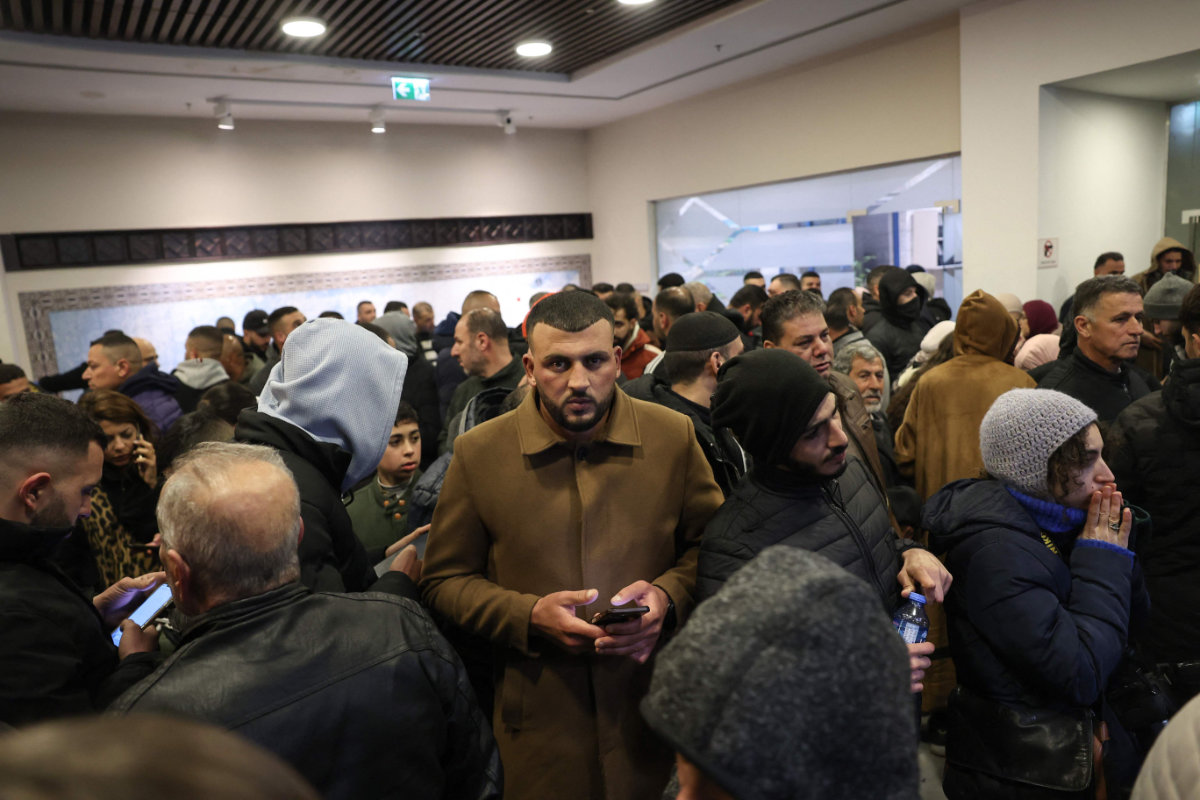
Palestinian families react after Israel delayed the release of Palestinian prisoners, scheduled to be released in the seventh hostage-prisoner exchange, in the occupied West Bank city of Ramallah early on February 23, 2025. (AFP)
Five of the six hostages freed Saturday had been escorted by masked, armed militants in front of a crowd — a display that the UN and Red Cross have criticized as cruel after previous handovers.
The Israeli statement cited “ceremonies that demean the dignity of our hostages and the cynical use of the hostages for propaganda purposes.” It was likely a reference to a Hamas video showing two hostages who have yet to be released watching a handover in Gaza on Saturday and speaking under duress.
The six were the last living hostages expected to be freed under the ceasefire ‘s first phase, with a week remaining in the initial stage. Talks on the ceasefire’s second phase are yet to start.
The six included three Israeli men seized from the Nova music festival and another taken while visiting family in southern Israel during the Hamas-led Oct. 7, 2023, attack that triggered the 16-month war in Gaza. The two others were held for a decade after entering Gaza on their own.
Five were handed over in staged ceremonies. In one, Omer Wenkert, Omer Shem Tov and Eliya Cohen were posed alongside Hamas fighters. A beaming Shem Tov, acting under duress, kissed two militants on the head and blew kisses to the crowd. They wore fake army uniforms, though they were not soldiers when abducted.
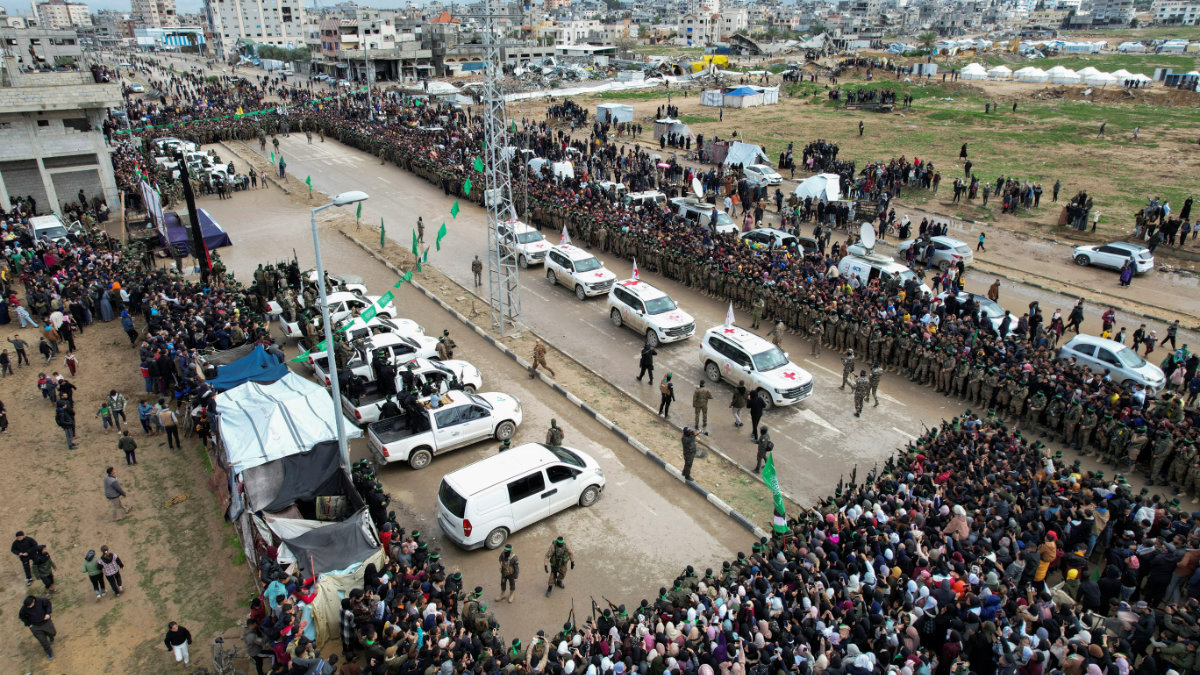
A drone view shows Eliya Cohen, Omer Shem Tov, and Omer Wenkert, hostages held in Gaza since the deadly October 7, 2023 attack, being escorted by Hamas militants as they are released in Nuseirat, central Gaza Strip, on Feb. 22, 2025. (REUTERS)
Cohen’s family and friends in Israel chanted “Eliya! Eliya! Eliya!” and cheered.
“You’re heroes,” Shem Tov told his parents as they later embraced, laughing and crying. “You have no idea how much I dreamt of you.” His father, Malki Shem Tov, told public broadcaster Kan his son was held alone after the first 50 days and lost 17 kilograms (37 pounds).
Earlier Saturday, Tal Shoham, 40, and Avera Mengistu, 38, were freed. Mengistu, an Ethiopian-Israeli, entered Gaza in 2014. His family told Israeli media he has struggled with mental health issues. The Israeli-Austrian Shoham was taken from Kibbutz Be’eri. His wife and two children were freed in a 2023 exchange.
Later, Israel’s military said Hisham Al-Sayed, 36, was released. The Bedouin Israeli entered Gaza in 2015. His family has told Israeli media he was previously diagnosed with schizophrenia.
Israel’s government didn’t respond to questions about the delay in releasing prisoners. Hamas accused Israel of violating the ceasefire deal, with spokesperson Abdel Latif Al-Qanou accusing Netanyahu of “deliberately stalling.”
The hostage release followed a heartrending dispute when Hamas on Thursday handed over the wrong body for Shiri Bibas, an Israeli mother abducted with her two young boys. The remains were determined to be those of a Palestinian woman. Netanyahu vowed revenge for “a cruel and malicious violation.” Hamas suggested it was a mistake.
Israeli forensic authorities confirmed a body handed over on Friday was Bibas. Dr. Chen Kugel, head of the National Institute of Forensic Medicine, said they found no evidence Bibas and her children were killed in an Israeli airstrike, as Hamas has claimed. Kugel did not give a cause.
Hamas denied the Israeli military claim, based on forensic evidence and unspecified “intelligence,” that its militants killed the children “with their bare hands,” calling it a lie aimed at justifying Israeli military actions against civilians in Gaza.
Difficult talks likely over the ceasefire’s next phase
The ceasefire deal has paused the deadliest and most devastating fighting ever between Israel and Hamas, but there are fears the war will resume. Negotiations on the ceasefire’s second phase are likely to be more difficult.
Hamas had said it will release four bodies next week, completing the truce’s first phase. After that, Hamas will hold over 60 hostages — about half believed to be alive.
Hamas has said it won’t release the remaining captives without a lasting ceasefire and full Israeli withdrawal from Gaza. Netanyahu, with the backing of US President Donald Trump’s administration, says he’s committed to destroying Hamas’ military and governing capacities and returning all hostages, goals widely seen as mutually exclusive.
An Israeli official had said Netanyahu would meet with security advisers on Saturday evening about the ceasefire’s future, focusing “on the goal of returning all our hostages, alive and dead.” The official spoke on condition of anonymity because the meeting had not been formally announced.
Freed hostages bring relief and a sign of life
Wenkert, Cohen, Shoham and Shem Tov had an “extremely difficult period in captivity,” the Beilinson hospital said, but it did not give details at the families’ request.
Niva Wenkert, Omer’s mother, told Israel’s Channel 12 that “on the surface, he looks OK, but there’s no telling what’s inside.”
“This is an unforgettable moment, where all emotions are rapidly mixing together,” Shoham’s family said, and called for a deal to free all hostages still held.
Families and others rallied again Saturday night in Tel Aviv to pressure Netanyahu’s government for a deal.
“How is it possible that President Trump and special envoy (Steven) Witkoff are more committed to the return of Israeli hostages than you are?” said Naama Weinberg, cousin of deceased hostage Itay Svirsky. “Netanyahu, these are your citizens who were abandoned on your watch!”
Hamas later released a video showing two hostages still held, Evyatar David and Guy Gilboa Dallal, as they sat in a vehicle and spoke under duress at the handover for Shem Tov, Cohen and Wenkert. A group representing hostages’ families called the video “sickening.”
Hundreds of Palestinian prisoners
The 620 Palestinian prisoners meant to be freed include 151 serving life or other sentences for attacks against Israelis. Almost 100 would be deported, according to the Palestinian prisoners’ media office.
A Palestinian prisoner rights association said they include Nael Barghouti, who spent over 45 years in prison for an attack that killed an Israeli bus driver.
Also meant to be released are 445 men, 23 children aged 15 to 19, and a woman, all seized by Israeli troops in Gaza without charge during the war.
Israel’s military offensive has killed over 48,000 Palestinians, mostly women and children, according to Gaza’s Health Ministry, which doesn’t distinguish between civilians and combatants. Israel says it has killed more than 17,000 fighters, without providing evidence.
The offensive destroyed vast areas of Gaza, reducing entire neighborhoods to rubble. At its height, the war displaced 90 percent of Gaza’s population.
The Oct. 7 attack killed about 1,200 people, mostly civilians. Hundreds of Israeli soldiers have died in the war.


