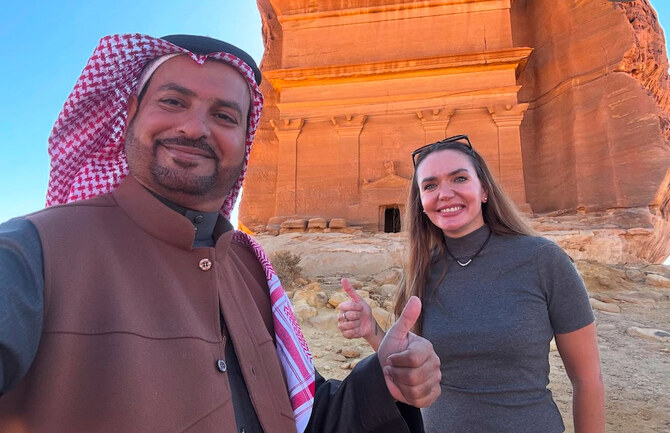
Ibrahim Al-Balawi’s journey rooted in self-learning, dedication
Updated 22 February 2025
Nada Hameed
JEDDAH: Despite being deaf and mute, Ibrahim Al-Balawi, a 48-year-old Saudi tour guide who is passionate about AlUla’s rich history and breathtaking sights, has become a pioneer in inclusive tourism.
His journey, rooted in self-learning and dedication, began long before AlUla emerged as a global tourism destination.
Al-Balawi’s tour guide timeline started even before tourism was officially established in AlUla in 2001.
His deep love of history drove him to frequent the locations, study their significance, and independently translate material to educate himself and others.
With an extensive knowledge of archaeological sites, he led visitors through AlUla’s ancient locations, sharing stories and insights he had gathered over the years.
Hind Shabaa, Al-Balawi’s wife, who is also from AlUla, has been a steadfast supporter. Married for 16 years, she learned sign language from her husband.
Saudi tour guide Ibrahim Al-Balawi. (Instagram: @chici.deaf)
Over time Shabaa became fluent in sign language and she formed friendships within the deaf community. She plays a crucial role today in her husband’s work by verbally translating sign language to hearing tourists, enhancing the tour experience for all visitors.
Shabaa told Arab News: “He supported me in learning the language, and I built friendships with deaf individuals.
“Because he had a wide network of friendships — having studied middle and high school in Jeddah — he had formed many connections inside and outside the Kingdom.
“When he brought his friends over, they would be accompanied by their wives, so I also picked up the language. I became so proficient that they were amazed at how well I could communicate verbally and in sign language.”
Silent but fun, sign language became an essential part of the family’s daily life, creating a deeper bond and shaping a unique communication.
Shabaa added: “Even our children learned sign language from their father. They became very skilled at it. I was so dedicated that I took additional courses to improve myself. At one point I became even better than some certified sign language trainers.”
Before the Saudi Tourism Commission was transformed into the Ministry of Tourism in 2020, Al-Balawi’s main mission was to showcase AlUla’s beauty to the world through his eyes and language. He welcomed visitors from the deaf community from across the Kingdom and beyond, including Germany, France, Canada, and China.
Saudi tour guide Ibrahim Al-Balawi. (Instagram: @chici.deaf)
Officials noticed him attracting tourists, most of whom were foreign visitors leveraging his proficiency in general sign language.
Al-Balawi slowly became a familiar face among tourism officials. As the industry grew more structured, he sought official permission to continue guiding, ensuring that foreign tourists could still benefit from his expertise.
Al-Balawi’s official career as a tour guide in AlUla began in 2017. He attended numerous educational courses once he officially joined the Ministry of Tourism, and training materials were provided.
Despite holding only a high-school diploma, Al-Balawi’s relentless pursuit of knowledge set him apart. He enrolled in history and tourism courses, attended specialized training, and memorized educational materials.
Recognizing the global diversity of sign languages, Al-Balawi taught himself multiple variations beyond Arabic sign language, enabling him to communicate with tourists from Western countries. His self-motivation allowed him to bridge cultural and linguistic gaps, ensuring that all visitors, especially those from the deaf community, could fully experience AlUla’s wonders.
Shabaa said: “I remember that from the time we got married he had books on Western sign languages and would always read and learn from them. Additionally, he traveled several times to the US and built friendships there, communicating through apps and video calls until he became proficient.
“He has expertise in both colloquial and formal Arabic sign language, as well as international sign languages, including American, Chinese, and Korean, which differ from the Saudi system. He taught himself these through travel, books, and personal research.”
Shabaa added: “For those who could speak, he was able to communicate with them effortlessly. He could read lips, record videos, send them messages, and speak to them in a casual dialect that made sign language easier for them. Learning sign language is often challenging for those around them, so when needed he would write things down to ensure clear communication.”
The couple’s commitment extends beyond guiding as they make sure they understand the unique needs of deaf travelers.
Shabaa said: “My husband established a private guesthouse specifically designed for the deaf, ensuring that visitors feel welcome, comfortable, and can fully enjoy AlUla’s offerings.”
Al-Balawi has conducted more than 800 tours in the past two years, welcoming tourists from nearly every region in Saudi Arabia and countries across the world, including the UK, the US, Syria, Germany, Egypt, Turkiye, Russia, and the UAE.
Al-Balawi is also having to cope with social media and has an Instagram page with over 4,500 followers from around the world. He displays photos and videos of his trips so he can attract more visitors.
Shabaa said: “He invites travelers through social media, guides them, documenting their visits with photos and videos. Many have been impressed by his effort and dedication.”
His ability to connect with people, whether through sign language, written communication, or sheer enthusiasm, has left a mark on those who have explored AlUla with his guidance.
Shabaa added: “The response of tourists has been amazing after every tour. They are always happy, and some even return for a second visit because they enjoyed their experience so much. AlUla fascinated them, and they love the tourism experience here.”
Erdogan to Asharq Al-Awsat: Our ties with Saudi Arabia are strategic for regional peace, stability, prosperity
Turkish president says Ankara is ready to mediate between the US and Iran to prevent a new regional war
Erdogan tells Asharq Al-Awsat his Riyadh visit aims to deepen Saudi ties, coordinate on Gaza, Syria and security
Updated 7 sec ago
Asharq Al-Awsat
RIYADH: Turkish President Recep Tayyip Erdogan stressed on Tuesday that his country was prepared to mediate between Iran and the US to ease tensions between them, warning against any step that may spark war in the region.
Erdogan arrived in Riyadh on an official visit on Tuesday. In an interview to Asharq Al-Awsat, he said relations between Riyadh and Ankara have strategic importance for peace, stability and prosperity in the region.
He revealed that his visit aims to expand bilateral consultations on regional issues, especially the situation in Gaza and Syria, as well as elevate bilateral ties to broader horizons.
Erdogan said: “Turkiye and Saudi Arabia are two friendly countries with deep historical ties, strong state traditions, and a shared sense of regional responsibility. We have never viewed this relationship through a narrow lens confined solely to bilateral matters. This is because the valuable friendship between our two countries also carries a strategic significance for the peace, stability, and prosperity of our region as a whole.”
“As a natural outcome of this understanding, Turkiye-Saudi Arabia relations constitute a line of stability that goes beyond economic cooperation alone, encompassing consultation, coordination, and the strengthening of common wisdom. Indeed, in our previous meetings with Prince Mohammed bin Salman, Crown Prince and Prime Minister, we addressed not only bilateral relations but also regional and global issues, and reaffirmed our mutual determination to further deepen our cooperation in the period ahead,” he added.
On his visit to Saudi Arabia, he said: “We aim to both deepen consultation on regional issues and advance our bilateral relations in concrete areas. In this regard, the inclusion of the business community in the program clearly reflects our commitment to elevating economic cooperation.
“This visit brings consultation and a positive agenda together at the same table. Our agenda includes Palestine, a permanent ceasefire in Gaza, and Syria,” Erdogan stated. “There is, of course, also an economic aspect, namely how we can expand our trade, investments, and joint projects, which we will address as well. Thus, we will strengthen consultation while also broadening the positive agenda.”
“Regarding new steps of cooperation, we do not view the matter solely through the lens of signing documents. What truly matters to us are sustainable and concrete projects that deliver tangible results on the ground and generate mutual benefit. We seek initiatives that will open new horizons for our business communities, create employment, and improve the lives of our people,” he went on to say.
“We see significant potential not only in the economy, trade, and investment, but also in fields such as energy, tourism, transportation, and logistics,” he noted. “We have no intention of leaving this potential merely on paper. Our objective is to expand this cooperation through concrete projects based on a mutual win-win approach and to elevate our relations to a more advanced level.”
“In the defense industry, our primary goal is to establish cooperation based on mutual trust that builds capacity and strengthens technological and production capabilities. I believe that steps to be taken in areas such as joint production, technology sharing, and training will not only strengthen the defense capacities of both countries, but also further consolidate the foundations of our strategic partnership,” he told Asharq Al-Awsat.
Erdogan told the newspaper that Turkiye and Saudi Arabia are two friendly countries with deep historical ties, strong state traditions, and a shared sense of regional responsibility. (SPA)
On the possibility of the eruption of a war between the US and Iran, he said: “Let me begin by stating that experience has proven that scenarios which fail to grasp the values, identity, history, and future of this geography have inflicted far greater suffering on the region than peace. The wounds inflicted by the implementation of such scenarios in Gaza, Iraq, Syria, and Afghanistan remain vivid in our collective memory.”
“For this reason, as Turkiye, we categorically oppose a new war or a new wave of destruction in our region,” he declared.
“We advocate resolving issues through dialogue, reason, prudence, and sound judgment. We have openly and consistently expressed our opposition to any military intervention against Iran on every platform. In this regard, we advise our counterparts to refrain from any steps that could escalate tensions, exercising due restraint.
“We informed our counterparts that we are closely following developments in Iran, attach importance to the country’s peace and stability, and do not support any external intervention that would bring suffering to the Iranian people,” he said.
“Moreover, we emphasize that Turkiye is ready to assume a facilitating role between Iran and the US in order to de-escalate tensions and help resolve issues through diplomatic means. In this context, our diplomatic engagement continues. We stand against every step that would plunge the region into flames, and we stand with every step that strengthens peace,” he added.
“We view the consultations and coordination we are conducting with regional countries within this framework. Our contacts with friendly countries, including Saudi Arabia and Pakistan, are ongoing,” he remarked.
“We do not view the matter through the lens of bloc alignment or alliances. What our region needs is not new divisions, but a foundation for cooperation shaped by common wisdom and shared responsibility. Our aim is not to manage conflict but to jointly strengthen the diplomatic groundwork that will prevent it from arising in the first place. For this reason, the establishment of regional security mechanisms would be beneficial in preventing crises.”
Erdogan and Crown Prince Mohammed bin Salman will discuss various topics - including Gaza, Syria and Iran - during the Turkish premier’s official visit to Riyadh. (SPA)
On the challenges hindering the success of the second phase of the Gaza peace plan after the Israeli Prime Minister’s rejection of Turkish and Qatari involvement in Gaza, Erdogan said: “The main issue in Gaza is to make the ceasefire permanent, to ensure the protection of civilians, to deliver humanitarian aid without interruption or obstruction, and to bring forced displacement to a complete end.”
“Any discussion held without securing these fundamental points would miss the essence of the matter,” he said.
“Moving on to the second phase of the Peace Plan is important; however, the greatest obstacle to this phase is, first and foremost, the continuing fragility of the ceasefire. At this point, it is essential that recovery and reconstruction efforts begin without delay, that urgent and basic needs in Gaza are met, that public services are provided, and that Israeli forces withdraw gradually from Gaza in line with UN Security Council Resolution 2803. As a member of the Board of Peace, Turkiye will actively contribute to these processes,” he added.
“Without establishing trust on the ground and ensuring lasting calm between the parties, it is impossible for this process to proceed in a sound manner. In addition, the destroyed infrastructure, the collapsed healthcare system, the water and electricity crises, the need for shelter, and the sheer scale of reconstruction all represent serious obstacles to the second phase. Therefore, success depends on establishing a framework that addresses both the security and humanitarian dimensions.”
“As for the debates on a peacekeeping force or an international mission, our approach is clear. Such mechanisms only make sense if they serve to protect civilians, guarantee humanitarian assistance, and support lasting peace. Regardless of the label attached to it, any arrangement that fails to serve peace on the ground lacks real meaning,” he continued.
“Once the necessary conditions are in place, Turkiye is ready to shoulder responsibility in contributing to peace in Gaza, including the possibility of a military contribution. And let me repeat: reducing this matter to a debate over ‘which country should or should not be involved’ will not produce a solution. The solution lies in a peace architecture shaped by the right conditions, the right mandate, and the right objectives,” he stressed.
“In any arrangement concerning Gaza’s future, the source of legitimacy is the will of the Palestinian people. A lasting solution cannot be established without taking into account the consent and expectations of the Palestinian people,” he stated.
“For Turkiye, our goal in Gaza is to contribute to establishing the conditions necessary for a lasting ceasefire, a just peace, humanitarian assistance, reconstruction, and a fair political solution,” he added.
On the relationship with Saudi Arabia, Erdogan said: “We have never viewed this relationship through a narrow lens confined solely to bilateral matters. This is because the valuable friendship between our two countries also carries a strategic significance for the peace, stability, and prosperity of our region as a whole.” (SPA)
On the efforts to reach an agreement between the Syrian government and the Syrian Democratic Forces (SDF), Erdogan replied: “For many years, Syria has paid the heavy costs of war and fragmentation. The positive developments now emerging both on the ground and in diplomacy show that a new political horizon is possible.”
“This path seeks to preserve Syria’s territorial integrity, consolidating national unity, and re-establishing state authority across the country. The way towards a lasting and just peace lies in strengthening a partnership that nurtures common wisdom and common will and acts with a sense of responsibility.”
“The narrowing of conflict zones in Syria, along with the agreements reached and the steps taken toward integration, shows that progress can be made in the right direction. However, for these gains to become permanent, developments on the ground alone are not sufficient; social reconciliation must also be established by strengthening a shared sense of belonging around the central government. Whether in the northeast, the south, or the coastal region, the same applies across Syria,” he noted.
“Our benchmark is clear: a Syria that does not threaten its neighbors, denies safe haven to terrorist organizations, and embraces all segments of society on the basis of equal citizenship is essential for regional stability,” Erdogan told Asharq Al-Awsat
“For Turkiye, we state that Syria’s future will be shaped by the will of the Syrian people. In this vein, alongside friendly and brotherly countries, foremost among them Saudi Arabia, we will continue to stand by every constructive step that strengthens Syria’s unity, integrity, and stability, both on the ground and at the negotiating table,” he stressed.
On Sudan, Erdogan noted: “The war there has reached its 1,000th day. Unfortunately, our Sudanese brothers and sisters are entering yet another Ramadan amid conflict. Sudan has suffered heavy losses due to this war. The brotherly people of Sudan are striving to survive under the devastating conditions brought about by the civil war.”
“We have supported every diplomatic effort to bring an end to this dire situation as soon as possible and to help Sudan achieve stability and prosperity. We have expressed our readiness to mediate between the conflicting parties,” he said.
“As a highly trusted external actor in Sudan, Turkiye has chosen not to launch separate diplomatic initiatives or add new tracks to existing efforts, but rather to strengthen ongoing processes and contribute to a peaceful resolution. However, I regret to say that, to date, no outcome has been reached that would put an end to the bloodshed and ongoing suffering,” he lamented.
“The Sudanese government and the brotherly people of Sudan have expectations from us. In response to these expectations, and with the participation of all relevant institutions, we have taken steps to restore peace and stability in Sudan and normalize daily life, ensuring the reopening of the Turkish Cooperation and Coordination Agency office and the Ziraat Bank branch in Port Sudan.”
On the sidelines of Erdogan’s visit to the Kingdom, a Saudi-Turkiye Investment Forum on Tuesday reflected an unprecedented level of political and economic alignment between the countries, Saudi Investment Minister Khalid Al-Falih commented. (SPA)
“To strengthen our Sudanese brothers’ and sisters’ connection with the outside world, we have launched Turkish Airlines flights to Port Sudan. Since 2024, nine aid vessels that we have dispatched have delivered a total of 12,600 tons of humanitarian aid and 30,000 tents to our Sudanese brothers and sisters. Our cooperation in the fields of agriculture, mining, and energy continues. We are also conducting the necessary assessments regarding the reconstruction of destroyed cities, particularly the capital, Khartoum,” Erdogan said.
“We undoubtedly value the constructive efforts of Saudi Arabia, the US, and Egypt within the established mechanism, and Turkiye will stand by every step taken towards peace and prosperity and will do whatever is necessary in this regard,” he vowed.
“Furthermore, we will steadfastly continue to advance our concrete proposals and diplomatic initiatives in all international and regional organizations, including the UN, the Organization of Islamic Cooperation, and the African Union.”
“Africa’s problems should be solved by Africans. Turkiye will do its utmost under all circumstances to foster constructive dialogue. The people of Sudan can rest assured that Turkiye stands by them,” he added.
Commenting on Israel’s recognition of Somaliland, Erdogan told Asharq Al-Awsat: “During President Hassan Sheikh Mohamud of Somalia’s visit to our country at the end of last month, we clearly and unequivocally expressed our views on this matter. We emphasized that preserving Somalia’s unity under all circumstances is a priority for us.”
“I would like to underscore that our position remains unchanged,” he added.
“Israel’s decision to recognize Somaliland is an illegitimate one and, in our view, null and void. Turkiye will continue to fully defend Somalia’s territorial integrity in accordance with UN resolutions,” he vowed.
“Our stance on this matter is entirely principled. Decisions regarding the future of the Federal Republic of Somalia and the Somaliland region should be made in a way that reflects the will of all Somali people.”
“The Netanyahu Government, committing genocide in Gaza, and, after its attacks against Lebanon, Yemen, Iran, Qatar, and Syria, now intends to destabilize the Horn of Africa. This is a major threat not only to the Horn of Africa but to the entire continent,” warned Erdogan.
“Any step that fails to contribute to resolving the disputes in the region only exacerbates the crisis. For this reason, I highly value statements by regional countries, foremost Saudi Arabia and Egypt, promptly rejecting this decision,” he added.
“Similarly, it is important to note that international organizations such as the EU, the OIC, and the Arab League, as well as officials such as the Chairperson of the African Union Commission, have expressed their rejection of the decision. I would like to reiterate that we attach great importance to these statements, which highlight Somalia’s territorial integrity and sovereignty.”
* This article originally appeared on Asharq Al-Awsat English, click here to read it.