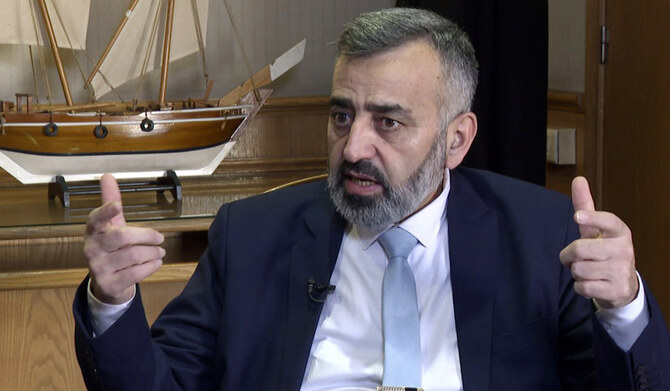

DAMASCUS, Syria: An official with the committee preparing a national dialogue conference in Syria to help chart the country’s future said Friday that it has not been decided whether the conference will take place before or after a new government is formed.
The date of the conference has not been set and the timing “is up for discussion by the citizens,” Hassan Al-Daghim, spokesperson for the committee, told The Associated Press in an interview in Damascus on Friday.
“If the transitional government is formed before the national dialogue conference, this is normal,” he said. On the other hand, he said, “the caretaker government may be extended until the end of the national dialogue.”
The conference will focus on drafting a constitution, the economy, transitional justice, institutional reform and how the authorities deal with Syrians, Al-Daghim said. The outcome of the national dialogue will be non-binding recommendations to the country’s new leaders.
“However, these recommendations are not only in the sense of advice and formalities,” Al-Daghim said. “They are recommendations that the president of the republic is waiting for in order to build on them.”
After former President Bashir Assad was toppled in a lightning rebel offensive in December, Hayat Tahrir Al-Sham, or HTS, the main former rebel group now in control of Syria, set up an interim administration comprising mainly of members of its “salvation government” that had ruled in northwestern Syria.
They said at the time that a new government would be formed through an inclusive process by March. In January, former HTS leader Ahmad Al-Sharaa was named Syria’s interim president after a meeting of most of the country’s former rebel factions. The groups agreed to dissolve the country’s constitution, the former national army, security service and official political parties.
The armed groups present at the meetings also agreed to dissolve themselves and for their members to be absorbed into the new national army and security forces. Notably absent was the Kurdish-led Syrian Democratic Forces, which holds sway in northeastern Syria.
There has been international pressure for Al-Sharaa to follow through on promises of an inclusive political transition. UN special envoy for Syria Geir Pedersen said this week that formation of a “new inclusive government” by March 1 could help determine whether Western sanctions are lifted as the country rebuilds.
Al-Daghim said the decisions taken in the meeting of former rebel factions in January dealt with “security issues that concern the life of every citizen” and “these sensitive issues could not be postponed” to wait for an inclusive process.
In recent weeks, the preparatory committee has been holding meetings in different parts of Syria to get input ahead of the main conference. Al-Daghim said that in those meetings, the committee had heard a broad consensus on the need for “transitional justice and unity of the country.”
“There was a great rejection of the issue of quotas, cantons, federalization or anything like this,” he said.
But he said there was “disagreement on the order of priorities.” In the coastal cities of Latakia and Tartous, for instance, many were concerned about the low salaries paid to government workers, while in Idlib and suburbs of Damascus that saw vast destruction during nearly 14 years of civil war, reconstruction was the priority.
The number of participants to be invited to the national conference has not yet been determined and may range from 400 to 1,000, Al-Daghim said, and could include religious leaders, academics, artists, politicians and members of civil society, including some of the millions of Syrians displaced outside the country.
The committee has said that the dialogue would include members of all of Syria’s communities but that people affiliated with Assad’s government and armed groups that refuse to dissolve and join the national army — chief among them the SDF — would not be invited.
Al-Daghim said Syria’s Kurds would be part of the conference even if the SDF is not.
“The Kurds are a component of the people and founders of the Syrian state,” he said. “They are Syrians wherever they are.”