

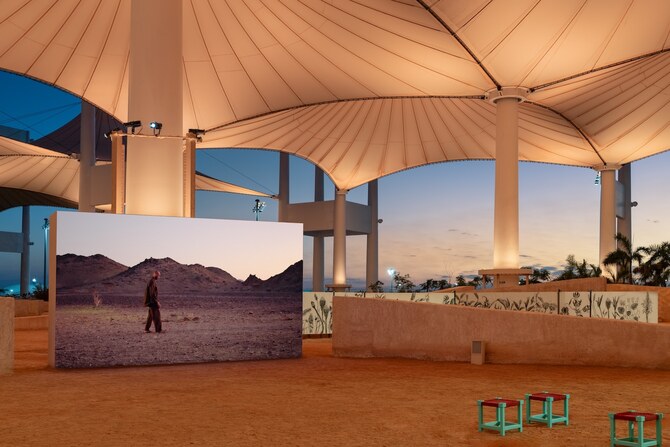

JEDDAH: “The role of contemporary (art) is to act as a link between the past, our present and this imagining of our future,” says Muhannad Shono, contemporary art curator at the second Islamic Arts Biennale in Jeddah, which opened in January and runs through May.
Shono’s section of the biennale features 30 new commissions from local and international artists “giving shape to the theme,” which this year is “And All That is in Between” — drawn from a Qur’anic verse: “To Allah belongs the dominion of the heavens and the earth and all that is in between” — guiding artists and audiences to reflect on the spaces that exist between known boundaries, whether physical, spiritual, or conceptual.
Set across multiple indoor galleries and integrated into outdoor spaces, the contemporary works are woven seamlessly into the Biennale’s landscape alongside ancient artifacts.
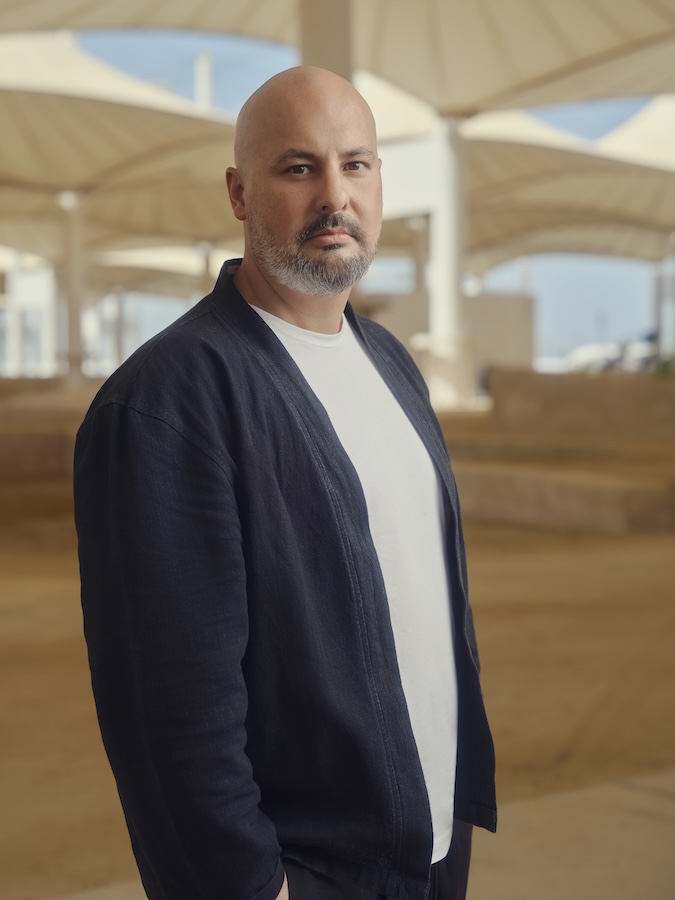
Muhannad Shono. (Supplied)
One striking example is in the AlMidhallah section, where Japanese artist Takashi Kuribayashi’s installation, “Barrels,” features a formation of oil barrels from which a tree emerges, with reflective mirrors blurring the line between man-made and natural elements.
Pakistani artist Imran Qureshi’s “Zubaydah Trail (Between Sacred Cities),” meanwhile, is an immersive space where visitors are invited to kick off their shoes and sit and reflect between the Makkah Al-Mukarramah and Madinah Al-Munawwarah biennale pavilions. Deeply saturated, vibrant strips of color make the space feel both playful and serious at once. Each color and shape carries symbolic meaning — the zig-zag pattern represents the streaming water of Makkah’s Zamzam well, while the green hue evokes the peacefulness of Madinah.
There are many other beautiful works, such as Saudi artist Bilal Allaf’s “What I Heard in the Valley,” which draws inspiration from Sa’i, the ritual walk performed by pilgrims during Hajj and Umrah.
“The overall theme of the biennale is interpreted across five galleries and, of course, across the contemporary interpretations as well,” says the biennale’s artistic director Abdul Rahman Azzam. Contemporary art here serves as a bridge, as Shono suggested, linking the past, present, and possible futures.

Takashi Kuribayashi's 'Barrels.' (Supplied)
AlBidaya, which translates to “the beginning,” is one of the galleries where this concept comes to life, exploring the emotional connections between objects and ideas.
“In the beginning, we were kind of focusing on the heavens and the earth. But then we realized that the true power and potential of this biennale is ‘all that is in between,’” Shono tells Arab News. “This idea of the inclusive, the expansive, the layered, the transformative space that is liminal, that is not interested in its edges, it’s not focused on the binary of options of right and wrong and light and dark and good and evil. It is more interested in that new space that we are exploring.”
Shono was a featured artist at the first Islamic Arts Biennale in 2023. His role this time is very different, but it’s an opportunity he embraced wholeheartedly.
“I responded yes immediately and I threw myself into the work,” he says. “It was a shift in priorities, it was a shift in what I thought my year was going to look like, and it was completely kind of throwing yourself into the process, into motion.
“The most surprising part about preparing was how natural it felt. (I wanted to make sure) that I went through this with a smile, and because I experienced the last edition, I knew what it was going to end up feeling like. So it wasn’t an attempt to top anything or compete with anything but more to do it honestly and naturally, as I would do my own work.”

Imran Qureshi’s 'Zubaydah Trail (Between Sacred Cities).' (Supplied)
What was especially important to him as a curator was working with younger Saudi artists and emerging voices.
“The word ‘change’ is used a lot here in Saudi and the Biennale really embodies that, bringing in the past — which was very rigid… did not want to be negotiated with, did not want to change its narrative or the parameters of its definitions and space — and bringing contemporary thoughts embodied in contemporary art practices, whose roles are to question, think laterally, reimagine, reinterpret,” he says. “It’s a big testimony to what the country’s going through. And so when I was invited, I really wanted to do it — this speaks to my work and I wanted to extend that into the role of curation.”
Many of the featured artists were present at the opening, engaging with visitors. “(Art) is not just about showing things; it’s about experiencing things, exchanging things. It responds to your presence. It reacts to you,” says Shono.
He is grateful to see so many visitors eager to engage with Saudi Arabia’s art scene. The experience, he believes, speaks for itself.
“Every visit, every person who takes that leap of faith — beyond the stereotypes — is enacting change, is experiencing something that can’t be reversed because you’re really coming in contact with the truth, with people, their lives, their generosity, their authenticity,” he says.
While he is curating the spaces, he does not want to curate the impressions.
“I think most of the people are coming here and seeing for themselves what is going on in this country,” he says. “I grew up here in Saudi, so to see a country go through this very rooted experiment of social change… it’s important for it to succeed not only for the sake of this country, but for the entire region.”


