


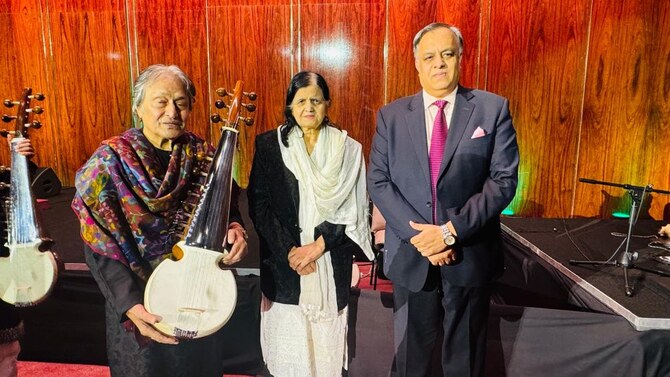

RIYADH: The internationally acclaimed sarod maestro Ustad Amjad Ali Khan, who gave a virtuoso performance of the stringed instrument in Riyadh recently, told Arab News: “Music has no boundaries, and does not belong to any religion.
“Its language transcends everything. In every religion, music is the way to reach God.”
In an exclusive interview with Arab News, Khan shared the experience of his maiden concert at the Cultural Palace, Diplomatic Quarter in Riyadh: “I feel extremely fortunate to be here.
“It’s a great honor to come to Riyadh and I am grateful to the Indian embassy, our ambassador Dr. Suhel Ajaz Khan, and the entire team of people behind this concert.”
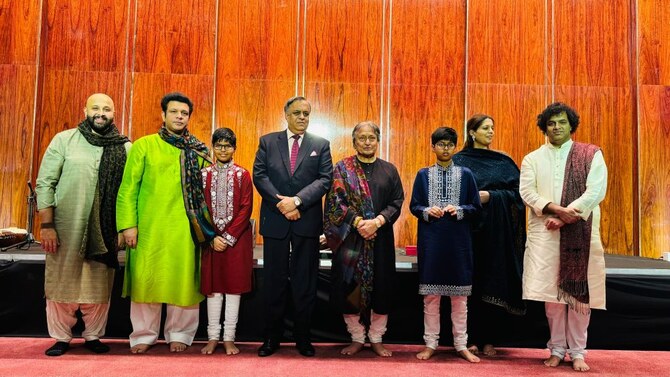
The Sarod quintet concert, “Three Generations, One Melody,” was organized by the Embassy of India in collaboration with the Diplomatic Quarter Office at the Royal Commission for Riyadh City, and featured Khan’s two sons and grandsons who are virtuosos in their own right.
Khan said: “We are invited all over the world. The Western world has given a lot of respect and love to classical music, because music I feel is a precious gift of God, and has connected the world.
“Music does not belong to any religion, like flowers, air, water, fire, fragrance, colors. They are just gifts of God and we have to learn from the role of flowers, and sound.”
Khan was born into a family of musicians, with the lineage reaching back to his great grandfather.
Khan’s father, Ustad Haafiz Ali Khan of Gwalior, was one of the foremost classical instrumentalists of his time.
Born in 1877, he belonged to the fifth generation in the Bangash family that is credited with the sarod’s origin and development.
UNESCO has since declared Gwalior as its creative capital of music.
“This legacy and lineage is a very big blessing of God Almighty,” Khan said. “When God is kind then the legacy continues, otherwise so many legacies discontinue as well.”
Khan was awarded India’s second highest civilian honor Padma Vibhushan in 2001, after being awarded its third highest civilian honor Padma Bhushan in 1991 and Padma Shree in 1975.
Khan cited the melodious voices from the mosque in the form of the call for prayer (Azaan) and the recitation from the Holy Qur’an. “They are really appealing.”
He said that he was happy to visit the holy cities of Makkah and Madinah.
“When I hear Azaan in Saudi Arabia or in the Middle East, I am so much reminded what kind of Azaan Hazrat Bilal must have given,” he said, referencing the historical figure of Bilal ibn Rabah who is considered to have given the first ever Azaan.
“So I look forward to hearing beautiful, appealing Azaan, which I experienced in Makkah and Madinah and all over the Middle East.
“But in India, unfortunately, the muezzin, the people who make the call to prayer, I think they need a lot of training.”
Khan told a story of how his father once gave some feedback to the muezzin of a neighboring mosque.
“One day he heard the Azaan from the neighboring mosque that was not very much in tune. So my father, being a musician, got so disturbed and he sent a message to the mosque and the priest that for next Azaan, he will come himself and make the call to prayer.”
“Call to prayer should be appealing,” the sarod player said.
The sarod is a fretless stringed instrument with a teak frame, a goatskin sound table and a metal fingerboard, with six to eight strings as well as additional sympathetic strings. The instrument lends itself to improvisation and graceful expression because of the ability of the musician to slide and glide between notes, much like a human voice.
“It’s very unfortunate that I don’t get a chance to perform and come to Saudi Arabia quite often. I feel at home when I am in Saudi Arabia,” said the Sarod maestro who performed Umrah in 2012.
“I hope and wish, I get more chances to perform in Saudi Arabia. It will be a great honor and pleasure, some day, if all of us could pay our respect through our music to King Salman and Crown Prince Mohammed bin Salman and his family,” the legendary artist added.
“My opening piece at the concert, ‘Three Generations, One Melody,’ was a tribute to Saudi Arabia. I played a Saudi Arabian tune on my sarod. My instrument is like the oud, a very historical ancient instrument of Saudi Arabia, and the Middle East. Oud rabab still exists all over the world, especially Afghanistan and Kashmir. So from rabab, it was modified to sarod. Sarod is a Persian word, which means music, melody,” he explained.
Khan has played with Iraqi oud artist Rahim AlHajj and produced an album, “Ancient Sounds: Music of Iraq and India,” in 2009. It was nominated for a Grammy award.
He said he was interested in collaborating with Saudi Arabia’s national orchestra, speaking about an orchestral composition he penned called “Samagam,” which means “the confluence of many cultures.”
His passion for bringing the sarod to new audiences has seen him being awarded numerous residencies as well as being appointed visiting professor at several universities, including Stanford University, University of New Mexico, York University and Jacob’s School of Music.
Khan expressed hope that people will realize the value of music: “With appealing music, plants grow faster, cattle give more milk, and now the medical world (is) realizing the value of music, they are using it as music therapy.”


