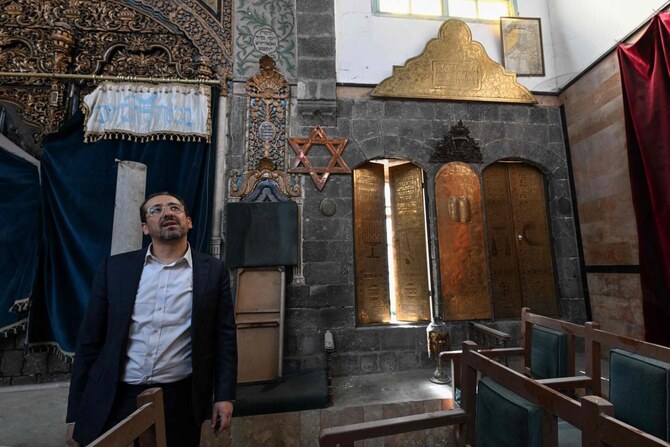
DAMASCUS: For the first time in three decades, Rabbi Joseph Hamra and his son Henry read from a Torah scroll in a synagogue in the heart of Syria’s capital Damascus, carefully passing their thumbs over the handwritten text as if still in awe they were back home.
The father and son fled Syria in the 1990s, after then-Syrian president Hafez Assad lifted a travel ban on the country’s historic Jewish community, which had faced decades of restrictions including on owning property or holding jobs.
Virtually all of the few thousand Jews in Syria promptly left, leaving less than 10 in the Syrian capital. Joseph and Henry — just a child at the time — settled in New York.
“Weren’t we in a prison? So we wanted to see what was on the outside,” said Joseph, now 77, on his reasons for leaving at the time. “Everyone else who left with us is dead.”
But when Assad’s son and successor as president Bashar Assad was toppled in December, the Hamra family began planning a once-unimaginable visit to Damascus with the help of the Syrian Emergency Task Force, a US-based advocacy group.
They met with Syria’s deputy foreign minister at the ministry, now managed by caretaker authorities installed by the Islamist rebels who ousted Assad after more than 50 years of family rule that saw itself as a bastion of secular Arab nationalism.
The new authorities have said all of Syria’s communities will play a role in their country’s future. But incidents of religious intolerance and reports of conservative Islamists proselytizing in public have kept more secular-minded Syrians and members of minority communities on edge.
Henry Hamra, now aged 48, said Syria’s foreign ministry had now pledged to protect Jewish heritage.
“We need the government’s help, we need the government’s security and it’s going to happen,” he said.
Walking through the narrow passages of the Old City, a UNESCO-listed World Heritage Site, Henry and Joseph ran into their onetime neighbors — Palestinian Syrians — and later marveled at hand-painted Hebrew lettering at several synagogues.
“I want to see my kids come back and see this beautiful synagogue. It’s a work of art,” said Henry.
But some things were missing, he said, including a golden-lettered Torah from one of the synagogues that was now stored in a library in Israel, to where thousands of Syrian Jews fled throughout the 20th century.
While the synagogues and Jewish school in the Old City remained relatively well-preserved, Syria’s largest synagogue in Jobar, an eastern suburb of Damascus, was reduced to rubble during the nearly 14-year civil war that erupted after Assad’s violent suppression of protests against him.
Jobar was home to a large Jewish community for hundreds of years until the 1800s and the synagogue, built in honor of the biblical prophet Elijah, was looted before it was destroyed.


![]()

After decades in exile, Syria’s Jews visit Damascus
Short Url
https://arab.news/raswx
After decades in exile, Syria’s Jews visit Damascus
- The new authorities have said all of Syria’s communities will play a role in their country’s future
- The synagogues and Jewish school in the Old City remained relatively well-preserved


Latest updates


© 2026 SAUDI RESEARCH & PUBLISHING COMPANY, All Rights Reserved And subject to Terms of Use Agreement.