

Saudi Arabia raises $818m in February sukuk sale 

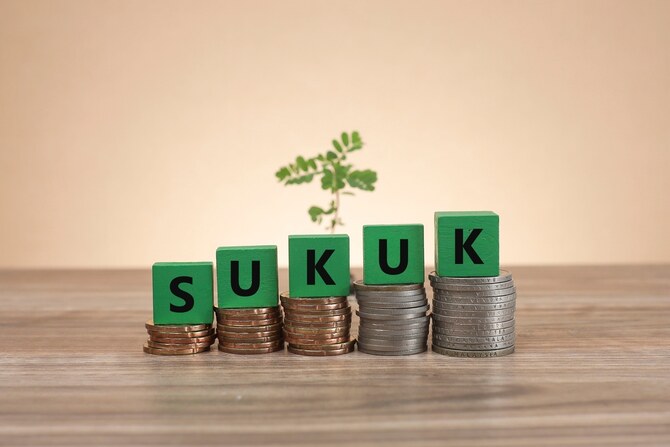
The latest riyal-denominated offering, managed by the National Debt Management Center, follows a SR3.72 billion issuance in January. Shutterstock
Short Url
Updated 19 February 2025
Follow

Saudi Arabia raises $818m in February sukuk sale 

RIYADH: Saudi Arabia raised SR3.07 billion ($818 million) through its February sukuk issuance as the Kingdom continues to tap debt markets to support economic diversification efforts. 

The latest riyal-denominated offering, managed by the National Debt Management Center, follows a SR3.72 billion issuance in January. The Kingdom raised SR11.59 billion in December and SR3.41 billion in November, according to official data. 

Sukuk, a Shariah-compliant financing instrument, allows investors to hold partial ownership in an issuer’s assets while adhering to Islamic finance principles. Saudi Arabia has been a key player in the global sukuk market, leveraging debt sales to finance projects under its Vision 2030 economic transformation plan. 

According to the NDMC, the February issuance was split into four tranches. The first, valued at SR585 million, matures in 2029, while the second, at SR1.70 billion, is set to mature in 2032. The third tranche, worth SR404 million, is due in 2036, and the final portion, totaling SR376 million, will expire in 2039. 

Saudi Arabia is expected to play a leading role in driving global debt and sukuk issuance over the next two years, Fitch Ratings said earlier this month. The Kingdom’s financial institutions and corporations are increasingly turning to international debt markets to diversify their funding sources, the agency noted. 

A separate report by Fitch projected Saudi Arabia’s debt capital market to reach $500 billion by the end of 2025, supported by a growing pipeline of infrastructure and development projects. 

The Kingdom is also set to lead bond and sukuk maturities in the Gulf region, with redemptions expected to total $168 billion between 2025 and 2029, according to a December report by Kamco Invest. Government-issued debt will account for the largest share, with maturities projected to reach $110.2 billion during the period. 

Across the Gulf Cooperation Council, the debt capital market surpassed the $1 trillion mark in outstanding issuances by the end of November, Fitch said in a separate report. 

Meanwhile, global sukuk issuance is forecast to range between $190 billion and $200 billion in 2025, driven by activity in key markets such as Saudi Arabia and Indonesia, according to S&P Global. The credit rating agency reported that global sukuk sales totaled $193.4 billion in 2024, slightly down from $197.8 billion in 2023.


Saudi Arabia set to attract $500bn in private investment, Al-Falih tells conference

Updated 09 December 2025
Follow

Saudi Arabia set to attract $500bn in private investment, Al-Falih tells conference

RIYADH: Sustainability, technology, and financial models were among the core topics discussed by financial leaders during the first day of the Momentum 2025 Development Finance Conference in Riyadh.

The three-day event features more than 100 speakers and over 20 exhibitors, with the central theme revolving around how development financial institutions can propel economic growth.

Speaking during a panel titled “The Sustainable Investment Opportunity,” Saudi Investment Minister Khalid Al-Falih elaborated on the significant investment progress made in the Kingdom.

“We estimate in the midterm of 2030 or maybe a couple of years more or so, about $1 trillion of infrastructure investment,” he said, adding: “We estimate, as a minimum, 40 percent of this infrastructure is going to be financed by the private sector, so we’re talking in the next few years $400 (billion) to $500 billion.”

The minister drew a correlation between the scale of investment needs and rising global energy demand, especially as artificial intelligence continues to evolve within data processing and digital infrastructure in global spheres.

“The world demand of energy is continuing to grow and is going to grow faster with the advent of the AI processing requirements (…) so our target of the electricity sector is 50 percent from renewables, and 50 percent from gas,” he added.

Al-Falih underscored the importance of AI as a key sector within Saudi Arabia’s development and investment strategy. He made note of the scale of capital expected to go into the sector in coming years, saying: “We have set a very aggressive, but we believe an achievable target, for AI, and we estimate in the short term about $30 billion immediately of investments.”

This emphasis on long-term investment and sustainability targets was echoed across panels at Momentum 2025, during which discussions on essential partnerships between public and private sectors were highlighted.

The shared ambition of translating the Kingdom’s goals into tangible outcomes was particularly essential within the banking sector, as it plays a central role in facilitating both projects and partnerships.

During the “Champions of Sectoral Transformation: Development Funds and Their Ecosystems” panel, Saudi National Bank CEO Tareq Al-Sadhan shed light on the importance of partnerships facilitated via financial institutions.

He explained how they help manage risk while supporting the Kingdom’s ambitions.

“We have different models that we are working on with development funds. We co-financed in certain projects where we see the risk is higher in terms of going alone as a bank to support a certain project,” the CEO said.

Al-Sadhan referred to the role of development funds as an enabler for banks to expand their participation and support for projects without assuming major risk.

“The role of the development fund definitely is to give more comfort to the banking sector to also extend the support … we don’t compete with each other; we always complement each other” he added.