

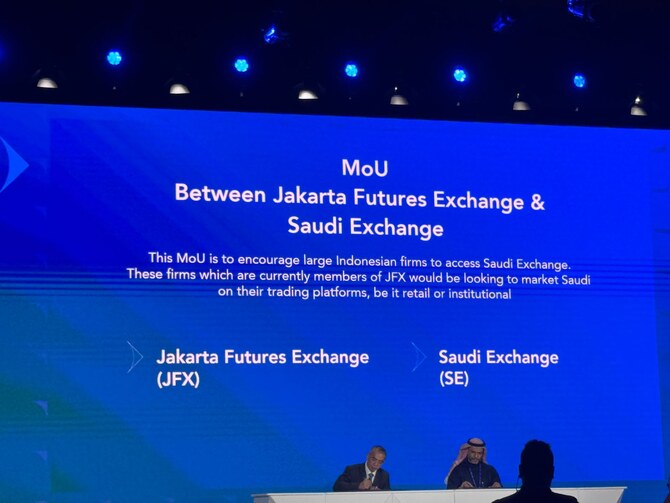

RIYADH: Saudi Arabia’s stock market is set to attract Indonesian firms following a new memorandum of understanding with the Jakarta Futures Exchange.
Signed during the fifth Capital Market Forum, the agreement will see JFX members promoting the Kingdom’s trading platforms to both retail and institutional investors, strengthening financial ties between the two markets.
In another step to bolster Saudi Arabia’s financial infrastructure, Fidelity Information Services Global inked an MoU with Muqassa, a subsidiary of the Saudi Tadawul Group, to enhance the Kingdom’s derivatives market. The partnership aims to integrate advanced technologies that improve market efficiency and liquidity.
These deals were among eight agreements signed during the conference, underscoring Saudi Arabia’s continued push for financial sector expansion and technological advancement.
The Financial Academy and Saudi Tadawul Group also joined forces to launch specialized training programs tailored for the financial industry.
The initiative, developed in collaboration with leading universities, will introduce the Sustainability Specialist in the Financial Sector certification and host workshops to deepen industry expertise.
Awqaf Investment has signed two key agreements. The first, with SNB Capital, is aimed at serving the SR8 billion ($2.1 billion) Awqaf market, with a focus on developing improved investment products that cater to the sector’s needs.
The second, an investment advisory agreement with Ehsan, will see Awqaf Investment Co. providing strategic advisory services for the Ehsan Waqf Fund, further strengthening the Kingdom’s philanthropic investment landscape.
Saudi Arabia’s real estate market is also set to benefit from a new collaboration between Aljazira Capital and Target, as the two entities launch the Wahat Alnakheel Real Estate Fund — a major initiative with a fund size exceeding SR1 billion.
Meanwhile, Dalipal Holdings Limited has partnered with Saudi investment firm BMG Financial Group to strengthen Dalipal’s presence in the Kingdom’s energy sector. The MoU leverages BMG’s regulatory expertise and investor network with Dalipal’s specialization in high-end energy pipes and seamless steel products. The collaboration could pave the way for a potential Dalipal listing on the Saudi Exchange.
A significant trilateral partnership was also unveiled, with Wamid, Google Cloud, and Deloitte teaming up to develop and launch new capital market data products. The initiative positions Saudi Tadawul Group as a leader in financial innovation and digital transformation.
Additionally, the Saudi Securities Depository Center Co., known as Edaa, has launched EDAA CONNECT, a centralized platform for mutual fund investments across the Saudi capital market.
The initiative, developed in partnership with 11 financial firms — including Albilad Capital, AlRajhi Capital, and Rassanah Capital, as well as Saudi Awwal Bank Invest, and SNB Capital — aims to streamline fund access and enhance investment efficiency.
Saudi Tadawul Group and its subsidiaries announced a series of strategic initiatives aimed at advancing the Saudi financial market.
The group unveiled the launch of the STG App, an integrated platform designed to unify all group services, streamline processes for investors, companies, and market participants, and simplify market access.


