



RIYADH: High interest rates, inflation concerns, and currency volatility are unlikely to disrupt Saudi Arabia’s non-oil economic growth, according to market experts citing resilience and structural reforms as key stabilizers.
Despite global economic uncertainty, the Kingdom’s private sector continues to expand, supported by steady investment flows and a diversified capital market.
During a panel discussion at the Capital Markets Forum in Riyadh, the co-Head of the Equity Capital Markets Origination team for the Europe, Middle East, and Africa region at Morgan Stanley, Natasha Sanders, emphasized the Kingdom’s economic stability, particularly outside of oil and commodities.
“We actually see (Saudi Arabia’s) economy being very resilient. And if you look at non-oil and non-commodities sectors, the growth has been very steady and actually very consistent, so we don’t see as much volatility,” she said.
She also highlighted that global monetary policy shifts, particularly in the US, could influence markets but are unlikely to derail the Kingdom’s growth trajectory.
“The most immediate impact is this uncertainty delaying the interest rate cutting cycle, and I think that’s something corporates and investors need to be able to navigate during this year,” Sanders said.
She added that the US Federal Reserve is being cautious, with bond markets anticipating a possible rate cut in June. However, the timing will depend on inflation trends.
Despite fluctuations in the dollar, Saudi Arabia’s outlook remains optimistic.
“It’s positive for oil economies. It’s been more challenging for the emerging markets,” Sanders said, adding that the Kingdom’s non-oil sectors continue to expand.
She also highlighted Saudi Arabia’s decreasing reliance on oil price movements, saying: “The effective use of policy tools means that currently, there’s less sensitivity to oil prices compared to what we’ve seen in the past.”
Faisal Al-Azmeh, head of Central and Eastern Europe, the Middle East, and Africa equity research at Goldman Sachs, echoed this sentiment, predicting stable economic conditions for the Kingdom despite external pressures.
“Goldman expects a rate cut in the second quarter of this year and another one in the fourth quarter of this year,” he said, adding that another is likely in the second quarter of 2026.
While oil will remain a key source of funding for economic diversification, he emphasized that Saudi Arabia’s “structural reforms” and “meaningful amount of oil revenue diversification” have significantly reduced its dependence on oil prices compared to five years ago.
Foreign investment continues to pour into the Kingdom, driven by the country’s growing initial public offering market and broader economic reforms.
Sanders highlighted that foreign direct investment continues to rise across various sectors while public markets remain highly liquid.
The expansion of Saudi Arabia’s capital markets is part of a broader effort to drive economic diversification under Vision 2030.
Sanders pointed to a major shift in the Kingdom’s economic structure, underlining that the private non-oil sector now accounts for 50 percent of the gross domestic product, up from 30 percent two decades ago.
“We’ve also seen increased diversification of the labor force, certification of funding with an increase in borrowing,” she said.
More companies are raising capital from foreign sources, including private equity, growth funds, and infrastructure funds. “So that’s all the proof that Vision 2030 is working and delivering results,” she added.
Charles-Henry Gaultier, equity capital markets managing director at Paris Lazard, credited Saudi Arabia’s proactive regulatory reforms for increasing foreign investor confidence.
“I think it’s really the decisive action taken by the government here, quite frankly, to align not only market regulations on international practice, which made global investors very comfortable deploying money in the region, but also all the technicalities of market functions that were there again aligned with best world practice,” he said.
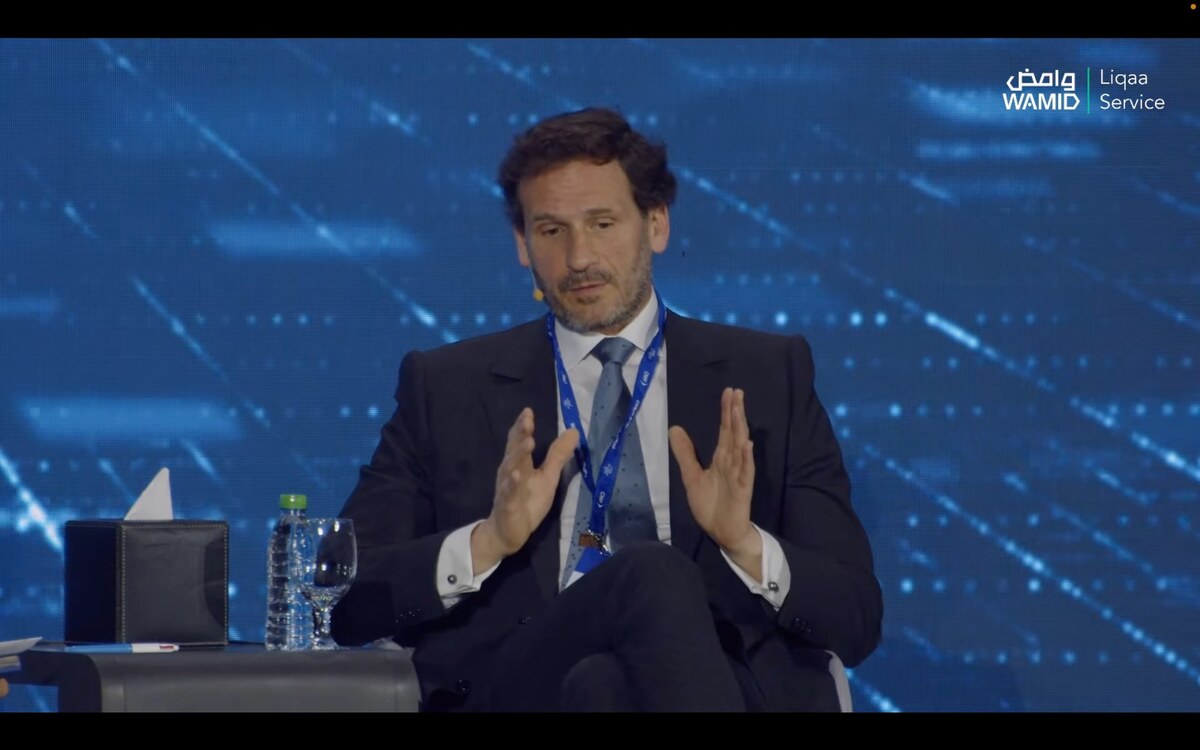
Charles-Henry Gaultier, equity capital markets managing director at Paris Lazard. Screenshot
He also highlighted the importance of the Kingdom’s IPO as a turning point in the market’s development.
“Because you need to start with one transaction, the government there again led the way with the emblematic IPO of Aramco, which demonstrated to the world the depth and liquidity of the market,” he added.
Saudi Arabia’s inclusion in global indices has further accelerated foreign capital inflows.
“With the entrance of the Kingdom and the markets of the Kingdom into the global indices, MSCI (Morgan Stanley Capital International), Russell, there again. It just provides more and more liquidity, more comfort to global investors, that they can deploy money, trade in and out of securities in the Kingdom,” Gaultier said.
He noted that Saudi IPOs alone accounted for nearly $4 billion in capital raised, making up one-third of the 23 percent growth in overall EMEA initial listing volumes.
Shakir Iqbal, head of CEEMEA Equity Sales at J.P. Morgan, pointed out that international investors are increasingly looking to the Kingdom to diversify their portfolios.
“You’d like to think that everyone’s coming here because these IPOs tend to perform, which they do. But I think it’s also the fact that you basically have structural underweight positions for global investors in the region,” he said.
He added that these initial listings and equity capital market activity offer investors a way to increase exposure to Saudi assets.
Saudi Arabia’s IPO market is also evolving beyond traditional sectors. “You’re actually seeing a representation of new economy companies,” Iqbal said, adding: “You’re seeing tech companies list. You’re seeing consumer names that we haven’t seen before, health care names, real estate.”
This diversification, he noted, is attracting global investors looking for unique opportunities in the region.
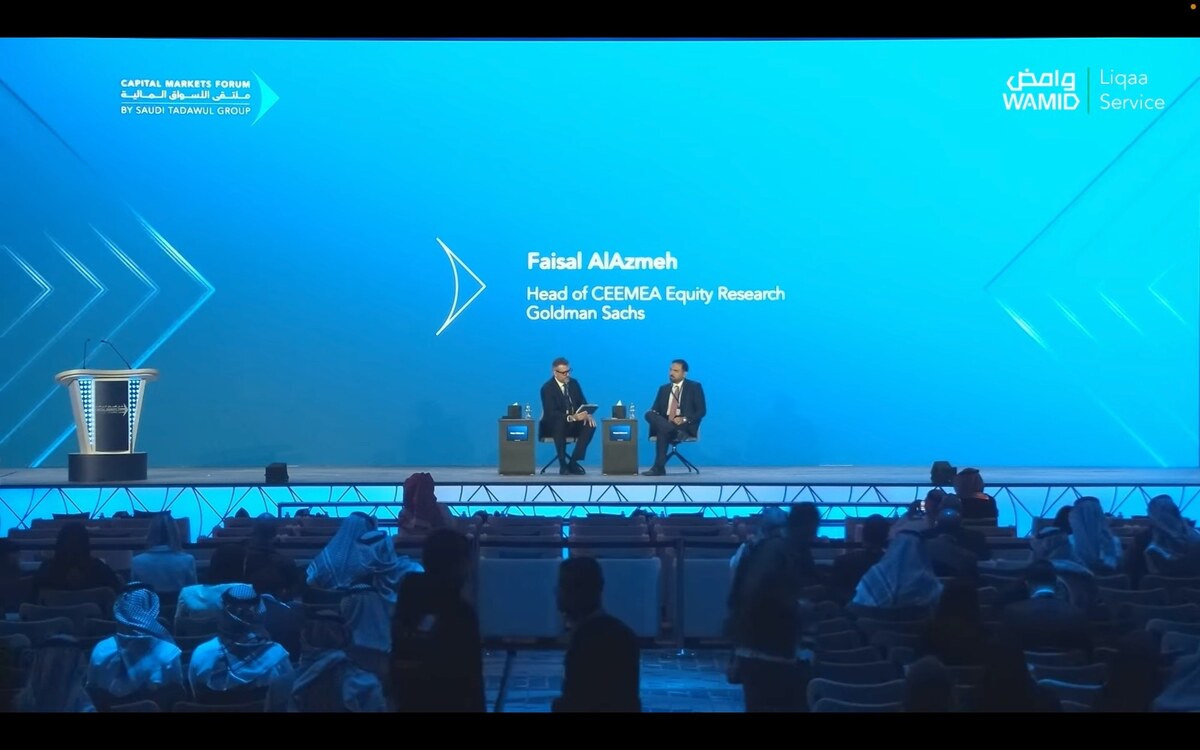
Faisal Al-Azmeh, head of Central and Eastern Europe, the Middle East, and Africa equity research at Goldman Sachs. Screenshot
Goldman Sachs remains bullish on the Kingdom’s financial markets in 2025. “We are overweight (on Saudi Arabia). We’re also constructive on a few other GCC (Gulf Cooperation Council) markets,” Al-Azmeh said.
He projected overall earnings per share growth of around 14 percent for the year, “largely coming from the financial space and the material space.”
Al-Azmeh also pointed to strong opportunities in regulated energy companies and real estate, particularly in the UAE.


