

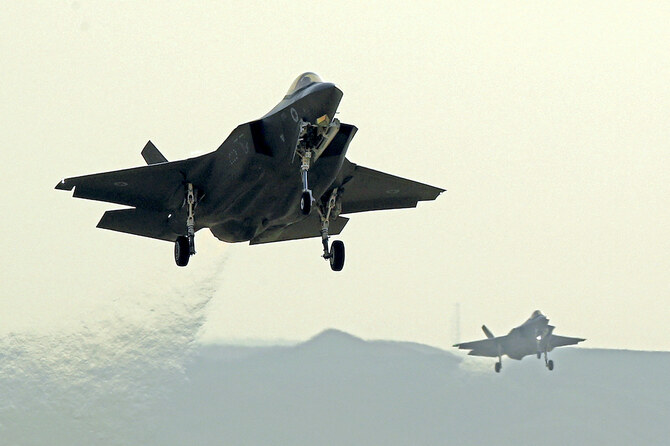

LONDON: More than 200 organizations worldwide have urged countries involved in the F-35 jet program to halt arms transfers to Israel over fears of humanitarian law violations, The Guardian reported on Tuesday.
It comes as the war in Gaza reached 500 days, with the F-35 jet being used extensively by the Israeli Air Force to conduct bombing operations throughout the conflict.
The organizations signed a letter that was sent on Monday to government ministers in the UK, the US, Australia, Canada, Denmark, Italy, the Netherlands and Norway.
The 232 signatories come from the countries involved in production of the jet, as well as Jordan, Lebanon, India, Belgium, Switzerland, Ireland and elsewhere.
Leading charities such as Oxfam, Amnesty International and Human Rights Watch signed the letter, which was coordinated by the Campaign Against Arms Trade.
It says: “The past 15 months have illustrated with devastating clarity that Israel is not committed to complying with international law.
“Partners to the F-35 program have individually and collectively failed to prevent these jets from being used to commit serious violations of international law by Israel.
“States have either been unwilling to observe their international legal obligations and/or claimed that the structure of the F-35 program means that it is not possible to apply arms controls to any end-user, making the entire program incompatible with international law.”
Israel is part of the international agreement behind the F-35 program. British firms supply 15 percent of the parts used in the jet, which is produced by a global consortium led by US defense firm Lockheed Martin.
Governments including those of the US, the UK, Australia and Canada have faced legal action over their involvement in granting arms licenses to Israel that include F-35 components.
The UK in September suspended 30 out of 350 arms export licenses to Israel over fears that the weapons may be used to violate international humanitarian law.
But components of the F-35 were exempt from the suspension for reasons of “international peace and security.”
All countries in the F-35 program are parties to the arms trade treaty, except the US, which is a signatory.
The treaty requires the prevention of military transfers where a risk of humanitarian law violations exists.
More than 48,000 people have been killed in Gaza since October 2023, with some researchers saying the death toll could be up to 40 percent higher than the number recorded by the enclave’s Health Ministry.
Katie Fallon, advocacy manager at CAAT, said: “The F-35 jet program is emblematic of the West’s complicity in Israel’s crimes against Palestinians.
“These jets were instrumental in Israel’s 466-day bombardment of Gaza, in crimes that include war crimes, crimes against humanity and genocide.
“Since the limited ceasefire the US government, and lead partner to the F-35 program, has threatened Gaza with mass ethnic cleansing and forced displacement.
“This program gives material and political consent from all western partners, including the UK, for these crimes to continue.”


