

Ukraine seeks surge in domestic arms production as US diverts Swiss order for Patriots to Kyiv

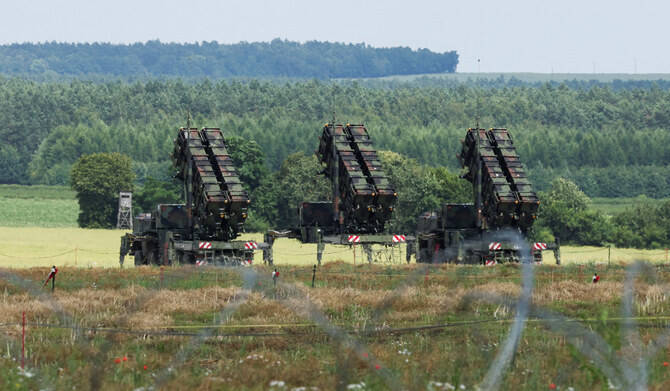
A new Ukrainian government approved Thursday will race to expand domestic arms production to meet half the country’s weapons needs within six months as it tries to push back Russia’s invasion, Ukrainian President Volodymyr Zelensky said. (Reuters/File)
Short Url
Updated 17 July 2025
Follow

Ukraine seeks surge in domestic arms production as US diverts Swiss order for Patriots to Kyiv

  • The Swiss Defense Ministry said Thursday it has been informed by the US Defense Department that it will “reprioritize the delivery of Patriot systems to support Ukraine”
  • “What we need is greater capacity to push the war back onto Russia’s territory,” Zelensky said

KYIV: A new Ukrainian government approved Thursday will race to expand domestic arms production to meet half the country’s weapons needs within six months as it tries to push back Russia’s invasion, Ukrainian President Volodymyr Zelensky said.

Meanwhile, Switzerland said Thursday that the US Defense Department had informed it that Washington is diverting a Swiss order for Patriot air defense systems to Ukraine, which badly needs to improve its response to increasingly heavy Russian aerial attacks.

The Swiss Defense Ministry, which in 2022 ordered five Patriot systems, said Thursday it has been informed by the US Defense Department that it will “reprioritize the delivery of Patriot systems to support Ukraine.”

Delivery to Switzerland of the systems, worth billions of dollars, was scheduled to begin in 2027 and be completed in 2028. But the Swiss government said Washington informed it of the delay on Wednesday, adding that it was unclear how many systems would be affected.

Domestic defense manufacturing already accounts for almost 40 percent of weapons used by the Ukrainian military, according to Zelensky. As uncertainty grows about how many more weapons shipments Western countries can provide — and how quickly — Ukraine is keen to increase its output and widen its strikes on Russian soil.

“What we need is greater capacity to push the war back onto Russia’s territory — back to where the war was brought from,” Zelensky said late Wednesday in his nightly video address.

“We must reach the level of 50 percent Ukrainian-made weapons within the first six months of the new government’s work by expanding our domestic production.”

The need to adequately arm Ukraine’s military is pressing as Russia looks to drive forward its summer offensive and pounds Ukrainian cities with hundreds of drones and ballistic and cruise missiles.

Meanwhile, it remained unclear when promises of US-made weapons, especially Patriot missile systems crucial for stretched Ukrainian air defenses, might reach Ukraine. US President Donald Trump agreed to send the weaponry, but it will be paid for by European countries.

NATO’s Supreme Allied Commander Europe, Gen. Alexus Grynkewich, told the Associated Press Thursday that “preparations are underway” for weapons transfers to Ukraine and that NATO is working “very closely” with Germany to transfer Patriot systems.

Grynkewich said at a military event in Wiesbaden, Germany, that he had been ordered to “move (the weapons) out as quickly as possible.” He said the number of weapons being transferred is classified.

“We’re already in preparation phase for the first tranche of capability to start moving with respect to Patriots,” he said.

An expert working group under NATO’s Supreme Allied Commander Europe will discuss concrete planning “very quickly but also with corresponding caution,” German Defense Ministry spokesperson Mitko Müller said Wednesday.

He said details were still being worked out.

“Regarding the systems that we are talking about, I can’t confirm that anything is currently on the way. I’m not aware of that,” he said.

NATO chief Mark Rutte said in Washington on Monday that the alliance is coordinating the military support with funding from allies in Europe and Canada. He said there were commitments from Germany, Finland, Denmark, Sweden, Norway, the United Kingdom, the Netherlands and Canada “with more expected to follow.”

Ukraine has also developed its own long-range drones, which it uses to strike deep inside Russia.

Russian air defenses shot down 122 Ukrainian drones overnight, the country’s defense ministry said Thursday. The wave of drones caused flights to be grounded at airports in Moscow and St. Petersburg, although most of the drones were reportedly destroyed over the border regions of Bryansk and Kursk.

Meanwhile, Russia attacked Ukraine with 64 Shahed and decoy drones overnight, killing at least one person, the Ukrainian air force reported. The assault centered on the industrial Dnipropetrovsk region, officials said.

In other developments:
Russia on Thursday sent to Ukraine 1,000 bodies, including some of the country’s fallen soldiers, the Ukrainian Coordination Headquarters for the Treatment of Prisoners of War said.

At the same time, Russia received the bodies of 19 soldiers, Russian presidential aide Vladimir Medinsky said.

The exchange was part of a deal reached at direct peace talks last May and June that produced few other agreements between the sides.


China’s DeepSeek trained AI model on Nvidia’s best chip despite US ban, official says

Updated 6 sec ago
Follow

China’s DeepSeek trained AI model on Nvidia’s best chip despite US ban, official says

  • DeepSeek could remove technical indicators showing use of US chips, official says
  • US export ‌controls bar Blackwell shipments to China

WASHINGTON: Chinese AI startup DeepSeek’s latest AI model, ​set to be released as soon as next week, was trained on Nvidia’s most advanced AI chip, the Blackwell, a senior Trump administration official said on Monday, in what could represent a violation of US export controls.
The US believes DeepSeek will remove the technical indicators that might reveal its use of American AI chips, the official said, adding that the Blackwells are likely clustered at its data center in Inner Mongolia, an autonomous region of China.
The person declined to say how the US government received the information or how DeepSeek obtained the chips, but emphasized that US policy ‌is :“we’re not shipping ‌Blackwells to China.”
Nvidia declined to comment, while the Commerce Department and ​DeepSeek ‌did ⁠not respond ​to ⁠requests for comment.
The Chinese embassy in Washington said Beijing opposes “drawing ideological lines, overstretching the concept of national security, expansive use of export controls and politicizing economic, trade, and technological issues.”
The news, not previously reported, could further divide Washington policymakers as they struggle to determine where to draw the line on Chinese access to the crown jewels of American AI semiconductor chips.
China hawks fear chips could easily be diverted from commercial uses to help supercharge China’s military and threaten US dominance in AI.
But White House AI ⁠Czar David Sacks and Nvidia CEO Jensen Huang argue that shipping advanced ‌AI chips to China discourages Chinese competitors like Huawei ‌from redoubling efforts to catch up with Nvidia’s and AMD’s technology.
US ​export controls, overseen by the Commerce Department, currently ‌bar Blackwell shipments to China.
In August, US President Donald Trump opened the door to Nvidia ‌selling a scaled-down version of the Blackwell in China. But he later reversed course, suggesting the firm’s most advanced chips should be reserved for US companies and kept out of China.
Trump’s decision in December to allow Chinese firms to buy Nvidia’s second most advanced chips, known as the H200, drew sharp criticism from China ‌hawks, but shipments of the chips remain stalled over guardrails built into the approvals.
“Chinese AI companies’ reliance on smuggled Blackwells underscores their massive ⁠shortfall of domestically produced ⁠AI chips and why approvals of H200 chips would represent a lifeline,” said Saif Khan, who served as director of technology and national security at the White House’s National Security Council under former President Joe Biden.
The official declined to comment on how the latest news would impact the Trump administration’s decision on whether to allow DeepSeek to buy H200s.
The model they helped train likely relied on the “distillation” of models made by leading-edge US AI companies, including Anthropic, Google, OpenAI, and xAI, echoing allegations made by OpenAI and Anthropic, the official added.
The technique known as distillation involves having an older, more established and powerful AI model evaluate the quality of the answers coming out of a newer model, effectively transferring the older model’s learnings.
Hangzhou-based DeepSeek shook markets early last ​year with a set of AI models that ​rivaled some of the best offerings from the US, fueling concerns in Washington that China could catch up in the AI race despite restrictions.