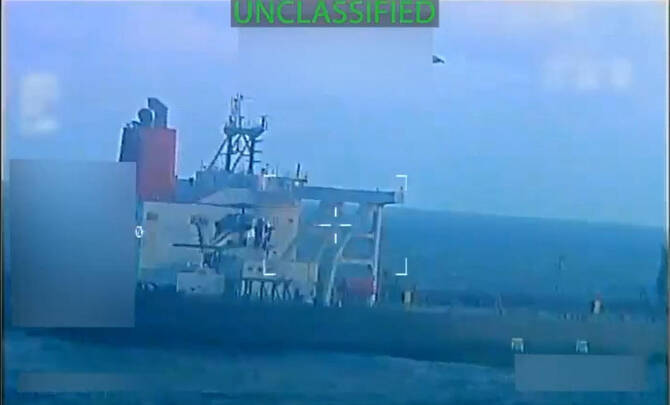
US moves to legally control tanker and 2M barrels of oil seized off Venezuela’s coast in December

The Justice Department has filed a complaint to legally take ownership of a sanctioned tanker and nearly 2 million barrels of petroleum seized off the coast of Venezuela in December. (AFP/File)
Short Url
Updated 27 February 2026
Follow

US moves to legally control tanker and 2M barrels of oil seized off Venezuela’s coast in December

  • “The era of secretly bankrolling regimes that pose clear threats to the United States is over,” Bondi said
  • The Trump administration has set out to control the production, refining and global distribution of Venezuela’s oil

WASHINGTON: The Justice Department has filed a complaint to legally take ownership of a sanctioned tanker and nearly 2 million barrels of petroleum seized off the coast of Venezuela in December, another step by President Donald Trump’s administration to assert power over the country’s oil sector after capturing leader Nicolás Maduro.
It’s the first complaint filed by the US to start the legal process to formally take control of one of at least 10 oil tankers intercepted by American authorities since late last year. The US has accused Venezuela of using a shadow fleet of falsely flagged vessels to smuggle illicit crude into global supply chains.
“Under President Trump’s leadership, the era of secretly bankrolling regimes that pose clear threats to the United States is over,” Attorney General Pam Bondi said in an emailed statement.
“This Department of Justice will deploy every legal authority at our disposal to completely dismantle and permanently shutter any operation that defies our laws and fuels chaos across the globe.”
The seizure of the vessel, named the Skipper, in December was the Republican administration’s first in a series of similar actions and marked a dramatic escalation in Trump’s campaign to pressure Maduro by cutting off access to oil revenue that has long been the lifeblood of Venezuela’s economy.
Maduro was arrested in a US raid last month and was taken to New York to face drug trafficking charges. He has pleaded not guilty, protesting his capture and declaring himself “the president of my country.” Following his ouster, several vessels fled the coast of Venezuela in spite of Trump’s quarantine on sanctioned oil tankers, and US forces have tracked and interdicted some of them as far away as the Indian Ocean.
The Trump administration has set out to control the production, refining and global distribution of Venezuela’s oil and oversee where the revenue flows. The US has begun lifting broad sanctions to allow foreign companies to operate in Venezuela in a bid to revitalize the ailing oil industry.
A judge in Washington’s federal court must sign off on the US government’s bid to permanently take ownership of the Skipper and its cargo so the oil can potentially be sold.
The Justice Department alleges the tanker moved oil from Iran and Venezuela throughout the world, flying false flags to hide its illegal activities while providing revenue for Iran’s paramilitary Revolutionary Guard, which the US has deemed a foreign terrorist organization.
“Because of the coordinated efforts of our prosecutors and law enforcement partners, a ghost tanker that for years secretly moved illicit oil from Iran and Venezuela around the globe has been taken off the seas,” Assistant Attorney General A. Tysen Duva, who leads the Justice Department’s Criminal Division, said in a statement.
“Today’s actions are an important step in making America and the world safer by disrupting the flow of millions of dollars to foreign terrorist organizations,” he said.


Afghanistan says it thwarted Pakistani airstrike on Bagram Air Base as fighting enters fourth day

Updated 01 March 2026
Follow

Afghanistan says it thwarted Pakistani airstrike on Bagram Air Base as fighting enters fourth day

  • The fighting has been the most severe between the neighbors for years
  • Pakistan accuses Taliban government of harboring militant groups that stage attacks against it

KABUL: Afghanistan thwarted attempted airstrikes on Bagram Air Base, the former US military base north of Kabul, authorities said Sunday, while cross-border fighting between Pakistan and Afghanistan stretched into a fourth day.
The fighting has been the most severe between the neighbors for years, with Pakistan declaring that it’s in “open war” with Afghanistan.
The conflict has alarmed the international community, particularly as the area is one where other militant organizations, including Al-Qaeda and the Daesh group, still have a presence and have been trying to resurface.
Pakistan accuses Afghanistan’s Taliban government of harboring militant groups that stage attacks against it and also of allying with its archrival India.
Border clashes in October killed dozens of soldiers, civilians and suspected militants until a Qatari-mediated ceasefire ended the intense fighting. But several rounds of peace talks in Turkiye in November failed to produce a lasting agreement, and the two sides have occasionally traded fire since then.
On Sunday, the police headquarters of Parwan province, where Bagram is located, said in a statement that several Pakistani military jets had entered Afghan airspace “and attempted to bomb Bagram Air Base” at around 5 a.m.
The statement said Afghan forces responded with “anti-aircraft and missile defense systems” and had managed to thwart the attack.
There was no immediate response from Pakistan’s military or government regarding Kabul’s claim of attempted airstrikes on Bagram or the ongoing fighting.
Bagram was the United States’ largest military base in Afghanistan. It was taken over by the Taliban as they swept across the country and took control in the wake of the chaotic US withdrawal from the country in 2021. Last year, US President Donald Trump suggested he wanted to reestablish a US presence at the base.
The current fighting began when Afghanistan launched a broad cross-border attack on Thursday night, saying it was in retaliation for Pakistani airstrikes the previous Sunday.
Pakistan had said its airstrike had targeted the outlawed Pakistani Taliban, also known as Tehreek-e-Taliban Pakistan, or TTP. Afghanistan had said only civilians were killed.
The TTP militant group, which is separate but closely allied with Afghanistan’s ruling Taliban, operates inside Pakistan, where it has been blamed for hundreds of deaths in bombings and other attacks over the years.
Pakistan accuses Afghanistan’s Taliban government of providing a safe haven within Afghanistan for the TTP, an accusation that Afghanistan denies.
After Thursday’s Afghan attack, Pakistani Defense Minister Khawaja Mohammad Asif declared that “our patience has now run out. Now it is open war between us.”
In the ongoing fighting, each side claims to have killed hundreds of the other side’s forces — and both governments put their own casualties at drastically lower numbers.
Two Pakistani security officials said that Pakistani ground forces were still in control on Sunday of a key Afghan post and a 32-square-kilometer area in the southern Zhob sector near Kandahar province, after having seized it during fighting Friday. The captured post and surrounding area remain under Pakistani control, they added. The officials spoke on condition of anonymity, because they weren’t authorized to speak publicly.
In Kabul, the Afghan government rejected Pakistan’s claims. Deputy government spokesman Hamdullah Fitrat called the reports “baseless.”
Afghan officials said that fighting had continued overnight and into Sunday in the border areas.
The police command spokesman for Nangarhar province, Said Tayyeb Hammad, said that anti-aircraft missiles were used from the provincial capital, Jalalabad, and surrounding areas on Pakistani fighter jets flying overhead Sunday morning.
Defense Ministry spokesman Enayatulah Khowarazmi said that Afghan forces had launched counterattacks with snipers across the border from Nangarhar, Paktia, Khost and Kandahar provinces overnight. He said that two Pakistani drones had been shot down and dozens of Pakistani soldiers had been killed.
Fitrat said that Pakistani drone attacks hit civilian homes in Nangarhar province late Saturday, killing a woman and a child, while mortar fire killed another civilian when it hit a home in Paktia province.
There was no immediate response to the claims from Pakistani officials.