

Saudi Capital Market Forum expands globally with events in Hong Kong and New York

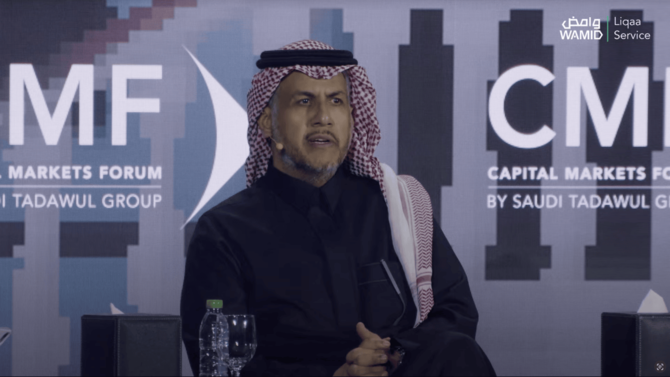
Khalid Al-Hussan, CEO of the Saudi Tadawul Group. Screenshot
Short Url
Updated 18 February 2025
Follow

Saudi Capital Market Forum expands globally with events in Hong Kong and New York

RIYADH: The Capital Market Forum is expanding its global footprint with two events scheduled in Hong Kong in May and New York in October, marking a step forward in Saudi Arabia’s financial sector growth. 

The new events were announced by the CEO of the Saudi Tadawul Group at its latest edition, which is running from Feb. 18 to 20 in Riyadh and serves as a platform for fostering international investment and regulatory collaboration. 

In a panel discussion titled “Global Capital Markets: Enhancing Resilience and Connectivity,” Khalid Al-Hussan emphasized the conference’s role in strengthening the Kingdom’s position as a global financial hub.

“Our market has evolved significantly. Previously, we had a single equity market accessible only to locals and residents. Today, we have two equity markets open to local, regional, and foreign investors,” Al-Hussan said, adding that foreign investment participation in the equity market has reached nearly $100 billion.

“Any investor can access any market. Any issuer can access any market. So, we need to build all the necessary components around the stock exchange to compete effectively,” he added.

Bonnie Y Chan, CEO of Hong Kong Exchanges and Clearing Limited, echoed the sentiment, emphasizing the need for a compelling value proposition for both issuers and investors. “We want to ensure we offer a full suite of products,” she said, acknowledging 2025 as a year of continued uncertainty despite a positive start.

Roland Chai, president of European Market Services at Nasdaq, said: “When regulation works, it protects investors, ensures seamless markets, and upholds reliability and integrity. As technology evolves, we must align regulations with market development to maintain efficiency.”

CEO of the World Federation of Exchanges, Nandini Sukumar, praised Saudi Arabia’s market transformation, describing its development in the last five years as astonishing, striking, and visible.

Al-Hussan also outlined Saudi Tadawul Group’s strategic investments in financial infrastructure, particularly in data services. “We have heavily invested in data infrastructure, and our first cloud-based product is set to launch in April,” he revealed, emphasizing the importance of trading, clearing, and settlement solutions in capital market infrastructure.

With CMF facilitating over 600 scheduled meetings between investors and issuers globally, the forum is set to bolster international collaboration and solidify the Kingdom’s position as a key player in the financial sector.

The start of day one of the CMF highlighted key global economic trends for 2025, with experts emphasizing steady growth despite market volatility, with a focus on international resilience, inflation normalization, and market performance.


Saudi non-oil trade surplus with GCC jumps 102% in November  

Updated 08 February 2026
Follow

Saudi non-oil trade surplus with GCC jumps 102% in November  

RIYADH: Saudi Arabia’s non-oil trade surplus with Gulf Cooperation Council countries more than doubled in November, driven by a surge in exports, preliminary government data showed. 

The surplus reached about SR6.6 billion ($1.76 billion), up 102 percent from SR3.3 billion a year earlier, according to the General Authority for Statistics. 

Total non-oil trade with GCC countries rose 30 percent to SR20.4 billion from SR15.7 billion, as exports outpaced import growth. Non-oil goods exports climbed to SR13.5 billion in November from SR9.5 billion a year earlier, while imports increased to SR6.9 billion from SR6.2 billion. 

Re-exports made up the bulk of outbound trade, rising to SR9.76 billion in November from SR6.56 billion a year earlier, while national exports increased to SR3.75 billion from SR2.92 billion. 

The UAE remained Saudi Arabia’s largest GCC trading partner on a non-oil basis. Exports to the Emirates totaled SR10.48 billion in November versus SR7.18 billion a year earlier, comprising SR8.38 billion in re-exports and SR2.10 billion in national exports.   

Imports from the UAE were SR4.79 billion, up from SR3.95 billion, lifting the non-oil trade surplus with the UAE to about SR5.69 billion from SR3.23 billion.  

Trade with Kuwait also expanded, with exports rising to SR769.9 million from SR610.6 million, including SR199.2 million in re-exports and SR570.7 million in national exports. Imports from Kuwait fell to SR176.4 million from SR333.3 million, pushing the trade surplus to SR593.5 million from SR277.3 million.  

With Bahrain, exports edged down to SR900.7 million from SR929.7 million, reflecting a decline in re-exports to SR380.3 million from SR572.7 million, while national exports increased to SR520.4 million from SR356.9 million. Imports rose to SR862.4 million from SR662.4 million, reducing the surplus to SR38.3 million from SR267.2 million.  

Saudi Arabia narrowed its non-oil trade deficit with Oman, as exports increased to SR666.7 million from SR356.5 million, supported by re-exports of SR259.6 million versus SR39.3 million and national exports of SR407.0 million versus SR317.3 million.   

Imports from Oman declined to SR873.2 million from SR1.11 billion, bringing the trade balance to a deficit of SR206.6 million compared with a deficit of SR749.1 million in November 2024.  

Trade with Qatar strengthened, with exports rising to SR691.1 million from SR395.8 million, including re-exports of SR536.2 million versus SR253.9 million and national exports of SR155.0 million versus SR141.9 million. Imports increased to SR199.3 million from SR148.9 million, resulting in a surplus of SR491.8 million, up from SR246.9 million.