ISLAMABAD: Economic Affairs Minister Ahad Cheema has said that Pakistan plans to privatize more than 50 state-owned enterprises (SOEs) within the next four years as part of its efforts to overhaul public entities and improve their performance, the Pakistani government said on Monday.
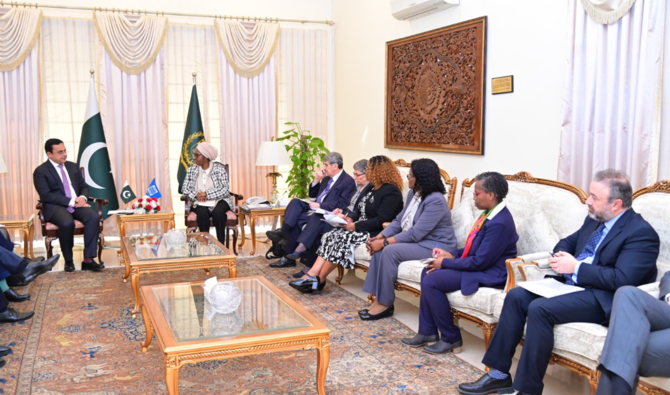
Cheema said this during his meeting with a delegation of top officials of the World Bank Group (WBG), according to the Press Information Department (PID) of the Pakistani government. The visit aims to enhance understanding of Pakistan’s economic, political, social and governance landscape, while exploring opportunities for future development support.
The development comes months after Prime Minister Shehbaz Sharif announced his government would privatize all state entities, except those considered “strategically important” or essential. In 2023, the International Monetary Fund (IMF), as part of Pakistan’s $3 billion bailout, had stressed the need for stronger governance of SOEs, whose losses were heavily impacting the government finances.
Last year Pakistan’s Cabinet Committee on Privatization (CCOP), responsible for the Privatization Program 2024-29, approved the privatization of 24 entities. However, it decided that the inclusion of other state entities would be determined after a review to assess their categorization as strategic or essential enterprises.
“In the first phase, the government is focusing on the privatization of power distribution companies (DISCOS) and in the second phase, Pakistan International Airlines (PIA) and other SOEs are to be privatized,” Cheema was quoted as saying by the PID, following his meeting with the World Bank delegation.
“The minister shared that the government aims to privatize up to 50 SOEs over the next 3-4 years.”
The minister informed the delegation about the challenges faced by the power sector, including high tariffs for consumers, inefficiencies in line losses and efforts to achieve full cost of recovery, according to the statement.
The World Bank delegates commended Pakistan’s efforts in addressing critical challenges and expressed their support for Pakistan’s newly launched Country Partnership Framework (CPF) for 2026-2035 to help achieve its development goals, with an unprecedented commitment of $40 billion. It would include sovereign lending of $20 billion by the International Development Association (IDA) and International Bank for Reconstruction & Development (IBRD). IFC will mobilize another $20 billion to foster private sector investments in Pakistan.
Last week, Pakistan also signed a financial advisory agreement with a consortium, led by Dubai-based Alvarez & Marsal Middle East Limited, to privatize three major power distribution companies.
The agreement is part of the government’s broader effort to reform the power sector which has long struggled with circular debt, operational inefficiencies and power theft. The divestment of state-run power companies is a key component of Pakistan’s economic reform agenda as outlined by the IMF in its current $7 billion loan program.


![]()

Pakistan says will privatize over 50 state entities within four years
Short Url
https://arab.news/b74b3
Pakistan says will privatize over 50 state entities within four years
- The statement comes after Economic Affairs Minister Ahad Cheema’s meeting with a World Bank delegation
- Divestment of state entities is key component of Pakistan’s reform agenda under $7 billion IMF program
Latest updates


Recommended


© 2026 SAUDI RESEARCH & PUBLISHING COMPANY, All Rights Reserved And subject to Terms of Use Agreement.