

Jeddah conference highlights Saudi-French archaeological discoveries on Farasan Islands

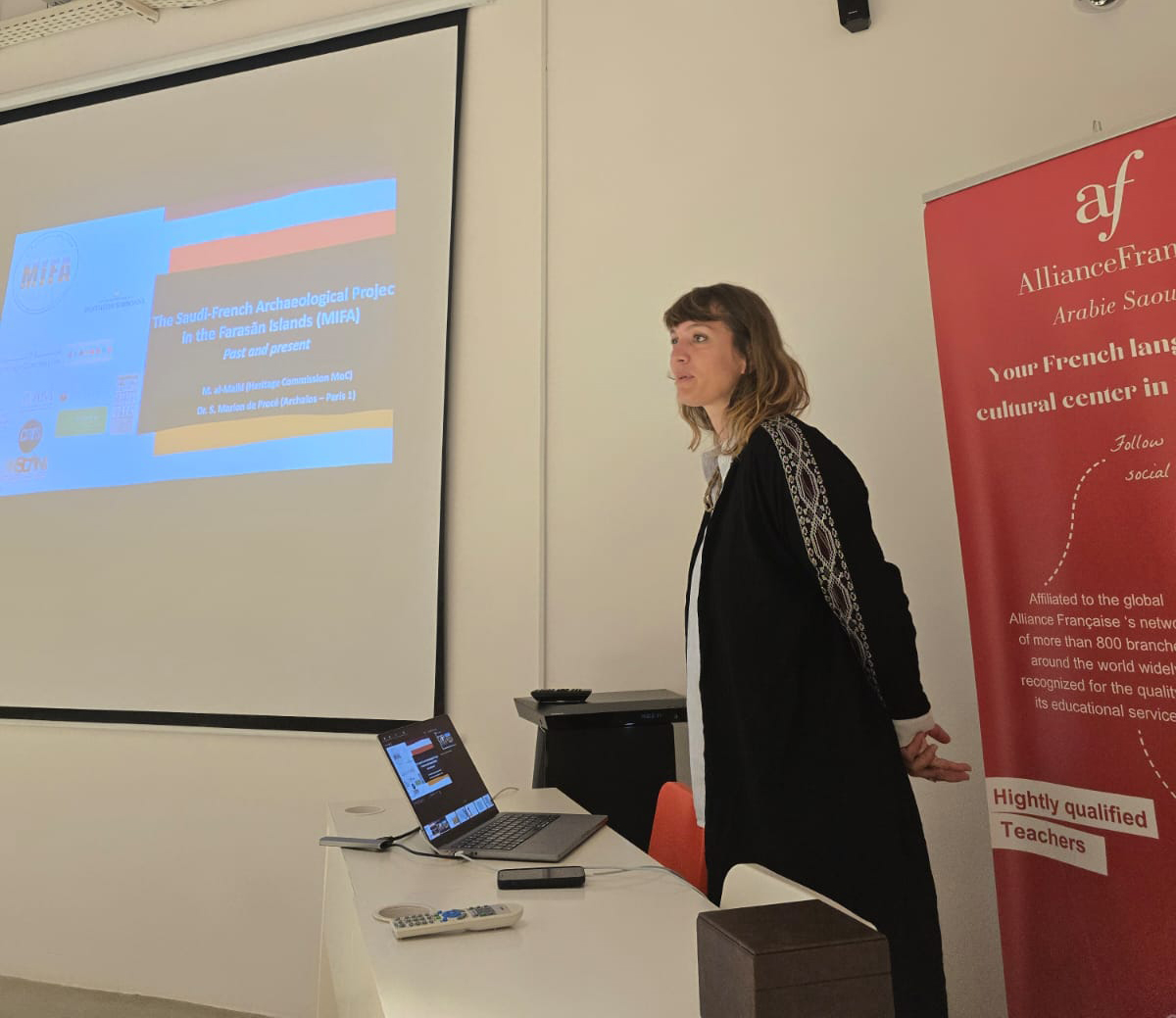
French archeologist and researcher Solene Marion de Proce provided a comprehensive overview of the collaborative efforts as part of the Saudi-French archeological mission on the Farasan Islands. (Supplied)
Short Url
Updated 18 February 2025
Follow

Jeddah conference highlights Saudi-French archaeological discoveries on Farasan Islands

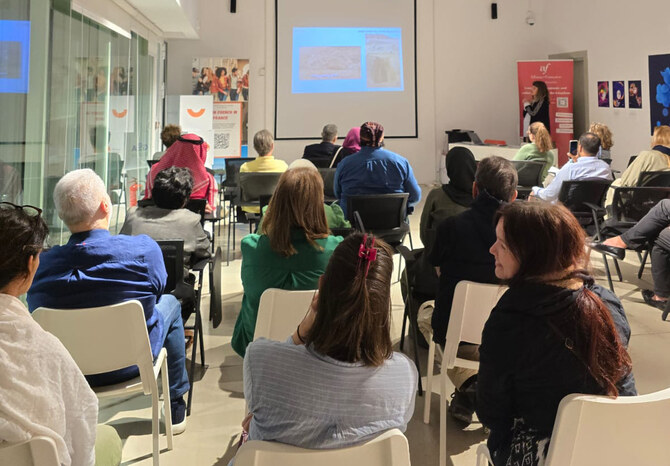
JEDDAH: French archaeologist and researcher Solene Marion de Proce hosted a conference titled “The Saudi-French Archaeological Project in the Farasan Islands: Past and Present” at the Alliance Francaise Saudi Arabia in Hay Jameel, Jeddah, on Sunday.

The conference explored the history and recent archaeological discoveries on the Farasan Islands, highlighting the outcomes of the unique scientific collaboration between France and Saudi Arabia.

In her presentation, Marion de Proce provided a comprehensive overview of the collaborative efforts between the Heritage Commission of the Ministry of Culture and the University Paris 1 Pantheon-Sorbonne as part of the Saudi-French archaeological mission on the Farasan Islands.

“We discussed the project’s history, sharing both past results and the most recent discoveries, as our team just completed the winter season of 2025,” she said. “The interest in the Farasan Islands began with the discovery of a Latin inscription by Farasani scholar, writer, and poet Ibrahim Miftah. The implications for understanding ancient maritime trade and Roman history were game-changing.”

She said that subsequent surveys and excavations led to the establishment of the Saudi-French mission on the Farasan Islands.

“The archipelago is a unique archaeological laboratory. The sites are well preserved, offering a window into the region’s cultural traits over time. It acts as a time capsule, a dream for every archaeologist."


French archeologist and researcher Solene Marion de Proce provided a comprehensive overview of the collaborative efforts as part of the Saudi-French archeological mission on the Farasan Islands. (Supplied)

The Saudi-French archaeological project has unearthed several significant discoveries, and Solene highlighted some key findings.

“The archipelago hosts many sites from the Late Bronze Age to Late Antiquity, which is the focus of our project. Led by Saudi archaeologist Mohammad Ali Al-Malki and myself, the team uncovered a South Arabian-style temple, long-duration settlements, and a Roman military camp — the southernmost ever discovered.”

Marion de Proce expressed optimism about the future of archaeological research in the region. “I am confident that the future of archaeological research in the Jazan/Farasan region is promising. It has so much to offer and much remains to be discovered. People are genuinely eager to learn more about their past.”

Larry Lamartiniere, managing director of Alliance Francaise Saudi Arabia, said: “Alliance Francaise, alongside the French Consulate in Jeddah, launched a series of conferences last month where French experts and scholars shared their research on Saudi Arabia and the Middle East with our community.

“This conference is a prime example of the excellence of the Saudi-French relationship, particularly through the ongoing archaeological project on the Farasan Islands. Our goal with these lectures is to make our space a hub for knowledge and discussion, providing experts with a platform to share their work. This time, we decided to present the lecture in English so that even non-French speakers could attend.”


How private Christmas celebrations in Saudi Arabia offer moments of cultural exchange

Christmas celebrations at Vives Compound complete with “amazing” Christmas tree lighting. (Supplied)
Updated 59 min ago
Follow

How private Christmas celebrations in Saudi Arabia offer moments of cultural exchange

  • Christmas spirit in major cities is growing as Saudi Arabia continues to embrace its religious diversity
  • One of Riyadh’s decorations was held privately in a residential compound

RIYADH: As the days get colder and the year comes to an end, people across Saudi Arabia are looking to their families for warmth and their faith for comfort. For the Kingdom’s Christian residents, the holiday cheer has never been louder.

The Christmas spirit in major cities is growing as Saudi Arabia continues to embrace its religious diversity. One of Riyadh’s decorations was held privately in a residential compound.

The compound’s general manager, Jean Noujaim, told Arab News: “Christmas is being celebrated more and more … things that were frowned upon are now becoming less so.”

Guests were wrapped in fake snow while shopping around the Christmas market, admiring the illustrious decorations, enjoying the live choir, and entertaining their children with a host of games and activities.

The event also included a few very special guest stars including elves, the Grinch, and the season’s hero, Santa Claus.

The compound’s largest event thus far, approximately 1,500 residents and 2,000 visitors were in attendance.

“It showed how much people were missing these types of events,” Noujaim said.

Breaking records in “every way,” the event also saw its highest number of Saudi attendees for a Christmas celebration, having hosted similar festivities on an annual basis.

Noujaim wanted those of all faiths to feel welcome, emphasizing that it was a celebration centered around children and joy.

“Everyone who came told me they had goosebumps during the event. They felt it was magical … their children were very happy.”

The Vives Compound Christmas celebration was held on Nov. 20 and will be held annually.

While celebrations in the Kingdom remain low-key and largely private, they are increasingly shaped by a sense of community, cultural exchange, and shared hospitality, often extending to Saudi friends and colleagues. 

For many expats, Christmas in Saudi Arabia is marked by intimate gatherings at home or within residential compounds. Decorations are modest, featuring Christmas trees, lights, and small festive touches that recreate a sense of home far from home. 

Jazmin Soledad Huanca, a Peruvian expatriate working in Saudi Arabia, described Christmas as one of the most anticipated moments of the year for foreigners living in the Kingdom. 

“Christmas represents unity and family,” she said. “The first thing many of us do is decorate our space, whether with a tree, lights, or a small reminder of Christmas. We prepare to visit close friends or family, exchange secret gifts, and share food together.” 

Food, she added, plays a central role in the celebrations, ranging from cookies and hot chocolate to baked turkey served with salads. For many expats who arrived in Saudi Arabia alone, the occasion carries an added emotional weight. 

“Here, many of us came individually, which makes Christmas different but equally beautiful,” Huanca said. “In some compounds, activities are organized for children, families, and single people. On that day, we all become one community.” 

Inviting Saudi friends to join the celebrations has become increasingly common. “Yes, we invite Saudis,” Huanca said. “For us, Christmas is about unity and family. We want them to feel that.” 

She added that hosting Saudi guests brings a special sense of joy. “It feels like having an important guest at home. You want them to feel comfortable, like this is their home too.” 

International schools across Saudi Arabia have also been embracing the festive season with inclusive and joyful Christmas celebrations. 

At the American International School of Jeddah the campus has been filled with holiday cheer through festive bazaars, extensive decorations including seven Christmas trees, daily morning musical performances by students and teachers, and even a surprise visit from Santa Claus.

Superintendent Robert Rinaldo said: “With more than 1,500 students representing 68 nationalities, we see Christmas celebrations as a true reflection of our diverse community. The festive atmosphere on campus, from holiday-themed decorations to daily musical performances, highlights that diversity and helps create an environment where everyone feels a genuine sense of belonging and can come together to share in the joy of the season.”

Raza Ali, headmaster of Jeddah Prep and Grammar School, said: “As a British school overseas, we appropriately acknowledge Christmas during this time of year through school decorations, a winter musical, and references within certain class lessons, while always ensuring that we respect all cultural backgrounds within our community.”

Parents also value this balance. AISJ parent Victoria Joseph said: “Even though we are far from our home in California, my son is able to experience and understand the holiday season just as he would in the United States. It’s wonderful to see how the school embraces the festivities while showing such respect and adaptability toward the celebration in the Kingdom.”

As Saudi Arabia continues to grow as a multicultural society, these understated celebrations reflect a broader story of coexistence, where traditions are preserved, shared, and respectfully experienced across cultures.