Pakistan’s Imran Khan announces nationwide protest after Ramadan for ‘restoration of democracy’

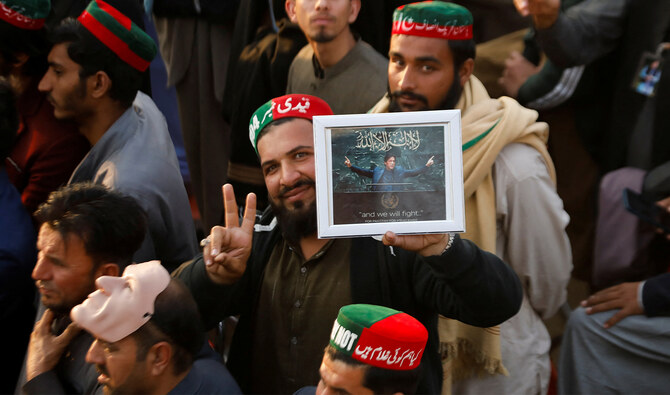
A supporter of the former Pakistani Prime Minister Imran Khan's party, the Pakistan Tehreek-e-Insaf (PTI), poses with his portrait as he, along with others gather, to protest what they call a black day and a stolen mandate in last year's general election, during a rally in Swabi, Pakistan on February 8, 2025. (REUTERS/File)
Short Url
Updated 17 February 2025
Follow

Pakistan’s Imran Khan announces nationwide protest after Ramadan for ‘restoration of democracy’

  • Khan asks party’s negotiation committee to expedite communication with opposition parties, people from all walks of life
  • Pakistan’s ruling coalition government accuses Khan and his party of leading violent protests, particularly in 2023 and 2024

ISLAMABAD: Former prime minister Imran Khan has announced that his Pakistan Tehreek-e-Insaf (PTI) party will launch a nationwide protest movement with other opposition parties for “the restoration of democracy” and Pakistan’s constitution after the holy month of Ramadan. 

Khan, who has been in jail since August 2023 on a slew of charges that he says are politically motivated, claims the February 2024 general elections were rigged by the caretaker government at the time and the election commission, who had the army’s backing, to keep him away from power. All three deny the allegations, with the army repeatedly saying it refrains from interfering in political matters. 

The former premier and his party have been accused of leading violent anti-government protests in the past, particularly in May 2023 and November 2024. On May 9, 2023, frenzied mobs across the country carrying the PTI’s flags attacked government and military installations while in November last year, Khan supporters gathered in Islamabad to demand his release from prison. The government says four troops were killed in clashes with Khan supporters. The PTI denies it instigated its followers to violence in both instances, accusing the military and its political rivals of resorting to rights abuses, including torture and a nationwide crackdown against its supporters. 

“After the holy month of Ramadan, we will formulate a strategy in collaboration with all opposition parties and launch a nationwide protest movement,” a statement posted from Khan’s social media account on X said on Sunday night. 

The cricketer-turned-politician said he has directed his party’s negotiation committee to expedite communications with other parties, adding that the PTI would invite individuals from all sectors of Pakistan including lawyers, farmers, laborers, scholars and students to participate in the protest. 

“This protest will be for the restoration of democracy and the constitution, and for our genuine freedom and sovereignty,” he added. 

Khan’s party held negotiations with the government in December 2024 to ease political tensions in the country. However, talks between both sides broke down in January after the PTI pulled away, accusing the government of not fulfilling its two principal demands of forming judicial commissions to investigate the 2023 and 2024 protests. 

The government rubbished the PTI’s allegations, accusing the party of “unilaterally” abandoning talks without waiting for the government to respond to its demands. 

“Despite our repeated demands, no judicial commission has been formed to investigate the events of May 9th and November 26th (2024),” Khan’s statement read. “The truth would have been revealed to the public if such a commission had been established.”

Khan alleged his supporters were being denied their right to visit him in prison, describing it as a fundamental violation of his rights. 

“Even my own children are not allowed to speak with me, all in an attempt to exert pressure on me,” the former premier claimed. 

The government has so far not reacted to Khan’s call for protests. 

Khan’s ouster from office since April 2022 has plunged Pakistan into a political crisis, particularly after he was sent to jail in 2023. The former prime minister fell out with Pakistan army’s top leaders in the lead-up to his ouster and has since led an unprecedented campaign of defiance against the institution.

He continues to remain popular among the masses, with his party’s rallies drawing thousands of people in various cities. 


Pakistan, global crypto exchange discuss modernizing digital payments, creating job prospects 

Updated 05 December 2025
Follow

Pakistan, global crypto exchange discuss modernizing digital payments, creating job prospects 

  • Pakistani officials, Binance team discuss coordination between Islamabad, local banks and global exchanges
  • Pakistan has attempted to tap into growing crypto market to curb illicit transactions, improve oversight

ISLAMABAD: Pakistan’s finance officials and the team of a global cryptocurrency exchange on Friday held discussions aimed at modernizing the country’s digital payments system and building local talent pipelines to meet rising demand for blockchain and Web3 skills, the finance ministry said.

The development took place during a high-level meeting between Finance Minister Muhammad Aurangzeb, Pakistan Virtual Assets Regulatory Authority (PVARA) Chairman Bilal bin Saqib, domestic bank presidents and a Binance team led by Global CEO Richard Teng. The meeting was held to advance work on Pakistan’s National Digital Asset Framework, a regulatory setup to govern Pakistan’s digital assets.

Pakistan has been moving to regulate its fast-growing crypto and digital assets market by bringing virtual asset service providers (VASPs) under a formal licensing regime. Officials say the push is aimed at curbing illicit transactions, improving oversight, and encouraging innovation in blockchain-based financial services.

“Participants reviewed opportunities to modernize Pakistan’s digital payments landscape, noting that blockchain-based systems could significantly reduce costs from the country’s $38 billion annual remittance flows,” the finance ministry said in a statement. 

“Discussions also emphasized building local talent pipelines to meet rising global demand for blockchain and Web3 skills, creating high-value employment prospects for Pakistani youth.”

Blockchain is a type of digital database that is shared, transparent and tamper-resistant. Instead of being stored on one computer, the data is kept on a distributed network of computers, making it very hard to alter or hack.

Web3 refers to the next generation of the Internet built using blockchain, focusing on giving users more control over their data, identity and digital assets rather than big tech companies controlling it.

Participants of the meeting also discussed sovereign debt tokenization, which is the process of converting a country’s debt such as government bonds, into digital tokens on a blockchain, the ministry said. 

Aurangzeb called for close coordination between the government, domestic banks and global exchanges to modernize Pakistan’s payment landscape.

Participants of the meeting also discussed considering a “time-bound amnesty” to encourage users to move assets onto regulated platforms, stressing the need for stronger verifications and a risk-mitigation system.

Pakistan has attempted in recent months to tap into the country’s growing crypto market, crack down on money laundering and terror financing, and promote responsible innovation — a move analysts say could bring an estimated $25 billion in virtual assets into the tax net.

In September, Islamabad invited international crypto exchanges and other VASPs to apply for licenses to operate in the country, a step aimed at formalizing and regulating its fast-growing digital market.