

Saudi Arabia emerging as an economic ‘powerhouse,’ says top IMF official

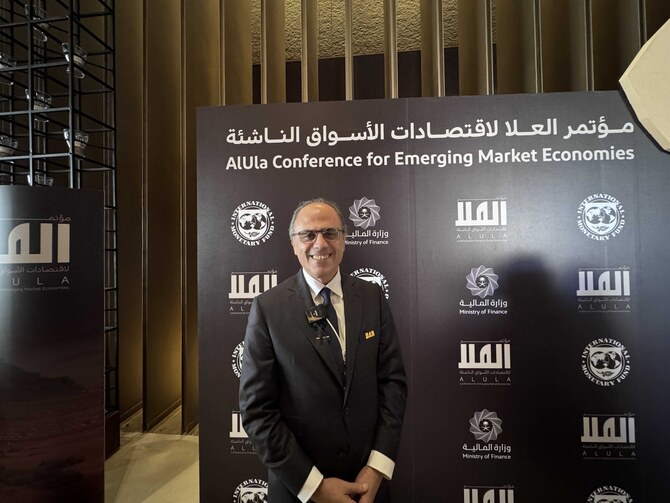
Jihad Azour, director of the Middle East and Central Asia department at the International Monetary Fund. AN photo
Short Url
Updated 17 February 2025
Follow

Saudi Arabia emerging as an economic ‘powerhouse,’ says top IMF official

RIYADH: Saudi Arabia’s role in the international financial system is growing, solidifying its position as an emerging economic “powerhouse,” according to a senior executive. 

In an interview with Arab News on the sidelines of the AlUla Conference for Emerging Market Economies, Jihad Azour, director of the Middle East and Central Asia department at the International Monetary Fund, stated that the Kingdom took a leadership role following the G20 summit in 2020. 

“The role of Saudi in the international financial system is growing. It’s an emerging global power. Now, after the G20 in 2020, Saudi is chairing the IMFC, which is the government body of the IMF,” Azour said. 

He continued: “Also, Saudi is very active in a certain number of global initiatives, like the debt relief initiative through the common framework, as well as also a certain number of important initiatives related to the role of emerging markets” and their contribution in setting global priorities.

Azour also noted that despite enduring multiple global economic shocks over the past five years, beginning with the COVID-19 crisis, the Kingdom has sustained strong economic growth. 

This resilience is largely attributed to government policies aimed at diversifying the economy beyond its reliance on oil. Fiscal policies have played a crucial role in strengthening economic management and stability. 

“Accelerating economic transformation has been beneficial to the GCC countries, in particular to Saudi. It helped maintain a high level of growth despite the various shocks that the region and Saudi economy faced over the last five years, starting from the COVID crisis and going on with several other global shocks,” he said, 

Azour added: “The investment in structural reforms that has increased women participation in the economy, improved the quality of infrastructure accelerated the trend in digitalization, has also contributed to accelerate the level of growth. 

Furthermore, large-scale infrastructure and development projects have played a key role in building a more prosperous future for the Kingdom by fostering economic expansion and modernization, Azour further elaborated.

The conference is set to deliver key recommendations to bolster financial stability and drive sustainable growth in emerging economies. 

Experts will also delve into the role of artificial intelligence and digital transformation in accelerating economic development across these markets.  

Discussions will focus on strategies to enhance economic resilience, fostering stronger collaboration between emerging and advanced economies to pave the way for a more equitable and sustainable global future.


What changed in Saudi stocks on 1st day of foreign entry 

Updated 59 min 33 sec ago
Follow

What changed in Saudi stocks on 1st day of foreign entry 

RIYADH: Saudi Arabia’s stock market saw foreign non-strategic investors reduce their ownership in nearly half of the companies listed on the main Tadawul All Share Index, or TASI, on the first day of implementing the decision to open the market to all categories of foreign investors, according to Tadawul data reflecting ownership positions as of Feb. 1  

According to the Financial Analysis Unit at Al-Eqtisadiah, foreign ownership declined in 120 companies, increased in 97 others, and remained unchanged in the rest, with no variation in the number of shares held by foreign investors. 

Foreign investors favor growth stocks 

Looking at the changes purely through valuation multiples — without factoring in operational or sectoral considerations — foreign investors appear to be reallocating ownership toward growth stocks at the expense of value stocks, with higher multiples used as an approximate indicator of growth. 

Ownership declines were concentrated in companies with lower valuation multiples, where the median price-to-earnings ratio stood at about 17.1 times and the median price-to-book ratio was around 2 times. 

Conversely, ownership rose in companies with higher multiples, with a median price-to-earnings ratio of 23.3 times and a median price-to-book ratio of 2.6 times. 

Mid- and small-cap firms see biggest changes 

Raoom, Entaj, and Obeikan Glass saw the largest declines in foreign ownership, dropping between 10 percent and 16 percent. In contrast, Tamkeen, SACO, and Abo Moati led gains, with foreign stakes rising 10 to 20 percent. 

In terms of overall foreign ownership, Al-Babtain, Rasan, and Etihad Etisalat topped the list at roughly 34 percent, 29 percent, and 24 percent, respectively.

Gradual foreign inflow and delayed impact 

The initial changes remain insufficient to reflect a major impact of the full foreign access decision, especially as the first day coincided with the weekend. Additionally, entry is expected to be gradual until financial institutions are fully ready to open accounts, particularly for individuals. 

Mohammed Al-Shammasi, CEO of Derayah Financial, has told Asharq that the firm received around 500 individual investor applications on the first day of full foreign access. 

Meanwhile, foreign institutions managing under $500 million can now invest directly in the market with easier access, joining more than 4,000 qualified foreign investors who already hold assets worth SR377 billion ($100.5 billion)