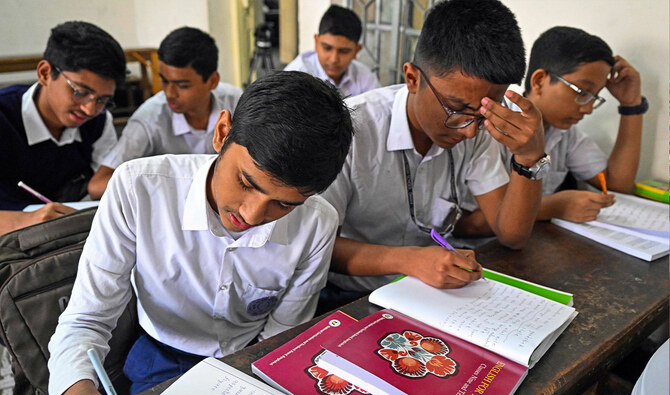
DHAKA: Bangladeshi high schooler Laiba is being educated for the future, but what she learns has been determined by the latest chapter in her country’s battle over its past.
Last year, a student-led revolution overthrew the government of iron-fisted premier Sheikh Hasina when public anger over her increasingly autocratic rule boiled over.
Her ouster has prompted Bangladesh to do something that has followed every sudden change in national leadership: rewrite its history books to suit new orthodoxies.
“The tradition of altering history must stop at some point — the sooner, the better,” Laiba’s mother Suraiya Akhtar Jahan told AFP.
“Textbooks should not change every time a new government takes office.”
Radical changes to the school curriculum are routine in Bangladesh, where febrile political divisions dating back to its ruinous 1971 independence war against Pakistan have persisted.
Until this year, textbooks gave special exaltation to the country’s first president Sheikh Mujibur Rahman for spearheading that liberation struggle.
But Mujib, assassinated in 1975 in a military coup, is also Hasina’s father, and his daughter’s disgrace and exile has dented the late leader’s stature.
“The books had turned into one side’s political manifesto,” AKM Riazul Hassan, head of the national agency tasked with reforming the curriculum, told AFP.
“That does not conform to the purpose of textbooks. We tried to get them back on track.”
New history books have expunged dozens of poems, speeches and articles penned by Mujib, alongside images of his daughter.
They instead now valorize the hundreds of people killed in the protests that ultimately toppled Hasina last summer, while bringing back from exile other previously erased heroes of Bangladesh’s early history.
Among them is former army chief Ziaur Rahman — no relation to Mujib — credited with issuing the first public proclamation of Bangladesh’s independence during the 1971 war.
Zia had been left out of the curriculum during Hasina’s time because he founded the Bangladesh Nationalist Party (BNP), her chief opposition.
His return to the page augurs the resurgence of the political force he created, which is strongly favored to win elections expected by next year.
While the overhaul of Bangladesh’s official history gives clues as to the country’s future direction, critics say the new curriculum has its own litany of omissions.
Of particular contention is one of the country’s darkest chapters — the murderous purge of its intellectual elite in the opening days of the 1971 war.
Bangladesh’s main Islamist party Jamaat-e-Islami, which at the time opposed the country’s independence, helped orchestrate these killings in concert with Pakistani forces.
Revised textbooks mention that militia groups were responsible for the murders, without mentioning that the militias were run by Jamaat.
The omission is significant because Jamaat — another party suppressed by Hasina’s government — is likely to be a major force in Bangladesh’s next parliament, and has governed in the past in coalition with the BNP.
Dhaka University professor Mujibur Rahman — no relation to the independence leader — told AFP that the apparently deliberate attempt to obscure details around the purge raised questions about the reasons behind the changes.
“The real question is whether this interim government wants students to learn the actual history,” he added.
Asked about the changes, Hassan said that the textbook commission he helms did not want to trap the nation’s youth “in an endless cycle of hatred.”
“At some point, we need to start reconciliation,” he added. “Should we make our textbooks flooded with hatred? How rational would it be?“
Other signs suggest the new textbooks have conceded several changes to hard-line religious sentiment in the Muslim-majority nation.
Hasina’s government, for all its other shortcomings on rights issues, was lauded for championing the rights of Bangladesh’s transgender community.
The new textbooks excise references to transgender Bangladeshis, a demand long held by Islamist groups.
Hassan acknowledged that the decision had been taken following objections from a Muslim group campaigning against representations of transgender issues in the curriculum.
“We took their concerns into account,” he said, “and made adjustments accordingly to minimize their anxiety.”

After revolution, Bangladesh textbooks rewrite history
Short Url
https://arab.news/jg8js
After revolution, Bangladesh textbooks rewrite history
- A student-led uprising last year overthrew iron-fisted premier Sheikh Hasina
- The ouster came as public anger over her increasingly autocratic rule boiled over
Irish minister defends ‘limited’ trade curbs on Israeli settlements
DUBLIN: Ireland’s planned curbs on trade with Israeli settlements will be limited strictly to goods, a minister told Reuters, offering the first clear signal on the scope of the contested legislation and rejecting accusations that the country is antisemitic.
Ireland has been preparing a law to curb trade with settlements in the Israeli-occupied West Bank, facing pressure at home to widen the scope of the ban from goods to services, while Israel and the United States want the bill scrapped.
Ireland has been one of the European Union’s most outspoken critics of Israel’s assault in Gaza, which authorities in the Palestinian enclave say has killed more than 67,000 people.
’EXTREMELY LIMITED MEASURE’, SAYS MINISTER
But Thomas Byrne, Ireland’s Minister of State for European Affairs and Defense, told Reuters that the bill is limited to the import of goods and that it would not become law this year.
“It’s an extremely limited measure, which would prohibit imports of goods from illegally-occupied territories,” he said in an interview. “Similar measures have already been brought in in a number of European countries.”
Byrne’s comments give insight into Dublin’s thinking as Ireland seeks to deflect pressure, including from US companies based in the country, to soften its criticism of Israel. Ireland’s bill is expected to help shape how other European nations launch similar curbs on trade with Israeli settlements.
The Irish government has signalled the bill is imminent but has yet to publicly announce its scope.
Byrne declined to say when it would be sent to parliament, as the government weighs the bill’s implications. “It’s certainly not going to be implemented this year,” he said.
Earlier this year, sources told Reuters that the government intended to blunt the law, curbing its scope to just a limited trade of goods, such as dried fruit, and not services.
That more ambitious move could have entangled companies in technology and other industries in Ireland doing business in Israel. Business lobby groups had sought to kill the idea.
Limiting the bill to goods only would catch just a handful of products imported from Israeli-occupied territories such as fruit that are worth just 200,000 euros ($234,660) a year.
LAWMAKER BLACK SAYS SHE STILL WANTS SERVICES BAN
Most of the international community considers Israeli settlements in the West Bank illegal under international law. Israel disputes this, citing historical and biblical ties to the area. It says the settlements provide strategic depth and security.
On Gaza, Israel says it acted in self-defense following the deadly October 7, 2023, Hamas attack that killed 1,200 people and resulted in 251 hostages, according to Israeli tallies. Israel has repeatedly said it is committed to international law and tries to minimize harm to the civilian population of Gaza.
Frances Black, the lawmaker who proposed the Irish bill, told Reuters she would push to include a ban on services. “It will take a lot of work in the new year to get services included but that’s exactly what I’m prepared to do.”
Byrne also defended Ireland’s government, after Israeli Foreign Minister Gideon Saar recently posted a video online where he accused the Irish government of having an “antisemitic nature.”
Saar said the Irish government’s response had been slow to a local proposal to rename a park bearing the name of Chaim Herzog, the former president of Israel who was raised in Dublin.
Irish ministers had roundly criticized the idea and Dublin City Council has since delayed a decision on whether to remove the name.
US senator Lindsey Graham had also labelled Ireland a “cesspool of antisemitism.”
EU LAWMAKER REJECTS ANTISEMITISM CHARGE AS ‘NONSENSE’
“I reject outright that the country is in any way antisemitic,” said Byrne. “We’re deeply conscious of the contribution that Jewish people have made in Ireland.”
Ireland’s relations with Israel have been fraught. Last December, Israel shut its embassy in Dublin amid a row over Ireland’s criticism of its war in Gaza, including Ireland’s recognition of a Palestinian state last year.
Barry Andrews, an Irish member of the European parliament, urged Dublin to go ahead with its occupied territories bill. “Claims that Ireland is antisemitic are nonsense,” he said. Ireland has nothing to fear. We are no longer the only ones doing this.”
On Wednesday, Ireland’s central bank governor Gabriel Makhlouf was forced to abandon a public speech in Dublin by pro-Palestinian protesters objecting to the central bank’s earlier role in the sale of Israeli bonds.
Ireland has been preparing a law to curb trade with settlements in the Israeli-occupied West Bank, facing pressure at home to widen the scope of the ban from goods to services, while Israel and the United States want the bill scrapped.
Ireland has been one of the European Union’s most outspoken critics of Israel’s assault in Gaza, which authorities in the Palestinian enclave say has killed more than 67,000 people.
’EXTREMELY LIMITED MEASURE’, SAYS MINISTER
But Thomas Byrne, Ireland’s Minister of State for European Affairs and Defense, told Reuters that the bill is limited to the import of goods and that it would not become law this year.
“It’s an extremely limited measure, which would prohibit imports of goods from illegally-occupied territories,” he said in an interview. “Similar measures have already been brought in in a number of European countries.”
Byrne’s comments give insight into Dublin’s thinking as Ireland seeks to deflect pressure, including from US companies based in the country, to soften its criticism of Israel. Ireland’s bill is expected to help shape how other European nations launch similar curbs on trade with Israeli settlements.
The Irish government has signalled the bill is imminent but has yet to publicly announce its scope.
Byrne declined to say when it would be sent to parliament, as the government weighs the bill’s implications. “It’s certainly not going to be implemented this year,” he said.
Earlier this year, sources told Reuters that the government intended to blunt the law, curbing its scope to just a limited trade of goods, such as dried fruit, and not services.
That more ambitious move could have entangled companies in technology and other industries in Ireland doing business in Israel. Business lobby groups had sought to kill the idea.
Limiting the bill to goods only would catch just a handful of products imported from Israeli-occupied territories such as fruit that are worth just 200,000 euros ($234,660) a year.
LAWMAKER BLACK SAYS SHE STILL WANTS SERVICES BAN
Most of the international community considers Israeli settlements in the West Bank illegal under international law. Israel disputes this, citing historical and biblical ties to the area. It says the settlements provide strategic depth and security.
On Gaza, Israel says it acted in self-defense following the deadly October 7, 2023, Hamas attack that killed 1,200 people and resulted in 251 hostages, according to Israeli tallies. Israel has repeatedly said it is committed to international law and tries to minimize harm to the civilian population of Gaza.
Frances Black, the lawmaker who proposed the Irish bill, told Reuters she would push to include a ban on services. “It will take a lot of work in the new year to get services included but that’s exactly what I’m prepared to do.”
Byrne also defended Ireland’s government, after Israeli Foreign Minister Gideon Saar recently posted a video online where he accused the Irish government of having an “antisemitic nature.”
Saar said the Irish government’s response had been slow to a local proposal to rename a park bearing the name of Chaim Herzog, the former president of Israel who was raised in Dublin.
Irish ministers had roundly criticized the idea and Dublin City Council has since delayed a decision on whether to remove the name.
US senator Lindsey Graham had also labelled Ireland a “cesspool of antisemitism.”
EU LAWMAKER REJECTS ANTISEMITISM CHARGE AS ‘NONSENSE’
“I reject outright that the country is in any way antisemitic,” said Byrne. “We’re deeply conscious of the contribution that Jewish people have made in Ireland.”
Ireland’s relations with Israel have been fraught. Last December, Israel shut its embassy in Dublin amid a row over Ireland’s criticism of its war in Gaza, including Ireland’s recognition of a Palestinian state last year.
Barry Andrews, an Irish member of the European parliament, urged Dublin to go ahead with its occupied territories bill. “Claims that Ireland is antisemitic are nonsense,” he said. Ireland has nothing to fear. We are no longer the only ones doing this.”
On Wednesday, Ireland’s central bank governor Gabriel Makhlouf was forced to abandon a public speech in Dublin by pro-Palestinian protesters objecting to the central bank’s earlier role in the sale of Israeli bonds.
© 2025 SAUDI RESEARCH & PUBLISHING COMPANY, All Rights Reserved And subject to Terms of Use Agreement.