

Gazans return to ruined homes and severe water shortage

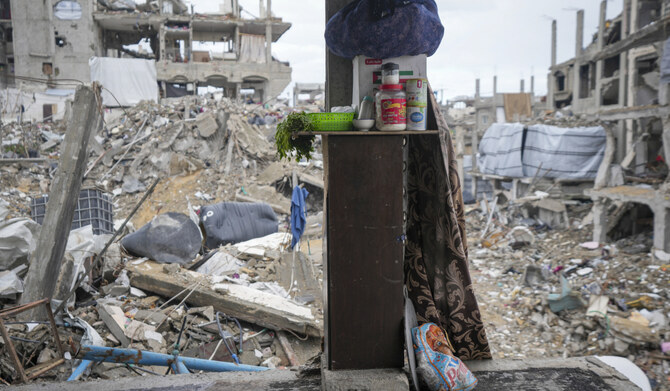
Destroyed walls expose the devastation outside the Odeh house in the Jabaliya refugee camp in the northern Gaza Strip, Friday, Feb. 7, 2025. (AP)
Short Url
Updated 14 February 2025
Follow

Gazans return to ruined homes and severe water shortage

  • Wells, pumps destroyed during the war
  • Israel claims it has repaired some damage

BEIT LAHIYA: A ceasefire has enabled some Gazans to go back to their ruined homes without fear of Israeli airstrikes, but they have returned to a severe water crisis.

“We returned here and found no pumps, no wells. We did not find buildings or houses,” said 50-year-old farmer Bassel Rajab, a resident of the northern town of Beit Lahiya.
“We came and set up tents to shelter in, but there is no water. We don’t have water. We are suffering.”
Drinking, cooking, and washing are a luxury in Gaza, 16 months after the start of the war between Israel and the Palestinian militant group Hamas.
Rajab said he sometimes walks 16 km, hoping to shower in Gaza City. Some Palestinians have dug wells in areas near the sea or rely on salty tap water from Gaza’s only aquifer, contaminated with seawater and sewage.
The Palestinian Water Authority estimates it will cost $2.7 billion to repair the water and sanitation sectors. Palestinians were already facing a severe water crisis as well as shortages of food, fuel,  and medicine before the wells were destroyed in the war.
The Palestinian Water Authority said in a statement on its website that 208 out of 306 wells had been knocked out of service during the war, and a further 39 were partially out of service.
“There is a big shortage as the occupation (Israel) is preventing the entrance (into Gaza) of drills, excavators, machines, equipment, and generators that are needed to operate wells and to dig them,” said Beit Lahiya Mayor Alaa Al-Attar.
Attar said small companies were trying to fix the wells but had minimal equipment.
He added: “We are trying to establish new wells to mitigate the severity of the water crisis at this stage.”
COGAT, the branch of the Israeli military that manages humanitarian activities, has said it has coordinated water line repairs with international organizations, including one to the northern Gaza Strip.
The Hamas-Israel ceasefire has been in force since Jan. 19.
Gazans hoping to one day rebuild are squeezed by shortages of water, food, medicines, and fuel in Gaza, which was grappling with poverty and high unemployment even before the war erupted.
Youssef Kallab, 35, says he has to carry heavy water containers to the roof of his home using a rope. The municipality supplies water every three days.
“We do not have the strength to carry it up and down the stairs. We have children, we have elderly. They all want water,” Kallab said as he lifted water containers.
Twelve-year-old Mohammed Al-Khatib says he has to drag a cart for 3-4 km to get water.
Mohammed Nassar, a 47-year-old Palestinian supermarket owner, said he has to walk for miles to fill buckets from a water pipe despite health problems and cartilage damage.
“We turn a blind eye to the pain because we have to,” he said.


Iraq’s parliament delays presidential vote

Updated 8 sec ago
Follow

Iraq’s parliament delays presidential vote

  • Iraq’s two main Kurdish parties, who ususally put forward a candidate for president, asked to postpone the vote
  • Once elected, the president will then have 15 days to appoint a prime minister
BAGHDAD: Iraq’s parliament postponed the election of the country’s president on Tuesday to allow Kurdish rivals time to agree on a candidate.
The parliament delayed the session, the official INA press agency reported, without saying whether a new date had been agreed.
The agency reported earlier that speaker Haibat Al-Halbussi received requests from Iraq’s two main Kurdish parties, the Kurdistan Democratic Party (KDP) and the Patriotic Union of Kurdistan (PUK), to postpone the vote to “allow both parties more time” to reach a deal.
By convention, a Shiite Muslim holds the powerful post of prime minister, the parliament speaker is a Sunni and the largely ceremonial presidency goes to a Kurd.
Under a tacit agreement between the two main Kurdish parties, a PUK member holds the Iraqi presidency, while the president and regional premier of the semi-autonomous Kurdish region is selected from the KDP.
But this time the KDP named its own candidate for Iraq’s presidency: Iraqi Foreign Minister Fuad Hussein.
Once elected, the president will then have 15 days to appoint a prime minister, expected to be former premier Nouri Al-Maliki.
On Saturday, the Coordination Framework, an alliance of Shiite parties with varying ties to Iran that holds a parliamentary majority, endorsed Maliki.
But his nomination appeared to stoke concern in Washington.
The 75-year-old shrewd politician is Iraq’s only two-term premier (2006-2014) since the 2003 US invasion.
Seen as close to Iran, Al-Maliki left power in 2014 following heated pressure from Washington.
US Secretary of State Marco Rubio warned on Sunday against a pro-Iranian government in Iraq.
An Iraqi source close to the Coordination Framework told AFP that Washington had conveyed that it “holds a negative view of previous governments led by former prime minister Maliki.”
In a letter, US representatives said that while the selection of the prime minister is an Iraqi decision, “the United States will make its own sovereign decisions regarding the next government in line with American interests.”
Another Iraqi source confirmed the letter, adding that the Shiite alliance had still moved forward with its choice, confident that Al-Maliki could allay Washington’s concerns.
Iraq has long been a proxy battleground between the US and Iran, with successive governments negotiating a delicate balance between the two foes.
Iraq’s new premier will be expected to address Washington’s longstanding demand that Baghdad disarm Tehran-backed factions, many of which are designated terrorist groups by the US.