

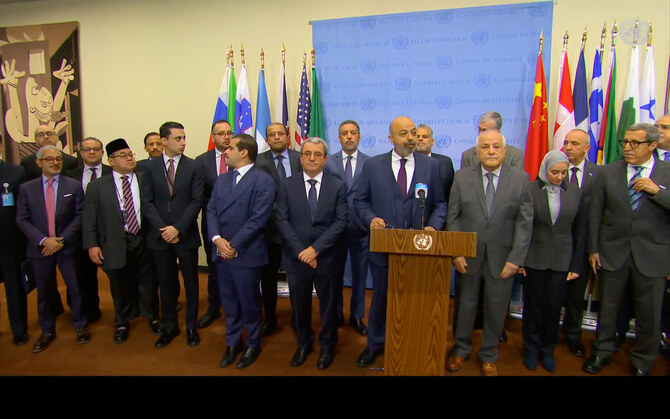

NEW YORK: Arab countries do want to see a Riviera in Gaza, but “a Palestinian Gazan Riviera in the independent and internationally recognized state of Palestine,” Kuwait’s permanent representative to the UN said on Friday.
Reflecting on the historical resilience of places destroyed by war, Tarek AlBanai emphasized that Gaza, with international support, could rebuild and flourish.
“Like any other country that has been devastated by war, like London in World War II, or Dresden, Warsaw, Stalingrad, Hiroshima and Nagasaki, everybody got together, built their cities back, and today they’re some of the most amazing cities around the world,” he said. “So like any other place in the world, this is how Gaza will be rebuilt.”
Speaking on behalf of the UN group of Arab countries, AlBanai condemned any actions aimed at displacing Palestinians from Gaza, which he said would be a violation of Article 49 of the Fourth Geneva Convention, which prohibits the forcible transfer of civilians from occupied territories.
US President Donald Trump has vowed to empty Gaza of its more than 2 million Palestinians and turn it into a “Riviera of the Middle East.”
At a press conference in New York, AlBanai was joined by a united front of ambassadors from across the Arab world, as well as the Organization of Islamic Cooperation, the Non-Aligned Movement, and the Committee on the Exercise of the Inalienable Rights of the Palestinian People, all of whom categorically rejected any mass transfer of Palestinians.
“We commend the international community’s firm stance in rejecting these proposals and reaffirming their illegality under international law,” AlBanai stated.
“The Arab Group is unwavering in its call for an immediate ceasefire, a return of Palestinian civilians to their homes, and the cessation of Israeli aggression in both Gaza and the West Bank.”
AlBanai, whose country holds the presidency of the Arab Group for February, called for the implementation of UN Security Council Resolution 2735, adopted with broad support, which calls for a complete ceasefire, the restoration of Palestinian homes and neighborhoods, and the delivery of humanitarian assistance on a large scale.
He also reiterated the international community’s commitment to a two-state solution, consistent with international law.
Palestinian Ambassador Riad Mansour stressed the importance of the international community's support for his people’s right to self-determination, and urged the UN to hold Israel accountable for its actions in the Occupied Territories.
“We’re united behind the full implementation of Resolution 2735, which the Security Council must uphold,” Mansour declared.
“The Palestinian people are resilient and we’ll rebuild Gaza, but we need the world’s support to stop the aggression and prevent further crimes against humanity.”
He also called on the international community to stop the forced displacement of Palestinians and respect their desire to return to their ancestral lands.
“Why is it so surprising that we, the Palestinian people, should be allowed to return to the places where we have memories, where we have stories, where we have connections?” Mansour asked passionately.
AlBanai and Mansour praised the efforts of Qatar, Egypt and the US, noting their critical roles in navigating the obstacles to achieving a ceasefire in Gaza.
They said the international community’s support for the ceasefire is essential for lasting peace in the region.
Mansour also outlined several key steps that the UNSC and the UN General Assembly must take in the coming weeks to move forward with the implementation of a permanent ceasefire and the rebuilding of Gaza.
These steps include continued support for the Palestinian government and a commitment to ending the illegal occupation of Palestinian territories.
“We’re not asking for anything beyond the right to live in peace in our own land,” Mansour said. “We want a just and lasting peace, and the path forward is clear: the establishment of a two-state solution, the end of the occupation, and the recognition of Palestine as a sovereign state.
“The international community has the opportunity now to pave the way for peace and support the creation of an independent Palestinian state.”


