KARACHI: Pakistani health authorities this week confirmed the country’s second polio case of 2025 in the country’s southern Sindh province, days after concluding a national immunization campaign against the infection.
Polio is a paralyzing disease with no cure and to ensure immunity, health experts say it is crucial that all children under five complete the oral polio vaccine series. The South Asian country last year reported 74 polio cases in 2024, a sharp increase from just six in 2023.
The second polio case of the year was reported from district Badin in Sindh, Pakistan’s Polio Eradication Program said in a statement on Wednesday. The first case of the infection was reported in the Dera Ismail Khan district in the northwestern Khyber Pakhtunkhwa (KP) province last month.
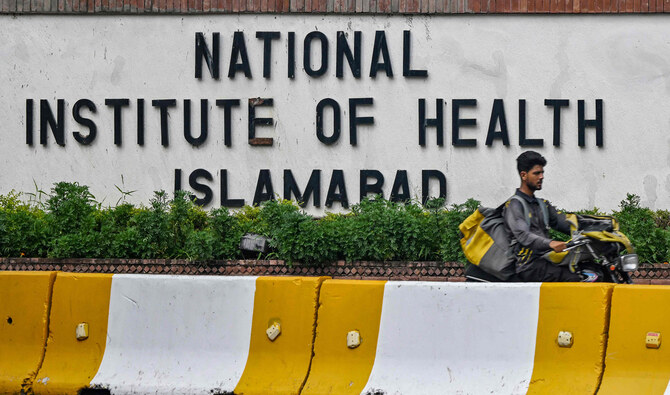
“The Regional Reference Laboratory for Polio Eradication at the National Institute of Health has confirmed the detection of the second wild poliovirus type 1 (WPV1) case of 2025,” Pakistan’s Polio Eradication Program said.
Of Pakistan’s 74 polio cases reported last year, 27 were from Balochistan, 22 from Khyber Pakhtunkhwa, 23 from Sindh, and one each from Punjab and Islamabad.
The Pakistan polio program runs several mass vaccination drives annually. This year’s first anti-polio drive was conducted from Feb. 3 to 9 during which over 45 million children were vaccinated.
Pakistan and Afghanistan are the last two countries where polio remains endemic. In the early 1990s, Pakistan reported around 20,000 cases annually but in 2018 the number dropped to eight cases.
Pakistan’s polio program began in 1994, but efforts to eradicate the virus have been hampered by vaccine misinformation, opposition from some religious hard-liners who view immunization as a foreign plot, and frequent attacks on polio vaccination teams by militant groups.


Pakistan reports second polio case of 2025 from southern Sindh province
https://arab.news/2ejqq
Pakistan reports second polio case of 2025 from southern Sindh province

- Latest polio case has been reported from country’s southern Badin district, Pakistani health authorities say
- Development takes place days after Pakistan conducted its first national anti-polio vaccination drive of 2025

Pakistan, China to sign multiple MoUs at major agriculture investment conference today
- Hundreds of Chinese and Pakistani firms to attend Islamabad event
- Conference seen as part of expanding CPEC ties into agriculture, trade
KARACHI: Islamabad and Beijing are set to sign multiple memorandums of understanding (MoUs) to boost agricultural investment and cooperation at a major conference taking place in the capital today, Monday, with hundreds of Chinese and Pakistani companies expected to participate.
The conference is being billed by Pakistan’s Ministry of National Food Security and Research as a platform for deepening bilateral agricultural ties and supporting broader economic engagement between the two countries.
“Multiple memorandums of understanding will be signed at the Pakistan–China Agricultural Conference,” the Ministry of National Food Security said in a statement. “115 Chinese and 165 Pakistani companies will participate.”
The conference reflects a growing emphasis on expanding Pakistan-China economic cooperation beyond the transport and energy foundations of the flagship China-Pakistan Economic Corridor (CPEC) into agriculture, industry and technology.
Under its first phase launched in 2015, CPEC, a core component of China’s Belt and Road Initiative, focused primarily on transportation infrastructure, energy generation and connectivity projects linking western China to the Arabian Sea via Pakistan. That phase included motorways, power plants and the development of the Gwadar Port in the country's southwest, aimed at helping Pakistan address chronic power shortages and enhance transport connectivity.
In recent years, both governments have formally moved toward a “CPEC 2.0” phase aimed at diversifying the corridor’s impact into areas such as special economic zones, innovation, digital cooperation and agriculture. Second-phase discussions have highlighted Pakistan’s goal of modernizing its agricultural sector, attracting Chinese technology and investment, and boosting export potential, with high-level talks taking place between planning officials and investors in Beijing.
Agri-sector cooperation has also seen practical collaboration, with joint initiatives examining technology transfer, export protocols and value-chain development, including partnerships in livestock, mechanization and horticulture.
Organizers say the Islamabad conference will bring together government policymakers, private sector investors, industry associations and multinational agribusiness firms from both nations. Discussions will center on investment opportunities, technology adoption, export expansion and building linkages with global buyers within the framework of Pakistan-China economic cooperation.


