


RIYADH: Saudi Arabia’s first homegrown electric vehicle brand, Ceer, signed 11 deals worth SR5.5 billion ($1.4 billion) at a Public Investment Fund event ahead of its model launch in 2026.
More than 80 percent of these agreements involve Saudi companies, reinforcing Ceer’s commitment to its 45 percent localization target and advancing the Kingdom’s Vision 2030’s economic diversification goals.
Among the key memorandums of understanding signed at the PIF Private Sector Forum are agreements related to heating and air conditioning, portable EV chargers and various manufacturing aspects, such as plastic injection parts.
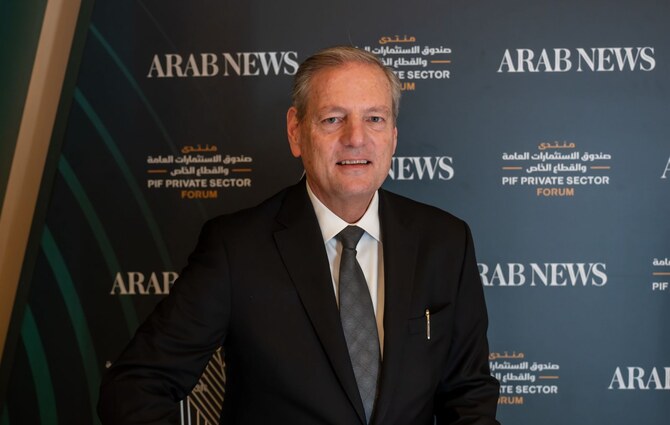
In an interview with Arab News on the sidelines of the event, Jim DeLuca, CEO of the company, said: “At Ceer, we say we’re not just starting a car company. We are igniting the automotive industry,” he said.
DeLuca highlighted that Ceer is the only company in Saudi Arabia managing the entire process — from designing and engineering to manufacturing, selling, and servicing a portfolio of battery electric vehicles.
He highlighted the King Abdullah Economic City manufacturing plant, a cutting-edge facility capable of producing 38 jobs per hour with integrated shops for press, body paint, and general assembly. “You can’t have an automotive ecosystem without a local supply base, so we’ve attracted some of the best global tier-one suppliers, they too are joining us in KAEC, and so we’re developing this whole ecosystem.”
DeLuca outlined Ceer’s strategic supply chain approach, explaining how global tier-one suppliers produce key components and subassemblies that will be shipped into the plant on schedule.
“We’re talking about things like front-rear subframes, interiors, front-rear fascias, body components, but that’s only the beginning. Those tier ones need a tier-two supply base, and many of today’s announcements are tier-two suppliers who will provide smaller parts and components to the tier ones, who will then supply to us just in time,” he explained.
Ceer’s localization efforts ensure an efficient, cost-effective supply chain. “This is a capital-intensive, low-margin business, you need a laser-like focus on the strategic elimination of waste,” the top official said.
He added: “One of the ways you do that is by having your supply base right next to the plant. And because we’re in KAEC with Lucid and Hyundai, and hopefully one day others, that’s the type of volume these suppliers need to have a very positive business case.”

Ceer was announced in November 2022. File
Scaling up production and Saudi’s automotive future
Ceer’s business plan extends through 2034, with the KAEC plant set to ramp up production in phases. “In 2024, we started plant construction. In 2025, we will install process equipment — press, body paint, general assembly. Then, at the beginning of 2026, we start validation builds, moving from non-salable to salable.”
DeLuca revealed that by the last quarter of 2026, Ceer will be up and running, producing its first two aspirational vehicles for sale in Saudi Arabia.
The CEO also emphasized the importance of the King Salman Automotive Cluster, which serves as the industry umbrella for KAEC’s expanding automotive sector. Ceer has secured contracts with major tier-one suppliers, including Lear, Forvia, and Shinyoung, as well as Benteler, and JVIS, to localize key vehicle components.
“These are global tier-ones, and we already have contracts with them. They haven’t been formally announced yet, but we’re talking about front-rear subframes, interiors, exterior body components, and sheet metal components — all large, complicated, and expensive to ship, so co-locating with the assembly plants is the right strategy,” he added.
Advancing charging infrastructure and market adoption
Addressing adoption challenges facing the sector, DeLuca pointed to PIF’s EV infrastructure initiative, EVIQ, which is deploying charging stations across major Saudi cities.
“A lot of people have anxiety when considering a battery electric vehicle. What gives them comfort is a strong charging infrastructure. EVIQ is rolling out charging stations in Riyadh, Jeddah, Dammam, and beyond to ensure a seamless transition as we ramp up production,” he said.
Ceer plans to introduce seven vehicle models, spanning the E, D, and C segments, including sedans and SUVs, from 2026 to 2029.
Ceer’s growth strategy and future outlook
Ceer’s assembly complex is designed for an annual capacity of 240,000 units and is fully funded, according to the CEO.
“Our current business plan is fully funded through 2034 between our shareholders and other financial instruments. I think the vision of any company is eventually, potentially to have an IPO (initial public offering) where you can start to monetize all of the great work that has taken place, so I won’t say one day it’s not going to happen,” he added.
He acknowledged that global EV market adoption has been slower than anticipated, emphasizing that product quality, pricing, infrastructure, and incentives will drive Saudi Arabia’s transition. “The Ministry of Investment is working on ecosystem incentives to accelerate EV adoption. We see steady growth in the early days, but incentives will be key to making EVs the catalyst for Saudi Arabia’s automotive transformation.”
Ceer’s agreements and localization drive
According to a press release, agreements were signed at the event with Zamil Central Air Conditioners Co. for heating, ventilation, and air conditioning systems, Zamil Plastic Industrial Co. for plastic injection parts, Obeikan Glass Co. and Abdul Latif Jameel Enterprises for alloy wheels, and the Saudi Co. for Controls and Maintenance for portable EV chargers.
Additional deals include Arabian Plastic Industrial Co. for blow parts, Saudi Aluminum Casting Co. for aluminum casting, First Telecom Industries for small stampings, and CTR for localizing aluminum forged parts in Saudi Arabia.
Ceer has also partnered with 263 local companies, awarding businesses worth SR6.6 billion to firms such as Modern Building Leaders, Nahil Computer, and Bupa Arabia, as well as Atlas Industrial Equipment Co., Saudi Business Machines, and Liva Insurance.
Speaking at the forum, DeLuca underscored Ceer’s role in realizing Vision 2030’s industrial and economic diversification goals. “Over the next decade, we will attract more than $150 million in foreign direct investment, create up to 30,000 direct and indirect jobs, localize 45 percent of our product content or built material and contribute $8 billion directly to Saudi’s GDP by 2034,” he said.
The company’s manufacturing complex, a $1.3 billion facility spanning 1 million sq. meters in King Abdullah Economic City, is poised to become the largest and most technologically advanced automotive production hub in the Middle East and North Africa region.
As part of its expansion strategy, the automotive company is set to welcome six major partners to KAEC, collectively contributing over SR50 billion in value.
DeLuca highlighted Ceer’s commitment to localizing its supply chain, with 45 percent of its product content and built materials to be sourced within the Kingdom.
The company’s workforce has already grown to over 1,300 employees, according to the top official, with a team of global experts bringing extensive experience to drive innovation and competitiveness.
DeLuca emphasized that strategic collaborations with leading automotive players such as Hyundai and Rimac are ensuring Ceer’s electric vehicles are technologically advanced and globally competitive.
One of Ceer’s standout features will be its industry-leading paint shop, offering an extensive color palette with over 30 shades in gloss, matte, and satin finishes, setting a new benchmark in vehicle customization.
“We’re here today at this forum as a testament to the power of collaboration and to highlight the vital role that the private sector plays in achieving all elements of Vision 2030,” DeLuca said.


