

Saudi Arabia’s PIF offers $10.67bn investment opportunities to strengthen local industries  

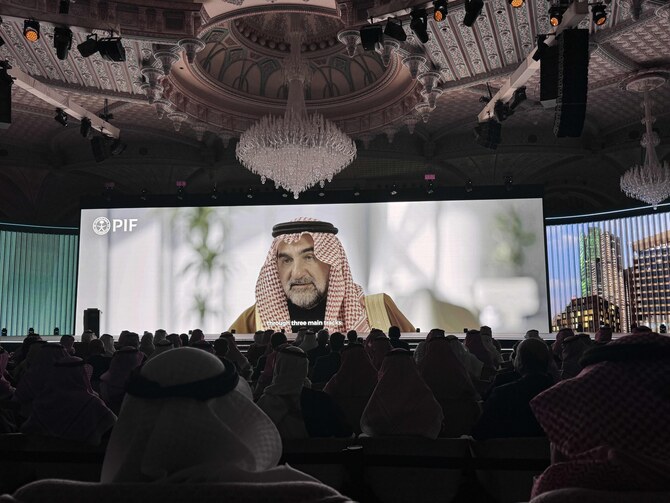
PIF Gov. Yasir Al-Rumayyan speaks at the PIF Private Sector Forum in Riyadh on Wednesday. AN photo by Nadin Hassan
Short Url
Updated 12 February 2025
Follow

Saudi Arabia’s PIF offers $10.67bn investment opportunities to strengthen local industries  

RIYADH: Saudi Arabia’s Public Investment Fund is offering SR40 billion ($10.67 billion) in investment opportunities through its private sector platform to strengthen local industries, supply chains, and business growth, its governor said. 

Speaking at the third PIF Private Sector Forum in Riyadh, Yasir Al-Rumayyan highlighted that the Kingdom’s sovereign wealth fund and its portfolio companies have invested around SR400 billion into local content from 2020 to 2023, supported by the MUSAHAMA Local Content Development Program. 

With assets exceeding $700 billion, PIF plays a central role in Saudi Arabia’s economic diversification under Vision 2030. Al-Rumayyan emphasized that sustainable growth is driven by regulatory reforms and economic diversification efforts, with PIF serving as a key enabler. 

The fund’s governor said that partnerships with private firms remain essential to PIF’s strategy, as Saudi Arabia continues regulatory reforms to foster long-term economic growth. 

According to Al-Rumayyan, the fund’s efforts have significantly increased local content contribution, raising its share from 47 percent to 53 percent across PIF and its subsidiaries. 

During his keynote speech, Jerry Todd, head of the National Development Division at PIF, addressed the 10,000 private sector attendees, emphasizing that the forum is designed to provide critical information and access to three major opportunity areas.  

“For suppliers, there are 100 PIF portfolio companies next door in the main hall, ready to discuss their procurement priorities and show you how you can register and qualify as a vendor,” Todd said. 

He added: “For supply chain developers, we will have dedicated sessions on automotive, transportation, and logistics, and for investors, 14 PIF portfolio companies will be sharing opportunities over the next two days.” 

Todd also provided updates on two recently launched initiatives aimed at empowering Saudi talent.   

“The first, which the governor mentioned, is our Accelerated Manufacturing Program. Thirteen small and medium enterprises were selected from 350 applicants for a six-month intensive program that began last September,” he said. 

Todd added: “They will graduate tomorrow and have already secured 12 commercial agreements and two product development agreements with PIF portfolio companies. Seven private sector MoUs will be signed over the next two days, and they have tapped into seven new export markets.”  

Highlighting the second initiative, Todd introduced the MUSAHAMA Design Competition, stating: “373 Saudi architectural students and 160 emerging local design firms have been competing to reimagine a community zone within one of our ROSHN developments, focusing on maximizing the use of locally sourced building materials.” 

Todd said that the forum serves as a platform for businesses to explore opportunities in three key areas: supplying goods and services to PIF portfolio companies, developing local tech-enabled supply chains to support emerging sectors, and investing in Saudi Arabia’s rapidly expanding economy.  

“I encourage you to meet with participants from both of these programs. Their progress, their potential, and their energy are inspiring and remind us all of our young people, who are our nation’s greatest asset,” Todd said. 

He concluded by urging the private sector to collaborate in stimulating local demand, expanding domestic supply chains, and creating investment opportunities across the Kingdom. 


Industry leaders highlight Riyadh’s Metro, infrastructure as investment catalysts

Updated 29 December 2025
Follow

Industry leaders highlight Riyadh’s Metro, infrastructure as investment catalysts

RIYADH: Saudi Arabia’s capital, Riyadh, is experiencing a transformative phase in its real estate sector, with the construction market projected to reach approximately $100 billion in 2025, accompanied by an anticipated annual growth rate of 5.4 percent through 2029.

The Kingdom is simultaneously advancing its data center capacity at an accelerated pace, with an impressive 2.7 GW currently in the pipeline. This expansion underscores the critical role of strategic land and power planning in establishing national infrastructure as a cornerstone of economic growth.

These insights were shared by leading industry experts during JLL’s recent client event in Riyadh, which focused on the city’s macroeconomic landscape and emerging trends across office, residential, retail, hospitality, and pioneering sectors, including AI infrastructure and Transit-Oriented Development.

Saud Al-Sulaimani, Country Lead and Head of Capital Markets at JLL Saudi Arabia, commented: “Riyadh is positioned at the forefront of Saudi Arabia’s Vision 2030, offering unparalleled opportunities for both investors and developers. National priorities are continuously recalibrated to ensure strategic alignment of projects and foster deeper collaboration with the private sector.”

He added: “Recent regulatory developments, including the introduction of the White Land Tax and the rent freeze, are designed to stabilize the market and are expected to drive renewed focus on delivering premium-quality assets. This dynamic environment, coupled with evolving construction cost considerations in select segments, is fundamentally reshaping the market landscape while accelerating progress toward our national objectives.”

The event further underscored the transformative impact of infrastructure initiatives. Mireille Azzam Vidjen, Head of Consulting for the Middle East and Africa at JLL, highlighted Riyadh’s transit revolution. She detailed the Riyadh Metro, a $22.5 billion investment encompassing 176 kilometers, six lines, and 84 stations, providing extensive geographic coverage, with a depth of 9.8 km per 100 sq. km. This strategic development generates significant TOD opportunities, with properties in proximity potentially commanding a 20-30 percent premium. JLL emphasized the importance of implementing climate-responsive last-mile solutions to enhance mobility and accessibility, particularly given Riyadh’s extreme temperatures.

Gaurav Mathur, Head of Data Centers at JLL, emphasized the rapid expansion of the Kingdom’s AI infrastructure, signaling a critical area for technological investment and innovation.

Focusing on the construction sector, Maroun Deeb, Head of Projects and Development Services, KSA at JLL, explained that the industry is actively navigating complexities such as skilled labor availability, material costs, and supply chain dynamics.

He highlighted the adoption of Building Information Modeling as a key driver for enhancing operational efficiency and project delivery.