

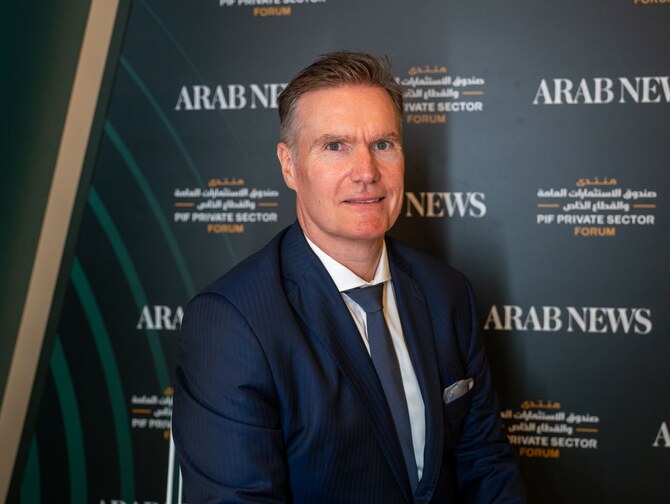

RIYADH: TASARU Mobility Investments, a subsidiary fully owned by Saudi Arabia’s Public Investment Fund, has partnered with Bahri and Mosolf Group to create a joint venture to strengthen the automotive logistics sector in the Kingdom.
In an interview with Arab News at the Private Sector Forum in Riyadh on Feb. 12, TASARU CEO Michael Mueller explained that this collaboration is a strategic investment to meet the growing demand in the automotive and mobility industries, particularly in the electric vehicle market.
The partnership aligns with Saudi Arabia’s broader Vision 2030 initiative, which aims to position the Kingdom as a global logistics hub while helping to achieve its net-zero emissions goals by promoting the adoption of EVs.
The joint venture is designed to provide innovative and comprehensive logistics solutions that are tailored to the specific needs of the automotive and mobility sectors in Saudi Arabia.
Commenting on the deal signed with Bahri and Mosolf Group, Mueller said: “It is more of a cooperation joint venture here on the ground to establish logistics services, in respect of, specifically more or less toward electrification and EV cars. So, finally, we have cooperation with two partners who are experienced in the local workforce and marine logistics. So, this is a great opportunity to lift the logistics sector, specifically in the area of electric vehicles to the next level.”
Under the terms of the agreement, TASARU’s primary responsibility will be to provide crucial capital, enabling access to the local market and enhancing the capacity of automotive companies to manage their operations efficiently within the Kingdom, while addressing market demand effectively.
Bahri will oversee shipping operations, leveraging its extensive maritime logistics experience and local market knowledge, while Mosolf Group will contribute technical expertise drawn from its European automotive logistics operations.
Mueller also disclosed that the new joint venture’s operations are set to begin by mid-2026 in King Abdullah Economic City.
“All investments we are doing always have this local anchor at the end. So we want to bring new technologies, like autonomous technologies but also focus on these logistic services,” he said.
He further emphasized that the joint venture will create more job opportunities for young Saudi professionals.
In a separate press release, TASARU stated that the formation of the joint venture aims to address the fragmented automotive logistics landscape in Saudi Arabia by providing comprehensive end-to-end solutions that align with key Vision 2030 objectives.
It also highlighted that the joint venture will contribute to industrial growth and enhance infrastructure to support local manufacturing, as well as the import and export of vehicles, through the development of critical logistics infrastructure.
Talking about the vitality of strengthening the logistics sector in Saudi Arabia’s automotive sector, Mueller said: “Now logistics is always a key topic. You can have factories, you can have suppliers around. If logistics is not established, then the pieces are not moving more or less as fast as they should have. So this is the reason why we went into this joint venture.”
Mueller added that the future of mobility in Saudi Arabia could be driven by autonomous vehicles and electrification, as well as the usage of hydrogen as a fuel in heavy trucks.
Talking about the future plans of TASARU in Saudi Arabia, Mueller said: “Here, our full priority right now is to go heavily into the localization supplier business. This is more or less our first pillar, our main pillar right now. So, here we talk to a lot of suppliers like Ceer or Lucid.”


