


RIYADH: Saudi Arabia is preparing to export industrial robots to international markets by the end of May which are capable of performing manufacturing tasks faster than humans, an official said.
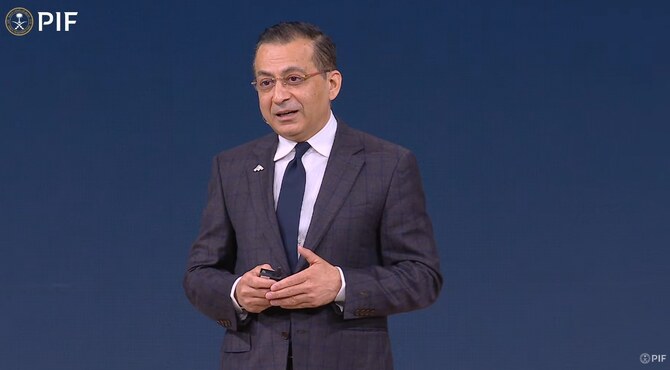
Speaking at the Private Sector Forum in Riyadh on Feb. 12, Amit Midha, CEO of Alat — a company backed by the Public Investment Fund —highlighted that these machines will revolutionize the manufacturing and assembling processes, not just in the Kingdom but globally.
Midha revealed that this milestone achievement resulted from Alat’s strategic partnership agreement inked with SoftBank Group in February 2024 to form a joint venture to manufacture industrial robots within Saudi Arabia.
This development aligns with the Kingdom’s broader Vision 2030 goal to establish the country as a global hub of innovation and technology by the end of this decade.
“By May of this year, we will be exporting robots to all over the world, and they will be built in Riyadh. We are investing in a fully automated manufacturing and engineering hub which is dedicated to produce cutting edge industrial robots,” said Midha.
He added: “Imagine the robots that can program themselves. Imagine the robots that have three times to five times the speed of a normal laborer. These robots can really revolutionize how, where and what can be manufactured.”
According to Midha, these robots are going to “redefine” the traditional manufacturing sector, as these machines are going to be highly cost-effective.
“Some of the manufacturing centers developed in the last few decades will get reshaped because now the cost of robots and automation is going to be the same as hiring a person or an operator in a manufacturing facility,” he said.
Midha added that Saudi Arabia will also export laptops and personal computers to international destinations by the end of this year thanks to Alat’s $2 billion partnership with Chinese tech giant Lenovo.
“We did the groundbreaking, but within this year, we will be exporting our notebooks, the PCs, servers, not only just for our needs but on a global scenario as well,” he said.
Launched in February 2024, Alat seeks to transform global industries and create a world-class manufacturing hub in Saudi Arabia powered by clean energy.
The future of manufacturing and the role of private sector
According to Midha, the future of the manufacturing sector will be steered by advanced technologies like artificial intelligence, and the Kingdom will lead this automation journey.
“We are at a transformational moment in the global industry. AI technology is disrupting and recreating everything. Sustainability is becoming a core pillar for all things in the future. Supply chain resilience is becoming just as important as efficiency,” said Midha.
He added: “Saudi Arabia’s Vision 2030 is built on clear objectives. It aims to establish the Kingdom as a leading global hub for advanced manufacturing. The vision goes beyond the traditional industrial growth, it aims to create an integrated manufacturing ecosystem that fosters a knowledge-based economy.”
According to the Alat official, the PIF-backed firm envisions a future where manufacturing will become autonomous, intelligent, and adaptive, as well as sustainable, and future-leaning.
Midha added that Alat will transform the way traditional factories function, where manual labor limits flexibility and efficiency.
He further said that this transformation in the manufacturing sector led by Saudi Arabia will be only possible with private-sector partnerships driven by these entities’ expertise, innovation, and innovation.
Midha went on to say that Saudi Arabia is the most attractive destination for industrial investments, with the Kingdom holding mineral wealth projected at $2.5 trillion, as well as having a strategic and unique geographical location.
“Transformation is already there. The policy is fully there to support our businesses and partnerships. It is expanding across diversified sectors. Foreign direct investment is on the growth. And this is really a once in a generational opportunity,” said Midha.
He added: “This level of opportunity is unprecedented, and we are here to help you realize together. We do not have to compromise on efficiency or technology. We can bring all the factors together to compete on the global stage.”
Midha said Alat is prioritizing nine business units where private sectors can collaborate and partner, including semiconductors, smart devices, smart buildings, and smart health.
Other areas of potential collaboration are smart appliances, advanced industrials, Next-Gen Infrastructure, as well as, electrification and AI infrastructure.
“The companies that invest in Saudi Arabia today will be positioned for unprecedented growth and first-mover advantage. Our commitment to shaping the future of manufacturing goes beyond the vision, it is rooted in action. True innovation demands action not just conversation,” said Midha.
Vision 2030: Turning goals into realities
During the speech, Midha said that Saudi Arabia’s National Industrial Strategy is pivotal in turning the Kingdom’s Vision 2030 goals into reality.
The strategy aims to build an industrial economy that attracts investment, enhances economic diversification, develops the Kingdom’s gross domestic product, and increases non-oil exports.
Underscoring the role of the Saudi Industrial Development Fund in strengthening the country’s manufacturing industry, Midha revealed that SIDF disseminated SR161 billion ($42.93 billion) by the second quarter of 2024 to support industrial projects.
He added that Saudi Arabia’s National Industrial Development and Logistics Program is investing heavily in infrastructure, logistics and workforce development.
“Grand visions must be matched by tangible progress and real-world results. This spirit of action represents the Kingdom’s unwavering commitment to turning ambition into achievement. It is a declaration that the Kingdom is not merely envisioning a future shaped by innovation, it is building it, step by step, with determination and purpose,” said Midha.
He concluded: “By transforming visionary ideas into ground-breaking outcomes, the Kingdom is proving to the world that it does not just talk about change, it leads it and we are delivering on this promise. By advancing the manufacturing sector and fostering economic diversification, the Kingdom is redefining its role on the global stage.”


