Egyptians furious over Trump’s Gaza plan, downplay aid threat

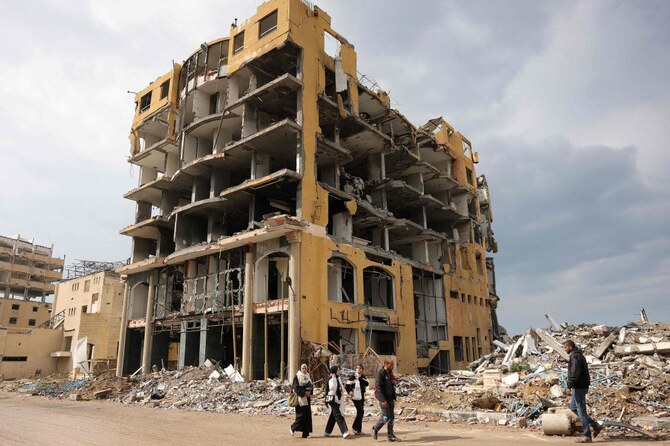
People walk past the heavily-damaged Commodore Hotel in western Gaza City, on February 11, 2025, amid the current ceasefire deal. (AFP)
Short Url
Updated 11 February 2025
Follow

Egyptians furious over Trump’s Gaza plan, downplay aid threat

  • Hashtag “on the shoe” — common Egyptian phrase meaning “we could not care less” — began to trend in response to what many saw as intimidation attempt

CAIRO: Egyptians reacted with fury on Tuesday to US President Donald Trump’s plan to displace Palestinians from Gaza to Egypt and Jordan, while downplaying his threat to cut aid to both countries if they refuse.
The state-owned Al-Ahram newspaper ran a front-page headline declaring “Egypt urges the world to end historical injustice against the Palestinian people,” while the private daily Al-Masry Al-Youm wrote, “Palestinian anger: Gaza is not for sale.”
On X, the hashtag “on the shoe” — a common Egyptian phrase meaning “we could not care less” — began to trend in response to what many saw as an attempt at intimidation.
The phrase can be traced back to a historic speech by late president Gamal Abdel Nasser, who dismissed US aid threats during Egypt’s wars with Israel.
On Monday, a strongly worded statement from Egypt’s foreign ministry rejected “any compromise” that could infringe on Palestinians’ rights, including to remain on their land.
The statement followed a meeting in Washington between Egypt’s foreign minister Badr Abdelatty and his US counterpart Marco Rubio.
During a phone call with the Danish prime minister on Tuesday, President Abdel Fattah El-Sisi said that the establishment of a Palestinian state is “the only guarantee for achieving lasting peace” in the region.
The Egyptian leader also called for the reconstruction of Gaza “without displacing” its residents, according to a statement from his office.
Trump, speaking on Monday, said the United States could “conceivably” halt assistance to Egypt and Jordan unless they agree to take in Palestinians from Gaza — a proposal Cairo and Amman have repeatedly rejected.
The US provides its regional ally Egypt with around $1.3 billion in military aid annually, making it one of the country’s largest foreign donors.
According to US government data, Egypt received roughly $1.5 billion in both military and economic assistance from the United States last year.
Hussein Haridi, a former diplomat and assistant foreign minister, downplayed the significance of US aid, arguing that it would not sway Egypt’s position on Gaza.
“This small amount (about $200 million) in economic aid will not affect the Egyptian economy,” Haridi told AFP.
“Regardless of its impact, we will not bow to Trump’s threats,” he said.
Haridi also said that Trump had little understanding of “the true character of Egyptians” and the country’s historical role in defending Arab interests and in particular the Palestinian cause.
“We do not care about Trump’s threats. Egypt is fully prepared to confront them and these threats will backfire on US interests in the region.”
“This is not just El-Sisi’s stance or the Egyptian government’s stance — it is the stance of the Egyptian people,” he added.
Gamal Bayoumi, a former diplomat and assistant foreign minister, meanwhile, told AFP that Egypt has made its stance clear: any attempt to force Palestinians out of Gaza “will be considered an act of war.”
Bayoumi added that Egypt was well prepared for any measures Washington might take, including a potential halt to financial assistance.
Among ordinary Egyptians, the Trump plan provoked outrage.
“After bombing and killing them, they now want to displace them?” said Samir Gomaa, a 71-year-old garage owner in Cairo.
“This is Palestinian land. Who in their right mind sells land that isn’t theirs and turns it into a tourist project?,” Gomaa told AFP.
Despite Egypt’s economic struggles, including soaring inflation and mounting debt, many citizens expressed support for El-Sisi’s stance.
“Our president is a hero for saying no, even though we’re struggling with inflation,” said Mohamed Abdel Tawab, 53, a paper trader.
“The Arab world will rebuild Gaza and Egypt will stand firm,” he said.
Since early in the Gaza war, which began in October 2023 with Hamas’s attack on Israel, officials and lawmakers in Egypt have repeatedly warned against any attempts to alter the region’s demographics, seeing it as a national security threat.


Syrian military tells civilians to evacuate contested area east of Aleppo amid rising tensions

Updated 15 January 2026
Follow

Syrian military tells civilians to evacuate contested area east of Aleppo amid rising tensions

  • Syria’s military has announced it will open a “humanitarian corridor” for civilians to evacuate from an area in Aleppo province
  • This follows several days of intense clashes between government forces and the Kurdish-led Syrian Democratic Forces

DAMASCUS: Syria’s military said it would open a corridor Thursday for civilians to evacuate an area of Aleppo province that has seen a military buildup following intense clashes between government and Kurdish-led forces in Aleppo city.
The army’s announcement late Wednesday — which said civilians would be able to evacuate through the “humanitarian corridor” from 9 a.m. to 5 p.m. Thursday — appeared to signal plans for an offensive in the towns of Deir Hafer and Maskana and surrounding areas, about 60 kilometers (40 miles) east of Aleppo city.
The military called on the Kurdish-led Syrian Democratic Forces and other armed groups to withdraw to the other side of the the Euphrates River, to the east of the contested zone.
Syrian government troops have already sent troop reinforcements to the area after accusing the SDF of building up its own forces there, which the SDF denied. There have been limited exchanges of fire between the two sides, and the SDF has said that Turkish drones carried out strikes there.
The government has accused the SDF of launching drone strikes in Aleppo city, including one that hit the Aleppo governorate building on Saturday shortly after two Cabinet ministers and a local official held a news conference there.
The tensions in the Deir Hafer area come after several days of intense clashes last week in Aleppo city that ended with the evacuation of Kurdish fighters and government forces taking control of three contested neighborhoods. The fighting killed at least 23 people, wounded dozens more, and displaced tens of thousands.
The fighting broke out as negotiations have stalled between Damascus and the SDF, which controls large swaths of northeast Syria, over an agreement to integrate their forces and for the central government to take control of institutions including border crossings and oil fields in the northeast.
Some of the factions that make up the new Syrian army, which was formed after the fall of former President Bashar Assad in a rebel offensive in December 2024, were previously Turkiye-backed insurgent groups that have a long history of clashing with Kurdish forces.
The SDF for years has been the main US partner in Syria in fighting against the Daesh group, but Turkiye considers the SDF a terrorist organization because of its association with the Kurdistan Workers’ Party, or PKK, which has waged a long-running insurgency in Turkiye. A peace process is now underway.
Despite the long-running US support for the SDF, the Trump administration has also developed close ties with the government of interim Syrian President Ahmad Al-Sharaa and has pushed the Kurds to implement the integration deal. Washington has so far avoided publicly taking sides in the clashes in Aleppo.
The SDF in a statement warned of “dangerous repercussions on civilians, infrastructure, and vital facilities” in case of a further escalation and said Damascus bears “full responsibility for this escalation and all ensuing humanitarian and security repercussions in the region.”
Adm. Brad Cooper, commander of US Central Command, said in a statement Tuesday that the US is “closely monitoring” the situation and called for “all parties to exercise maximum restraint, avoid actions that could further escalate tensions, and prioritize the protection of civilians and critical infrastructure.” He called on the parties to “return to the negotiating table in good faith.”
Al-Sharaa blasts the SDF
In a televised interview aired Wednesday, Al-Sharaa praised the “courage of the Kurds” and said he would guarantee their rights and wants them to be part of the Syrian army, but he lashed out at the SDF.
He accused the group of not abiding by an agreement reached last year under which their forces were supposed to withdraw from neighborhoods they controlled in Aleppo city and of forcibly preventing civilians from leaving when the army opened a corridor for them to evacuate amid the recent clashes.
Al-Sharaa claimed that the SDF refused attempts by France and the US to mediate a ceasefire and withdrawal of Kurdish forces during the clashes due to an order from the PKK.
The interview was initially intended to air Tuesday on Shams TV, a broadcaster based in Irbil — the seat of northern Iraq’s semi-autonomous Kurdish region — but was canceled for what the station initially said were technical reasons.
Later the station’s manager said that the interview had been spiked out of fear of further inflaming tensions because of the hard line Al-Sharaa took against the SDF.
Syria’s state TV station instead aired clips from the interview on Wednesday. There was no immediate response from the SDF to Al-Sharaa’s comments.