KARACHI: In a rare development on Tuesday, an International Monetary Fund (IMF) delegation visiting Pakistan met the country’s chief justice for discussions on judicial reforms, accountability and the recent controversial restructuring of a commission that recommends judges for Pakistan’s superior courts.
The finance ministry said on Sunday a three-member IMF mission would visit Pakistan in the coming week to conduct a Governance and Corruption Diagnostic Assessment under the country’s 2024 Extended Fund Facility program for a $7 billion loan. The ministry said the mission’s report would recommend actions for addressing corruption vulnerabilities and strengthening integrity and governance, with the findings helping to shape structural reforms.
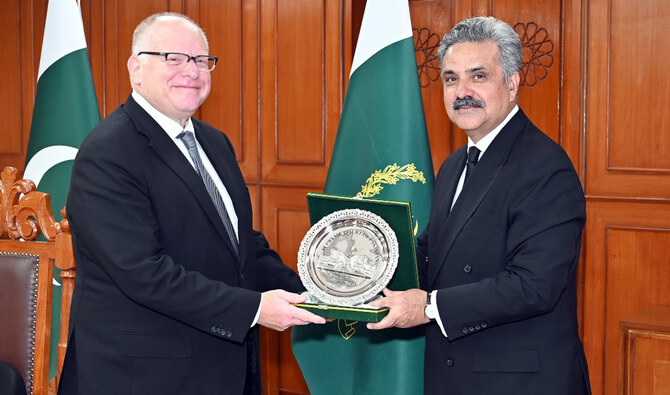
On Tuesday, the Supreme Court said in a press release the IMF team led by Joel Turkewitz had met with Chief Justice Yahya Afridi.
The statement quoted the CJ as saying he would be “quite guarded” in his comments to the IMF team and the judiciary was “not used to direct interaction with such missions,” but it was taking place on the request of the finance division.
“He then highlighted key Constitutional developments with respect to the Judicial Commission of Pakistan and reforms, including senior-level judicial appointments, judicial accountability, and the restructuring of the Judicial Commission of Pakistan (JCP). He elaborated on the merits of integrating the judiciary and the parliamentary committee to ensure a more transparent and efficient judicial selection process,” the SC statement said.
Discussions during the meeting also centered on judicial accountability and mechanisms for addressing complaints against judges.
“The Chief Justice emphasized the importance of a robust and fair accountability process to uphold the integrity and independence of the judiciary,” the statement said.
Mahir Binici, the IMF resident representative in Pakistan, said the mission is visiting Pakistan till Feb. 14 to prepare the way for a Governance and Corruption Diagnostic Assessment (GCDA) to assess governance and corruption vulnerabilities, and propose recommendations to foster good governance such as promoting public sector transparency, accountability and integrity.
“The IMF team will meet with a range of stakeholders during the scoping mission, including Finance Division, Federal Board of Revenue, State Bank of Pakistan, Securities and Exchange Commission of Pakistan, Auditor General of Pakistan, and the Ministry of Law and Justice, as well as representatives from the business community, civil society, and international partners,” Binici said in a statement.
The finance ministry statement on Sunday had said the focus of the visiting mission would be to “examine the severity of corruption vulnerabilities across six core state functions.”
“These include fiscal governance, central bank governance and operations, financial sector oversight, market regulation, rule of law, and Anti-Money Laundering and Combating the Financing of Terrorism,” it read.
The finance ministry said the IMF had long provided advice and technical assistance to foster good governance such as promoting public sector transparency and accountability.
“Traditionally the IMF’s main focus has been on encouraging countries to correct macroeconomic imbalances, reduce inflation, and undertake key trade, exchange, and other market reforms needed to improve efficiency and support sustained economic growth,” the finance ministry said on Feb. 9.
“While these remain its main focus in all its member countries, however the IMF has found that a much broader range of institutional reforms is needed if countries are to establish and maintain private sector confidence and thereby lay the basis for sustained growth.”
The IMF identified that promoting good governance in all its aspects, including ensuring the rule of law, improving the efficiency and accountability of the public sector, and tackling corruption, “are essential elements of a framework within which economies can prosper,” the ministry said, welcoming the IMF’s technical support and saying the assessment would aid efforts to promote transparency and institutional capacity.
The South Asian country, currently bolstered by a $7 billion IMF facility granted in September, is navigating an economic recovery.
The IMF is set to review Pakistan’s progress by March, with the government and central bank expressing confidence about meeting its targets.


![]()

In unprecedented development, Pakistan chief justice meets visiting IMF team
Short Url
https://arab.news/gjcn6
In unprecedented development, Pakistan chief justice meets visiting IMF team
- Discusses judicial reforms, accountability, recent restructuring of commission that recommends judges to superior courts
- Finance ministry said on Sunday IMF mission would visit Pakistan to conduct Governance and Corruption Diagnostic Assessment


Latest updates





© 2026 SAUDI RESEARCH & PUBLISHING COMPANY, All Rights Reserved And subject to Terms of Use Agreement.