

Kuwait PM says Trump’s decisions will impact global economy

Short Url
Updated 11 February 2025
Follow

Kuwait PM says Trump’s decisions will impact global economy

  • US president ‘only looking for his own benefits,’ says Sheikh Ahmad Abdullah Al-Ahmed Al-Sabah

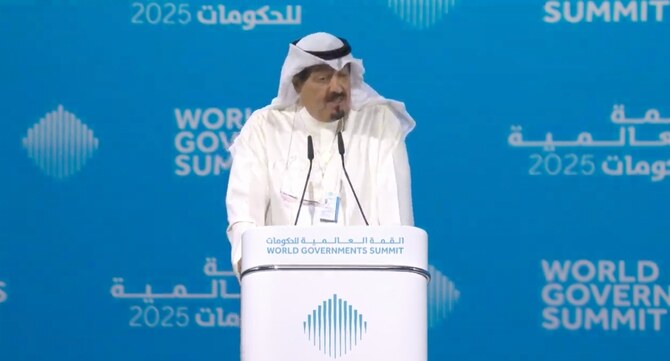
DUBAI: Kuwait’s Prime Minister Sheikh Ahmad Abdullah Al-Ahmed Al-Sabah has warned that US President Donald Trump’s economic decisions would have “repercussions” for the entire world.

Speaking at the World Governments Summit in Dubai on Tuesday, in a departure from his planned speech, the prime minister said listening to Kristalina Georgieva, managing director of the IMF, about the direction of the global economy and AI “was a joy.”

He added: “But I need to ask you all to be very attentive to Trump’s decisions.

“He seems to be only looking for his own benefits which will affect the whole world and there will be repercussions.”

On Monday, Trump increased tariffs on steel and aluminum imports to a flat 25 percent, with no exceptions or exemptions.

Trump said his decision was aimed at supporting struggling American industries. But the action risks triggering a global trade war.

While signing the order at the White House, Trump announced plans to follow Monday’s action with reciprocal tariffs on all countries that levy duties on US goods within the next two days.

He also mentioned considering tariffs on cars, semiconductors and pharmaceuticals.

(Additional reporting from Reuters)


Egypt’s president says Palestinian issue still a priority as Gaza enters second ceasefire phase

Updated 5 sec ago
Follow

Egypt’s president says Palestinian issue still a priority as Gaza enters second ceasefire phase

DUBAI: Egyptian President Abdel Fattah El-Sisi on Wednesday reaffirmed that the Palestinian cause is still “at the forefront of priorities” in the Middle East, emphasizing that peace and stability cannot be achieved in the region without a just resolution of the issue.

During his address at the World Economic Forum’s annual meeting in Davos, El-Sisi said resolving the Palestinian cause “forms the essence of the regional stability and a cornerstone to achieve a just and comprehensive peace.”

Shortly after his address to the WEF, Egypt’s foreign ministry said that El-Sisi had accepted an invitation from US President Donald Trump to join his “Board of Peace.”

Egypt “announces its acceptance of the invitation and its commitment to fulfilling the relevant legal and constitutional procedures,” the statement said, praising Trump for his Middle East policies.

“Egypt expresses its support for the Board of Peace’s mission for the second phase of the comprehensive plan to end the conflict in Gaza,” it added.

In Davos Egypt’s president welcomed the launch of the second phase of the ceasefire in Gaza, emphasizing the need to build on the outcomes of the Sharm El-Sheikh Peace Summit on Oct. 13, 2025. The summit produced the Gaza Ceasefire Agreement, which halted two years of fighting between Israel and Hamas.

El-Sisi praised Trump for his role in securing the ceasefire agreement.

The Egyptian leader called for intensified efforts to ensure a permanent ceasefire in Gaza, the uninterrupted delivery of humanitarian aid, and the acceleration of reconstruction in the war-ravaged enclave.

“Escalating geopolitical tensions and the ambitions of international legitimacy by some parties are undermining the endeavors of economic growth and weakening efforts to preserve international peace and security,” El-Sisi said.

The war in Gaza, he said, has had significant economic repercussions for Egypt. El-Sisi said the conflict has disrupted operations in the Suez Canal, a critical global trade artery, resulting in billions of dollars in losses for the Egyptian economy.

He reiterated Egypt’s longstanding foreign policy doctrine of promoting regional stability and non-interference in the internal affairs of other states. “We are hopeful that our positive role (through the Sharm El-Sheikh Summit) will be pivotal in crystallizing Phase 2 of the peace process in the region,” he said.

Highlighting Egypt’s regional diplomacy, El-Sisi said Cairo has worked since 2014 to help restore state institutions in neighboring Libya, Sudan, Syria and Somalia. “We always wanted Egypt to be a stabilizing force in the region that has suffered from some shocks in the last few years and we have never forgotten our role,” he said.

He also welcomed developments in Lebanon and Syria, expressing hope for “an inclusive and encompassing” Syria that represents all segments of its society.

El-Sisi also encouraged international investment in Egypt, highlighting major economic reforms aimed at attracting the private sector.

He praised his government’s efforts to overhaul infrastructure in Egypt in various sectors including highways, communications, transport, logistics and free zones.

“The economic zone of the Suez Canal stands as a strategic platform for trade and investment,” El-Sisi said during a panel discussion at Davos.

“The investor who chooses to work in Egypt will not only benefit from the promising local market, but will open up to broader markets linked with Egypt by FTAs in both the Arab and world markets,” he said. “Some existing huge markets are readily accessible, and the chances of international expansion are much higher.”
